

Why Oversized Mailers Get Noticed: A 2026 Guide

Oversized mailers are defined as direct mail pieces that exceed standard letter dimensions, and they outperform standard formats because their physical size triggers an instinctive prioritization response in the human brain. This is the core reason why oversized mailers get noticed before any other piece in the mailbox. Dimensional mail, the industry term for three-dimensional or oversized mail formats, achieves response rates that dwarf those of flat mail. Paragon Press documents how size alone forces visual dominance, while Linemark and Prospects Influential confirm the behavioral and logistical advantages that follow. This guide breaks down the psychology, the postal economics, and the design strategies that make large mailers the highest-performing format in direct mail today.
Why oversized mailers get noticed before anything else in the mailbox
The simplest explanation is neurological. Oversized mail creates visual dominance in the mailbox, forcing the brain to prioritize larger pieces before it processes smaller ones. Standard envelopes fade into the background when a larger piece is present. That is not a preference. It is a reflex.

Tactile engagement amplifies the effect. 3D mail triggers curiosity before the recipient can rationalize whether it is advertising or junk mail. The physical weight and shape of a dimensional mailer bypass the mental filter that discards most flat mail unopened. By the time the recipient consciously decides to open it, the decision is already made.
The memory advantage is equally significant. Research confirms that tactile engagement produces a stronger neurological imprint than two-dimensional ads. That means a recipient who handles your oversized mailer is more likely to recall your brand days later than someone who scrolled past your digital ad. Physical mail creates a memory trace that screens cannot replicate. For more on why tactile marketing outperforms digital formats, the behavioral science is well documented.
Key reasons large mailers stand out at the point of delivery:
- Physical size forces the eye to land on the largest piece first, every time
- Weight and texture signal importance before the piece is even turned over
- Unusual shape disrupts the sorting routine and demands attention
- Bold surface area allows headlines and visuals to register at a glance
Pro Tip: Test two versions of your mailer at different sizes before committing to a full run. A modest size increase, say from a standard #10 envelope to a 9×12 flat, can produce a measurable lift in open rate without a proportional increase in cost.
How oversized mailers bypass gatekeepers in B2B environments
In business environments, the mailroom is the first filter your mail must survive. Flat mail is sorted, batched, and frequently delayed or discarded before it reaches the intended recipient. Dimensional and oversized mail is treated differently.
Office mailrooms route packages as urgent deliveries, sending them directly to the named recipient rather than into a flat-mail stack. This routing behavior is not a policy choice by individual mailrooms. It is a standard protocol. Packages look like they matter. Flat envelopes look like they can wait.
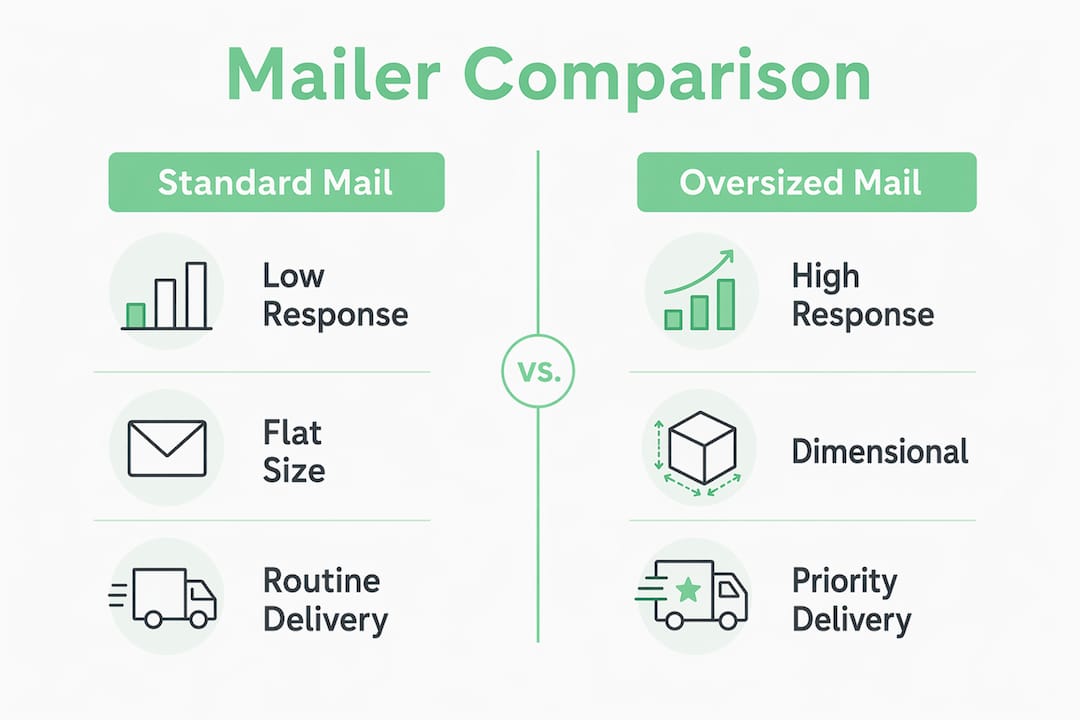
The result is a near 100% open rate when dimensional mail is sent to senior B2B decision-makers. That figure is not achievable through email, digital ads, or standard direct mail. It is a structural advantage built into how physical mail is handled in corporate environments.
Practical implications for B2B campaigns:
- Executive targeting becomes viable because the piece reaches the desk, not the recycling bin
- Assistants and receptionists treat dimensional mail as a delivery, not a solicitation
- Urgency signals from size and weight create a psychological obligation to open
- Follow-up timing improves because you know the piece was received and handled
Oversized mailers vs. standard flat mail: what the data shows
The performance gap between dimensional and flat mail is not marginal. Dimensional mailers achieve an 8.5% average response rate compared to 1% for standard flat mail. That is a 750% difference. For any campaign where the cost per acquisition matters, that gap changes the math entirely.
Beyond the initial response, oversized mailers create what Paragon Press calls “desktop real estate.” Oversized mail stays visible on desks and fridges for weeks, generating repeated brand impressions that no digital format can match. A recipient who pins your mailer to a bulletin board has seen your brand multiple times before they ever respond.
The psychological association also works in your favor. Larger mail signals quality and importance. Recipients unconsciously assign higher value to a brand that invests in a substantial physical piece. That perception carries into the response decision.
| Metric | Standard flat mail | Oversized or dimensional mailer |
|---|---|---|
| Average response rate | ~1% | ~8.5% |
| Open rate (B2B) | Low, gatekeeper filtered | Near 100% with direct routing |
| Desk or display life | Hours to days | Days to weeks |
| Brand recall | Low, competes with digital noise | High, tactile memory imprint |
| Visual impact at delivery | Minimal | Immediate, size-driven dominance |
The data makes a clear case. If you are running a campaign where each converted lead justifies a higher cost per piece, the advantages of oversized envelopes more than cover the difference in production and postage.
Postal costs and design strategies after the 2026 USPS rule changes
Cost management is the one area where oversized mailers require careful planning. The USPS changed its dimensional weight divisor from 166 to 139 in mid-2026, making dimensional weight billing more common and increasing shipping costs by $0.60 to $1.40 per package for standard-sized dimensional mail. That cost increase is real, but it is manageable with the right approach.
The key is to treat packaging design as a cost variable, not just a creative one. Every unnecessary cubic inch in your mailer adds to your dimensional weight charge. Tight, well-engineered packaging protects your margins while preserving the size advantage that makes large mailers effective. Envypak’s guide on packaging design and shipping costs covers this in practical detail.
Here is a numbered framework for managing costs while maximizing impact:
- Prototype with a Mail Piece Design Analyst. USPS offers this service at no charge. A Mail Piece Design Analyst will identify dimensional weight exposure before you commit to a print run, as Linemark recommends for all dimensional mailer campaigns.
- Minimize interior void space. Fill space with your marketing insert rather than packing material. This reduces dimensional weight while adding content value.
- Choose the right size deliberately. Going slightly larger than standard flat mail triggers the visual dominance effect without crossing into the highest dimensional weight tiers. Use Envypak’s envelope size selection guide to find the optimal format for your campaign.
- Test postage classifications. Some oversized flat mailers qualify as USPS Marketing Mail flats rather than packages, which carries lower postage rates. Confirm classification before printing.
- Negotiate volume rates. If your campaign exceeds 500 pieces, USPS volume discounts and presort options can offset the dimensional weight increase significantly.
Pro Tip: Request a postal consultation before finalizing your mailer dimensions. A one-inch reduction in height or width can shift your piece into a lower postage tier and save hundreds of dollars on a mid-size campaign run.
Creative applications that maximize engagement and ROI
The extra surface area of an oversized mailer is a strategic asset. Most marketers underuse it. Clean, high-impact visuals and clear branding outperform cluttered designs every time. The goal is to signal quality, not urgency. Aggressive language, excessive punctuation, and crowded layouts all trigger the junk mail association you are trying to avoid.
The most effective oversized mail campaigns use the space to do one thing well. A single bold headline, one strong image, and a clear call to action outperform a piece that tries to communicate five messages at once. Think of the extra space as a billboard, not a brochure. For direct mail design strategies that translate space into engagement, the principle is the same: less is more when the format already commands attention.
Practical applications that drive measurable ROI:
- Include a tactile object such as a product sample, a coin, or a branded item. Physical objects inside the mailer reinforce the curiosity reflex and give recipients a reason to keep the piece.
- Use personalization at scale. Variable data printing allows you to address recipients by name and reference their specific industry or purchase history. Personalized oversized mailers outperform generic ones by a significant margin.
- Integrate a digital bridge. A QR code or personalized URL on the mailer connects the physical piece to a landing page, making response tracking precise and attribution clean.
- Sequence your sends. A dimensional mailer works best as part of a sequence. Send a flat teaser first, follow with the oversized piece, then close with a digital touchpoint. The physical piece anchors the sequence in memory.
- Measure and iterate. Track response rates by list segment, design variant, and send timing. The high-converting mailer examples that consistently outperform benchmarks share one trait: they were tested and refined, not sent once and abandoned.
Key takeaways
Oversized mailers outperform standard flat mail because their physical size, tactile properties, and mailroom routing advantages combine to produce response rates up to 750% higher than conventional formats.
| Point | Details |
|---|---|
| Visual dominance drives opens | Larger pieces force the brain to prioritize them before any other mail in the stack. |
| B2B gatekeeper bypass | Dimensional mail routes directly to decision-makers, achieving near 100% open rates. |
| Response rate advantage | Dimensional mailers average 8.5% response vs. 1% for flat mail, a 750% difference. |
| 2026 postal cost management | The USPS DIM weight divisor change requires prototype testing and size optimization to control costs. |
| Design discipline matters | Clean, single-message visuals signal quality and outperform cluttered, high-pressure layouts. |
Why I still back oversized mailers despite the cost pressure
I have watched marketers abandon dimensional mail the moment postage costs rise. That is the wrong call, and the 2026 USPS divisor change is making it tempting again. Here is my honest read on the situation.
The cost increase is real. A $1.40 per-piece increase on a 1,000-piece campaign adds $1,400 to your budget. That sounds significant until you compare it to the cost of generating the same number of qualified responses through paid digital channels. At an 8.5% response rate versus 1%, you are sending far fewer pieces to get the same number of leads. The math still favors dimensional mail for most B2B and high-value B2C campaigns.
What I see marketers get wrong more often than cost is design. They invest in a premium format and then fill it with the same cluttered, urgent-sounding copy they use in email blasts. That destroys the quality signal the format creates. The format says “important.” The design says “spam.” Recipients notice the contradiction.
The other mistake is treating oversized mailers as a standalone tactic. The campaigns I have seen generate the best ROI use dimensional mail as the anchor in a multichannel sequence. The physical piece creates the memory. The digital follow-up converts it. Neither works as well alone.
Size is a strategic choice, not just a creative one. Use it deliberately, design it cleanly, and measure it rigorously. The marketers who do that consistently outperform their benchmarks, regardless of what postage costs in any given year.
— James
How Envypak helps you put oversized mail to work
Envypak’s premium clear mailing envelopes are built for exactly the kind of high-impact direct mail campaigns this article describes. Their formats are available in sizes that trigger visual dominance at delivery, and their crystal-clear construction lets your design speak before the envelope is even opened. That combination of size and transparency is one of the most effective tools for creating eye-catching mailers that recipients actually open.
Envypak’s envelopes are automation-compatible, eco-friendly, and available in custom sizes to match your campaign’s specific dimensional requirements. If you are rethinking your direct mail format after the 2026 USPS changes, start with choosing the right envelope size to find the format that balances cost, visibility, and impact for your next send. You can also explore their full range of custom envelopes and mailers to find the format that fits your campaign goals.
FAQ
Why do oversized mailers get higher open rates than standard mail?
Oversized mailers create immediate visual dominance in the mailbox, forcing recipients to notice them before smaller pieces. Their physical size and weight also trigger a curiosity reflex that prompts opening before rational filtering kicks in.
Do oversized mailers really bypass B2B gatekeepers?
Yes. Office mailrooms treat dimensional and oversized mail as urgent deliveries and route them directly to the named recipient. This protocol gives dimensional mail a near 100% open rate with senior B2B decision-makers, according to Prospects Influential.
How do the 2026 USPS changes affect oversized mailer costs?
The USPS dimensional weight divisor changed from 166 to 139 in mid-2026, increasing costs by $0.60 to $1.40 per package. Prototyping with a Mail Piece Design Analyst and minimizing void space are the most effective ways to control the increase.
What design approach works best for large mailers?
Clean, single-message visuals with clear branding outperform cluttered layouts. Mail America’s research confirms that designs signaling quality rather than urgency produce higher open rates and stronger brand recall.
How do oversized mailers compare to email for response rates?
Dimensional mailers average an 8.5% response rate compared to typical email response rates well below 1% for cold outreach. The physical format also generates repeated brand impressions through extended desk or display life that email cannot replicate.