

What Is a Self-Mailer? A Guide for Marketers

A self-mailer is a folded, sealed mail piece sent without an outer envelope, with the address and postage printed directly on its surface. Marketers use this format to deliver branded content at lower cost than a full letter package, while still offering far more creative space than a postcard. Understanding what is a self-mailer, how it compares to other direct mail formats, and how USPS rules govern its production gives you a real edge when planning campaigns. This guide covers fold types, compliance requirements, design strategy, and cost positioning so you can make an informed decision before your next print run.
What is a self-mailer in direct mail marketing?
A self-mailer is defined as a mail piece without an envelope, folded and secured with adhesive tabs or wafer seals, with the recipient’s address and postage applied directly to the piece. The format eliminates the envelope entirely, which cuts production cost and removes one barrier between your message and the reader. That single structural choice has real marketing consequences: the offer is visible the moment the piece lands in the mailbox.
The self-mailer definition covers a wide range of formats, from a simple bi-fold newsletter to a multi-panel product catalog. What all versions share is that the mail piece itself carries the address, the postage, and the content. No inserting, no stuffing, no separate outer shell.
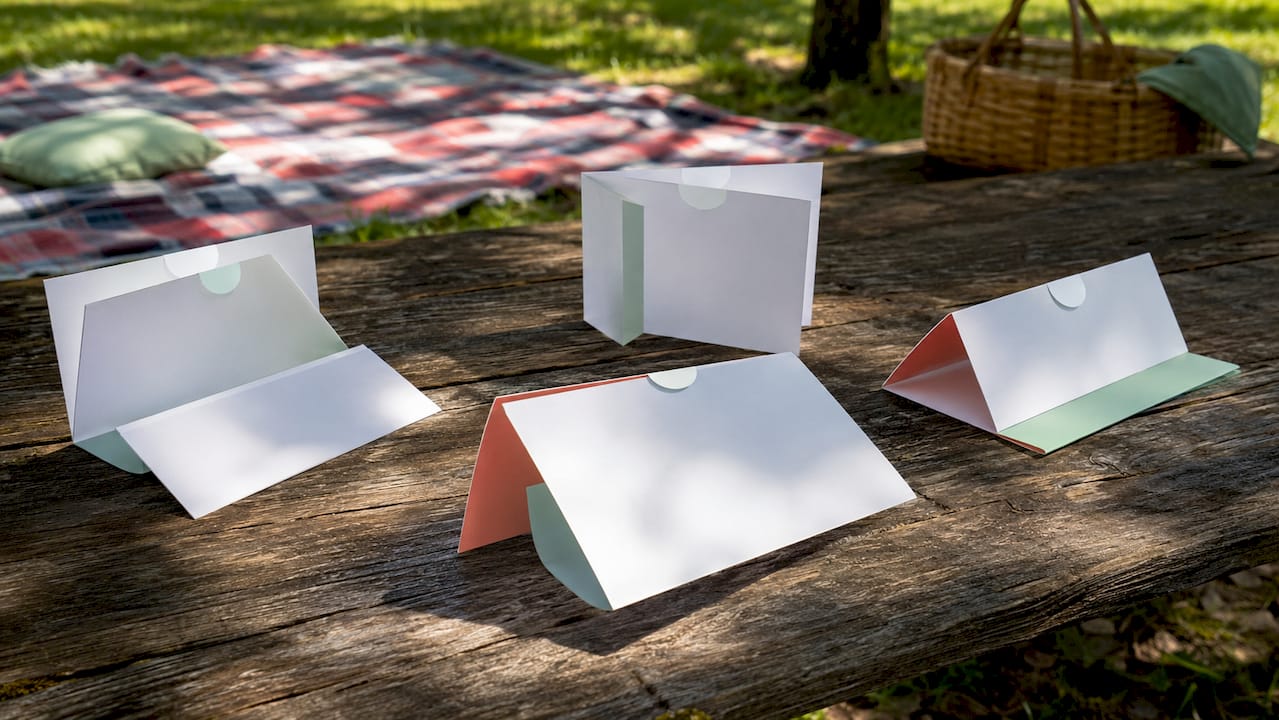
What are the common types and fold styles of self-mailers?
Fold type determines both the reading sequence a recipient experiences and the production method required to seal the piece. Choosing the wrong fold for your content is one of the most common and costly mistakes in self-mailer printing.
| Fold Type | Panels | Typical Use Case |
|---|---|---|
| Bi-fold | 4 | Newsletters, event invites |
| Tri-fold | 6 | Product promos, service menus |
| Four-panel | 8 | Catalogs, detailed offers |
| Z-fold / Accordion | 6+ | Sequential storytelling, coupons |
Each format has a distinct production profile:
- Bi-fold: Two folds create four panels. Simple to produce, easy to tab, and well-suited for event invitations or short announcements.
- Tri-fold: The standard for promotional mailers. Six panels let you organize content into a clear intro, body, and call to action.
- Four-panel: Eight panels give you catalog-level space. Ideal for product lines or detailed service explanations.
- Z-fold / Accordion: Panels unfold in a zigzag sequence. This format is excellent for step-by-step storytelling or multi-coupon layouts.
Fold choice affects sealing strategy directly. More complex folds require additional tabs or a different tab placement to pass USPS automated handling. Confirm sealing requirements with your printer before finalizing the design.
Pro Tip: Design the fold sequence before you write the copy. Knowing which panel the reader sees first, second, and last lets you build a narrative that pulls them through the piece instead of dumping all information at once.
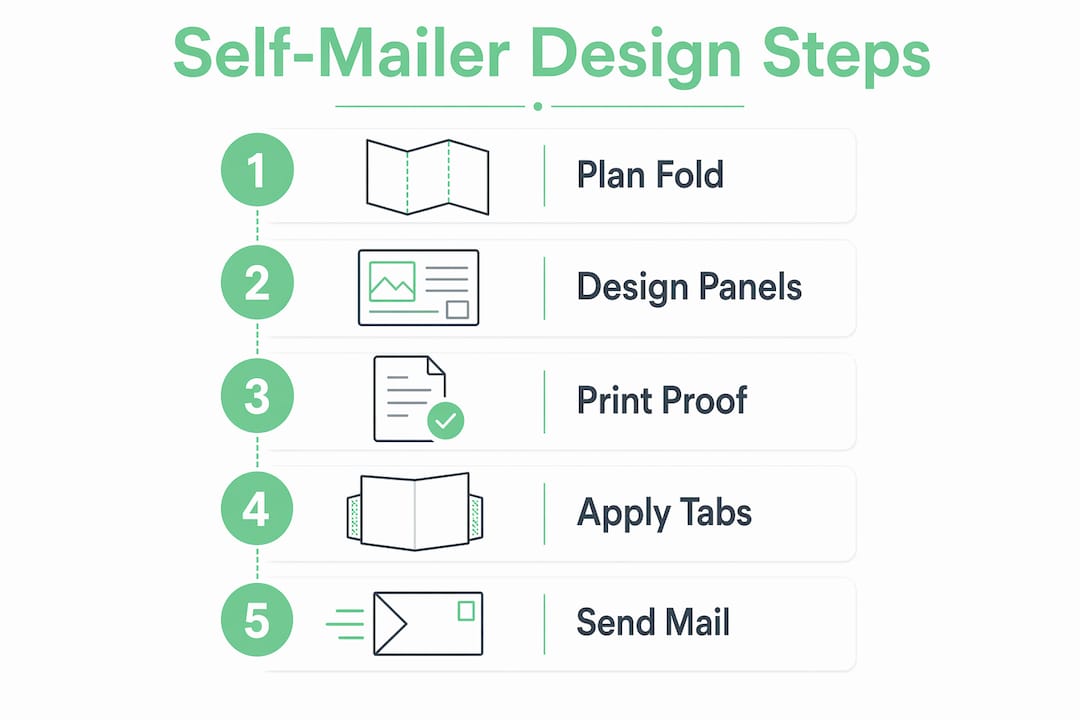
How does a self-mailer compare to postcards and letter packages?
Self-mailers cost about $0.55–$0.95 per piece, placing them squarely between postcards and full letter packages in both price and complexity. That mid-range position is not a compromise. It is the format’s core advantage for campaigns that need more than a postcard but do not require the trust signals of a sealed letter.
| Format | Cost Per Piece | Creative Space | Complexity |
|---|---|---|---|
| Postcard | Low | Minimal | Low |
| Self-mailer | Mid | Moderate to high | Medium |
| Letter package | High | High | High |
The practical differences go beyond price:
- Postcards deliver a single message fast. They work for simple offers, reminders, and brand awareness. They cannot carry detailed content.
- Self-mailers give you multiple panels for storytelling, product details, or multi-step offers. They cost less to produce than a letter package because there is no envelope, no inserting, and no separate reply card required.
- Letter packages carry the highest perceived value and privacy. They work best for cold outreach where trust is the primary barrier.
Self-mailers suit mid-level explanations better than postcards and work best with audiences who already know your brand. For cold lists, a sealed letter often outperforms because recipients associate the envelope with something personal and worth opening. For warm lists or existing customers, the self-mailer’s immediate visibility is a genuine advantage.
One production trade-off worth noting: reserving an address panel reduces your total marketing space compared to a letter package, where the entire interior is available for content. Plan your layout around this constraint from the start.
What USPS requirements must self-mailers follow?
USPS requires self-mailers to be secured with adhesive tabs or wafer seals under DMM 201.3 standards. This rule exists to prevent pieces from opening during automated mail processing, which would cause jams, damage, and non-delivery. Compliance is not optional, and errors here are expensive.
The core requirements every marketer must know:
- Tabs or wafer seals: Required on the open edges of the folded piece. The number and placement depend on the piece’s size and weight.
- Address placement: The address must appear on the outside face of the mail piece, in the designated address area, with correct orientation for automated reading.
- Postage placement: Postage goes in the upper right corner of the address panel. Indicia, meter marks, and stamps are all accepted.
- Size compliance: Self-mailers must meet USPS minimum and maximum dimensions for the mail class you are using. First-Class and Marketing Mail have different thresholds.
- Paper weight: Pieces that are too light may not survive automated handling. Most printers recommend a minimum of 60 lb. text stock for self-mailers.
Proper tabbing is critical not just for compliance but for deliverability. A piece that opens in transit is a wasted impression and a wasted budget. Review the USPS compliance details before finalizing your production specs.
Pro Tip: Ask your printer for a postal pre-certification review before your full print run. Catching a tab placement error on a proof costs nothing. Catching it after 10,000 pieces are printed costs everything.
How can marketers design self-mailers to maximize engagement?
The no-envelope format creates immediate offer visibility the moment the piece is pulled from the mailbox. That is a powerful hook, but only if the front panel earns attention in under three seconds. The front panel is your headline, your image, and your reason to keep reading. Treat it like a billboard, not a table of contents.
Effective self-mailer design follows a few proven principles:
- Lead with the offer on the front panel. Do not save the headline for inside. The recipient decides whether to open or recycle based on what they see first.
- Use fold sequence for storytelling. Each panel reveal should answer the next logical question. Panel one creates curiosity. Panel two delivers the offer. Panel three closes with the call to action.
- Add perforations for coupons or reply cards. A perforated tear-off increases engagement and gives recipients a physical reason to act. It also makes response tracking straightforward.
- Choose heavier cardstock for premium campaigns. A 100 lb. cover stock signals quality before the reader processes a single word. Weight and texture communicate brand value.
- Keep the address panel clean. Cluttered address panels fail postal scans and look unprofessional. Reserve that space for the address, postage, and a single short tagline at most.
Self-mailers tell a story through panel sequencing, which makes them well-suited for product launches, event invitations, seasonal promotions, and loyalty offers. For campaign types that require a recipient to absorb multiple benefits before acting, the multi-panel format outperforms a postcard every time. Pair strong visuals with a clear call to action on the final panel, and you have a complete persuasion arc in a single mail piece. For more ideas on format and layout, the direct mail design guide at Envypak covers interaction-focused approaches worth reviewing.
Key Takeaways
A self-mailer is the most cost-effective direct mail format for content-rich campaigns targeting warm audiences, combining immediate visibility with multi-panel storytelling at a mid-range production cost.
| Point | Details |
|---|---|
| Core self-mailer definition | A folded, sealed mail piece mailed without an envelope, with address and postage printed directly on it. |
| Fold type drives design | Bi-fold, tri-fold, Z-fold, and four-panel formats each affect reading sequence and sealing requirements. |
| Mid-range cost positioning | Self-mailers cost about $0.55–$0.95 per piece, more than postcards but less than full letter packages. |
| USPS compliance is non-negotiable | Adhesive tabs or wafer seals are required under DMM 201.3 to pass automated mail processing. |
| Front panel is the hook | The outer face must capture attention immediately since there is no envelope to create curiosity. |
Why I think most marketers underuse self-mailers
Most direct mail budgets default to postcards for cost and letters for trust. Self-mailers sit in the middle and get overlooked. That is a mistake I have seen repeatedly in mid-sized campaigns where the message was simply too complex for a postcard but the budget did not justify a full letter package.
The format shines brightest with warm audiences. If your list already knows your brand, a sealed envelope adds friction without adding value. A well-designed self-mailer puts your offer in front of them the second they touch it. That immediacy is genuinely hard to replicate with any other format at this price point.
The front panel is where most campaigns fail. Marketers spend the bulk of their design time on the interior panels and treat the outside as an afterthought. That is backwards. The front panel is the only thing standing between your campaign and the recycling bin. Treat it as your most valuable real estate, not your least.
My honest advice: test a self-mailer against your current postcard format on a warm segment before committing to a full rollout. The cost difference is small enough that a split test is low risk. The response rate difference, when the design is right, is often significant enough to justify the switch permanently.
Envypak’s direct mail solutions for your next campaign
Marketers who want the visual impact of a self-mailer without sacrificing presentation have another option worth considering. Envypak’s crystal clear mailing envelopes deliver the same immediate visibility as a self-mailer because the offer shows through the envelope before it is even opened.
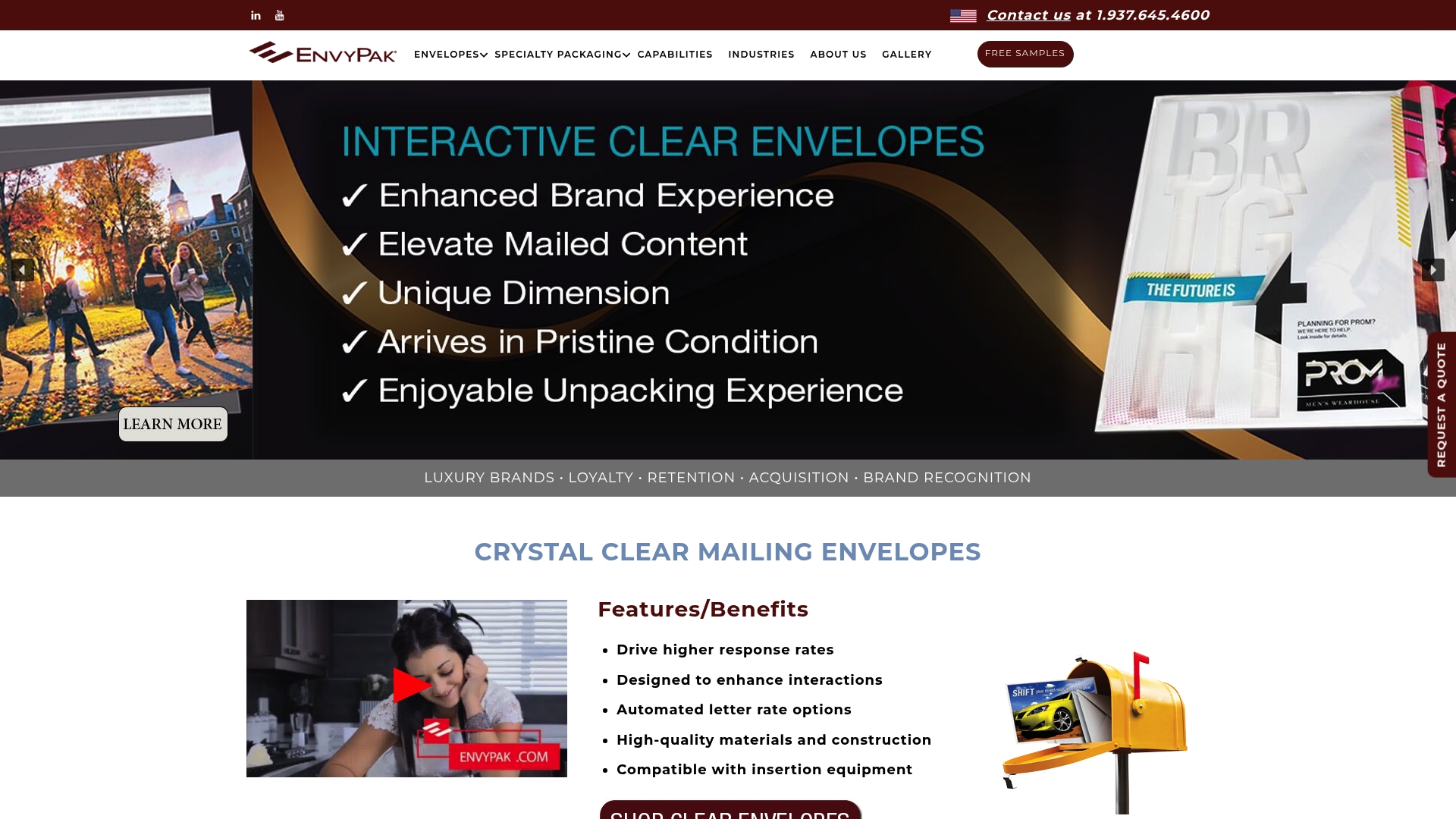
Envypak’s clear mailing envelopes are built for automation compatibility and made from eco-friendly materials, so they meet USPS processing standards while standing out in any mailbox. For campaigns where you want the engagement benefits of immediate visibility combined with the trust signal of a sealed piece, Envypak’s products give you both. Browse the full range of custom mailer options to find the right fit for your next direct mail campaign.
FAQ
What is a self-mailer in simple terms?
A self-mailer is a direct mail piece that folds and seals on itself, with no outer envelope required. The address and postage are printed directly on the piece.
What fold types are used for self-mailers?
The most common fold types are bi-fold, tri-fold, four-panel, and Z-fold (accordion). Each format creates a different number of panels and affects how the reader moves through the content.
Does USPS require tabs on self-mailers?
Yes. USPS requires self-mailers to be secured with adhesive tabs or wafer seals under DMM 201.3 to prevent the piece from opening during automated mail processing.
How much does it cost to produce a self-mailer?
Self-mailers typically cost about $0.55–$0.95 per piece, placing them between postcards and letter packages in production cost and creative space.
When should I use a self-mailer instead of a postcard?
Use a self-mailer when your message requires more than one panel to explain, especially for warm audiences who already recognize your brand. Postcards work for simple, single-point offers; self-mailers work for multi-benefit promotions and detailed product information.