

What Is Personalized Direct Mail and Why It Works

Personalized direct mail is physical postal marketing addressed or tailored to specific individuals using recipient data to make every piece feel like a one-to-one conversation. Unlike generic mass mailers, this approach, formally called targeted direct mail in industry practice, uses Variable Data Printing (VDP), personalized URLs (PURLs), and QR codes to swap out names, images, offers, and calls to action for each recipient. Canada Post describes Personalized Mail™ as a format that targets specific individuals and measures results through response rates and sales. The payoff is real: personalized mail marketing consistently outperforms generic alternatives on every metric that matters to a marketing budget.
What is personalized direct mail and how does it differ from generic mail?
Personalized direct mail uses customer data to produce mail pieces where content changes per recipient, not just the address label. A generic postcard sends the same image and offer to 50,000 people. A personalized version sends 50,000 different versions, each with a name, a neighborhood photo, a discount tied to past purchase behavior, and a QR code that routes to a landing page built for that individual. The difference in recipient experience is significant. Personalizing messages shows awareness of customer preferences, which directly boosts communication relevance and response likelihood.
Generic direct mail treats every recipient as identical. Personalized mail treats each one as known. That shift in framing changes how recipients engage with the piece, how long they hold onto it, and whether they act on it.
How does personalized direct mail work with variable data printing?
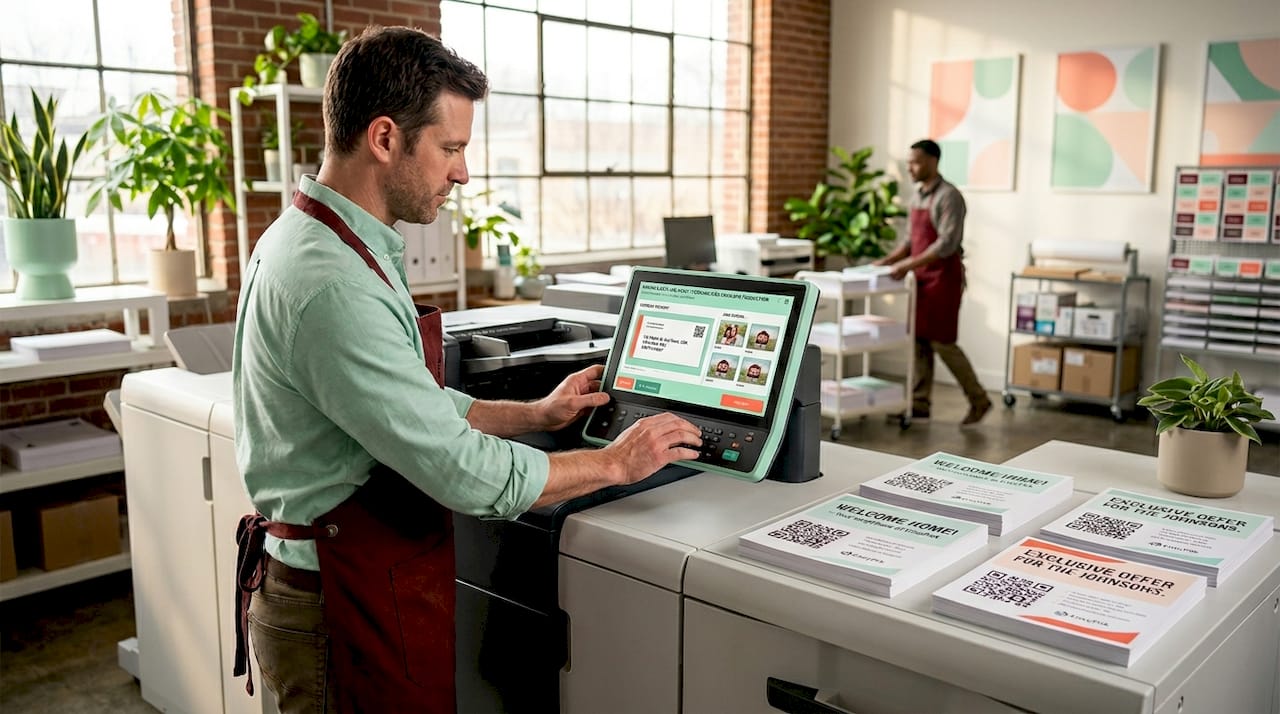
Variable Data Printing is the production technology that makes personalized direct mail possible at scale. A digital press reads a recipient data file alongside a fixed design template, then substitutes variable fields for each record before printing. The result is a unique mail piece for every person on your list, produced in a single continuous print run.
Here is how a standard VDP workflow runs from start to finish:
- Build your data file. Compile a clean spreadsheet or database with all recipient fields: name, address, purchase history, preferred product category, and any segment tags you plan to use.
- Design your template. Create a base layout in software like Adobe InDesign or a VDP platform. Mark every field that will change per recipient, including salutation, offer text, product image, and QR code destination.
- Map variables to fields. Connect each column in your data file to the corresponding placeholder in the template. VDP merges fixed templates with recipient data files, replacing static printing with dynamic production.
- Run a proof batch. Print a small test run covering edge cases: long names, missing fields, alternate offers. Catch layout breaks before the full run.
- Execute the print run. The digital press processes each record sequentially, producing unique pieces at production speed.
- Sort and mail. Pieces are sorted by postal route and handed off to USPS or your carrier.
Personalization variables include salutation, neighborhood photography, discount offers, and unique QR codes linking to personalized landing pages. That range of variables is what turns mail into targeted conversations at scale.
The most common failure point in this process is data quality. Poor data hygiene and incorrect mapping in VDP cause personalization errors that damage campaign performance and recipient trust. A piece addressed to “Dear [FIRST_NAME]” because a field failed to populate is worse than no personalization at all.
Pro Tip: Before sending your data file to the printer, run it through a deduplication and address verification tool such as Melissa Data or USPS CASS certification. Clean data is the single highest-leverage investment in any VDP campaign.
What are the measurable benefits of personalized direct mail?
Personalized direct mail produces returns that are difficult to match in digital channels. Direct mail produces $42 revenue per $1 spent, representing a 161% ROI that most email and paid social campaigns cannot approach. That figure reflects the combined effect of physical presence, personalization, and the absence of inbox competition.
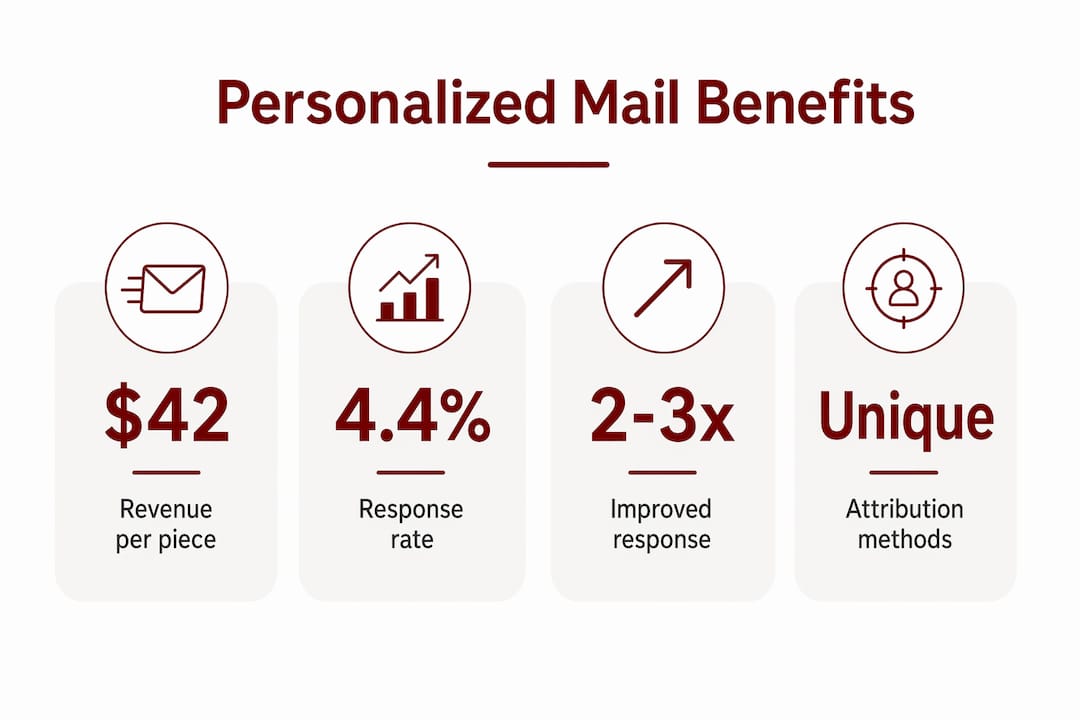
Response rates tell the same story. Personalized campaigns using VDP achieve 2 to 3 times higher response rates than generic mail, with prospect lists averaging around 4.4% and house lists reaching up to 9%. For context, average email open rates hover around 20%, but click-through rates rarely exceed 3%. Direct mail response rates represent physical action, not a passive open.
| Metric | Generic direct mail | Personalized direct mail |
|---|---|---|
| Prospect response rate | ~1.5% | ~4.4% |
| House list response rate | ~3% | Up to 9% |
| Estimated ROI | Moderate | $42 per $1 spent |
| Attribution method | Difficult | PURLs, QR codes, coupon codes |
Measurement is where personalized mail has a structural advantage over most digital channels. Canada Post recommends unique QR codes or URLs for attribution and measuring response rates and sales. Each recipient gets a unique code, so every redemption or page visit ties directly back to a named individual in your database. No modeling, no sampling, no guesswork.
This matters more now than it did five years ago. Tracking with unique PURLs or QR codes enables first-party attribution without relying on third-party cookies, making measurement auditable and privacy-compliant under modern data regulations like CCPA and GDPR. As cookie-based tracking erodes, direct mail’s built-in attribution model becomes a competitive advantage, not just a nice feature.
Key performance indicators worth tracking in every campaign include:
- Response rate: Total responses divided by total pieces mailed
- Conversion rate: Responses that completed the desired action (purchase, appointment, donation)
- Cost per acquisition: Total campaign spend divided by new customers acquired
- Revenue per piece mailed: Total attributed revenue divided by mail volume
- PURL visit rate: Percentage of recipients who visited their personalized landing page
You can explore direct mail ROI tracking methods in more detail to build a measurement framework before your next campaign launches.
How does personalized direct mail compare to other marketing channels?
Personalized direct mail occupies a position no digital channel can replicate: it arrives physically in a space the recipient controls, requires no opt-in, and cannot be blocked by an algorithm or a spam filter. That combination of guaranteed delivery and physical presence is the core strategic argument for including it in your channel mix.
Compared to email marketing, the differences are structural. Email requires an opt-in list, competes with hundreds of other messages in an inbox, and gets filtered by providers like Gmail and Outlook. Direct mail arrives in a physical mailbox with far less competition. The direct mail versus email comparison consistently shows mail winning on response rate and brand recall, while email wins on speed and cost per send.
Compared to generic direct mail, personalized versions win on nearly every performance metric, as the table above shows. The cost per piece is higher due to VDP production, but the lift in response rate typically more than offsets that premium.
| Channel | Opt-in required | Response rate | Attribution method | Physical presence |
|---|---|---|---|---|
| Generic direct mail | No | ~1.5% | Difficult | Yes |
| Personalized direct mail | No | 4.4% to 9% | PURLs, QR codes | Yes |
| Email marketing | Yes | ~3% click-through | Pixel-based | No |
| Paid social | No | Varies widely | Cookie-based | No |
Personalized direct mail is most effective in industries where purchase decisions are high-consideration: financial services, healthcare, real estate, luxury retail, and nonprofit fundraising. It also performs well for direct mail acquisition campaigns targeting cold prospects who have not yet opted into digital communications.
The strongest campaigns combine both channels. Lob details campaigns triggered by website activity, connecting physical mail to digital journeys. A prospect who visits your pricing page but does not convert can receive a personalized postcard within 48 hours, referencing the product they viewed and including a PURL that routes them back to a tailored landing page.
Pro Tip: Run a 30-day integrated test: trigger a personalized mail piece to any prospect who visits a key page on your site but does not convert within 24 hours. Measure the PURL response rate separately from your standard email nurture sequence. The lift is typically significant enough to justify permanent automation.
What are effective strategies for implementing personalized direct mail campaigns?
Execution separates campaigns that generate measurable returns from those that waste budget. The following process covers the decisions that matter most, in the order you need to make them.
- Set SMART goals before touching creative. Define your target response rate, cost per acquisition, and revenue per piece mailed before designing anything. Goals determine list size, offer depth, and acceptable production cost per piece.
- Segment your list with precision. Split your audience by demographics, purchase recency, product category interest, and geographic location. Personalization impact varies by element: offers and images matched to recipient data yield the highest response lifts, while name personalization alone has only moderate effect. Segment first, then build the offer.
- Design for the variable, not the template. Your base layout should be built around the assumption that names, images, and offers will change. Leave enough space for long names. Test every image swap for visual consistency. Avoid designs where a short offer headline looks awkward next to a long one.
- Build your tracking infrastructure before printing. Set up PURLs on your own domain, configure QR code destinations, and create unique coupon codes for each segment. Successful personalization depends heavily on clean data and correct variable mapping in templates, so verify every tracking link in your proof batch.
- Choose your production partner carefully. Platforms like Lob offer API-driven production that connects directly to your CRM, enabling triggered mail at scale. Traditional print shops offer more creative flexibility but require manual data handoffs.
- Test before scaling. Run an A/B test with two offer variants or two image sets on a 10% sample of your list. Let results from the test inform the full rollout. This discipline is the difference between a campaign that improves over time and one that repeats the same mistakes.
- Plan your follow-up sequence. A single mail piece rarely closes a sale. Build a follow-up email or second mail touch for recipients who visited their PURL but did not convert. The sequence, not the single piece, drives the final result.
For creative inspiration on formats that increase open rates, the direct mail ideas resource from Envypak covers formats that work across industries.
Key takeaways
Personalized direct mail outperforms generic mail because it combines physical presence with data-driven relevance, producing response rates 2 to 3 times higher and an ROI of $42 per $1 spent.
| Point | Details |
|---|---|
| Definition and core technology | Personalized direct mail uses VDP to produce unique mail pieces per recipient from a single print run. |
| Response rate advantage | Personalized campaigns achieve 4.4% to 9% response rates versus roughly 1.5% for generic mail. |
| Attribution without cookies | PURLs and unique QR codes provide first-party attribution that is privacy-compliant and fully auditable. |
| Data quality is non-negotiable | Clean, verified data is the highest-leverage investment before any VDP campaign goes to press. |
| Channel integration multiplies results | Triggering mail from digital behavior and following up via email significantly lifts overall campaign performance. |
Why personalized direct mail still surprises me after years in the field
I have watched marketers pour budget into digital channels while treating direct mail as a legacy tactic, and I have watched those same marketers discover that a well-executed personalized mail campaign outperformed their entire paid social spend for the quarter. The surprise is always genuine, and it tells me something important: the physical channel is undervalued precisely because it is underused.
What I have learned is that the creative is rarely the limiting factor. The campaigns that fail do so because of bad data, not bad design. A beautifully produced mailer with a mismatched offer or a broken PURL does more damage than a plain postcard with a clean, relevant message. Data quality and template mapping deserve as much attention as the headline and the image.
The integration angle is where I see the most untapped potential. Most teams still treat mail and digital as separate programs with separate budgets and separate measurement frameworks. The teams that connect them, using digital behavior to trigger mail and using mail response to inform digital retargeting, consistently see results that neither channel produces alone. That is not a future trend. It is available today with tools like Lob and a basic CRM integration.
My honest advice: start smaller than you think you need to. Run a 2,000-piece test with real segmentation and real tracking. Measure everything. The data from that test will tell you exactly where to invest next, and it will be far more persuasive to your leadership team than any benchmark statistic.
— blake
Make your personalized mail impossible to ignore with Envypak
The message inside a personalized mail piece only works if the recipient opens it. Envypak’s crystal clear mailing envelopes solve that problem before the piece even leaves the mailbox. Recipients see the personalized content through the envelope itself, which drives open rates before a single seal is broken.
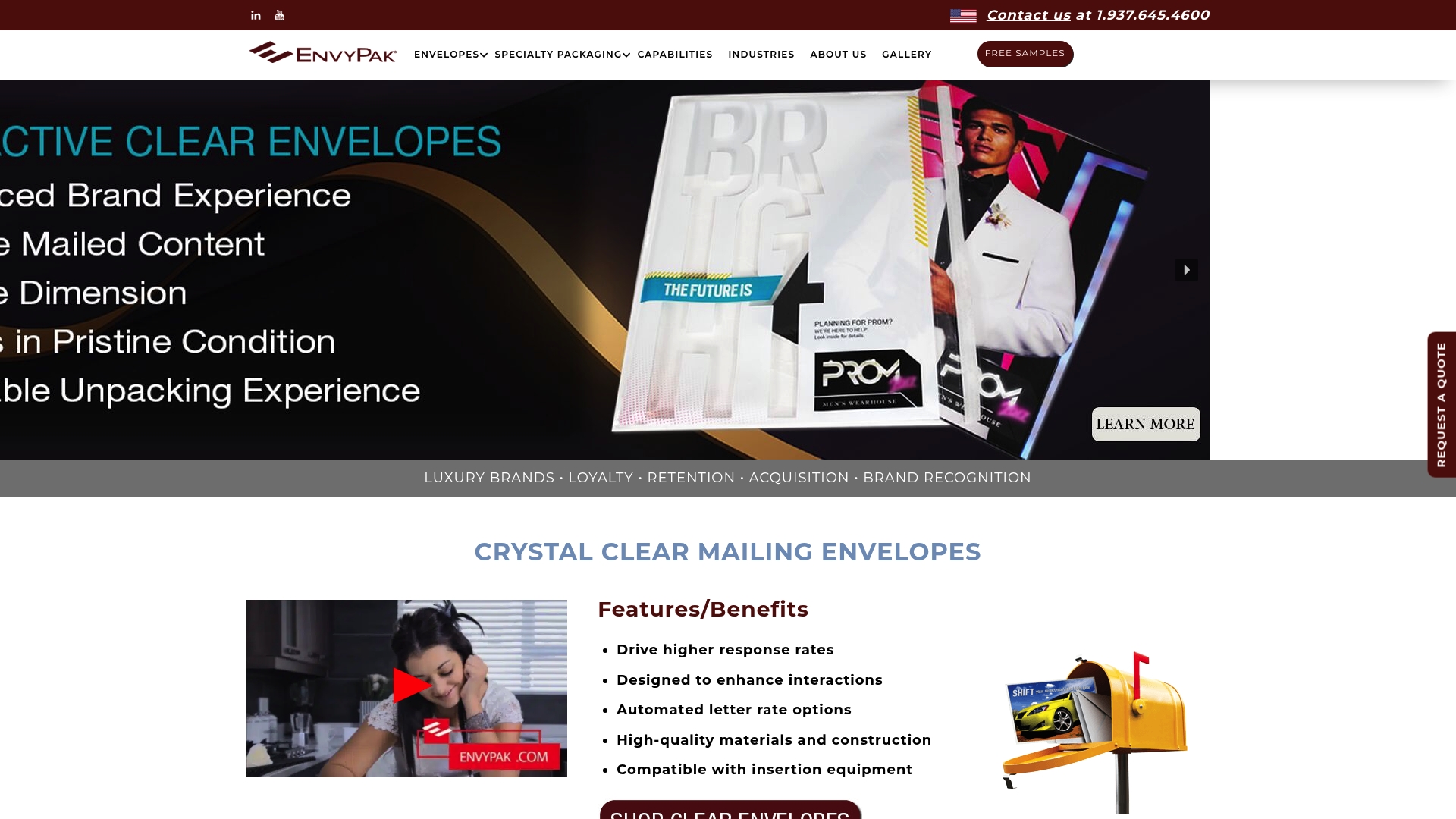
Envypak’s custom envelopes for direct mail are built to work with standard insertion equipment, so they fit into existing production workflows without retooling. For campaigns where visual impact is the differentiator, Envypak’s clear mailer options give your personalized creative the visibility it deserves. If you are ready to see what results look like in practice, the direct mail result stories page shows real campaign outcomes from brands that made the switch.
FAQ
What is the difference between personalized and targeted direct mail?
Targeted direct mail selects recipients based on demographic or behavioral criteria. Personalized direct mail goes further by customizing the content of each piece, including the name, offer, image, and call to action, for each individual recipient using Variable Data Printing.
How do you measure the success of a personalized direct mail campaign?
The most reliable methods are unique QR codes, personalized URLs, and unique coupon codes assigned per recipient or segment. These tools provide first-party attribution without relying on third-party cookies, making results auditable and privacy-compliant.
What response rates can I expect from personalized direct mail?
Prospect lists typically generate around 4.4% response rates, while house lists of existing customers can reach up to 9%. Both figures are 2 to 3 times higher than generic direct mail benchmarks.
What data do I need to run a personalized direct mail campaign?
At minimum, you need a clean mailing list with verified addresses, first names, and at least one segmentation variable such as purchase history or product interest. The more behavioral data you can include, the more precisely you can match offers and images to each recipient.
How does Variable Data Printing work for small businesses?
VDP is accessible at relatively small volumes through platforms like Lob or regional print shops that offer digital press services. A test run of 1,000 to 2,000 pieces is enough to generate statistically meaningful response data and validate your personalization strategy before scaling.