

Bulk Mailing Packaging Cost Reduction: 2026 Guide

Bulk mailing packaging cost reduction is the practice of lowering material and postage expenses for large-volume mailings without compromising package integrity or presentation quality. The biggest savings come from three levers: right-sizing packaging dimensions, aligning materials with USPS rate thresholds, and cleaning mailing data before a single piece ships. A 1.5 cm reduction in mailer dimensions cut ocean freight by 22%, last-mile postage by 15%, and material cost by 8% in one documented case. For marketing professionals managing direct mail campaigns at scale, those numbers are not marginal. They are budget-defining.
How does package right-sizing influence bulk mailing costs?
Right-sizing is the single highest-leverage tactic in bulk mailing packaging cost reduction. The reason is geometric. Small reductions in length, width, or height compound across thousands of pieces, shifting packages below USPS dimensional weight thresholds and improving pallet density simultaneously.
USPS charges parcels by actual or dimensional weight pricing when volume exceeds one cubic foot, whichever figure is greater. Packages over 22 or 30 inches in length also trigger length surcharges. That means a mailer that is even slightly oversized can jump an entire pricing tier, adding cost on every single piece in a campaign run.
The corrugation choice matters as much as the outer dimensions. Switching from B-flute to high-density E-flute corrugation maintains structural durability while reducing wall thickness. In the case study referenced above, that switch combined with a 1.5 cm size reduction increased master carton capacity from 60 to 85 mailers and raised pallet density from 2,400 to 3,400 boxes per pallet. The cube utilization gain alone justified the redesign investment.
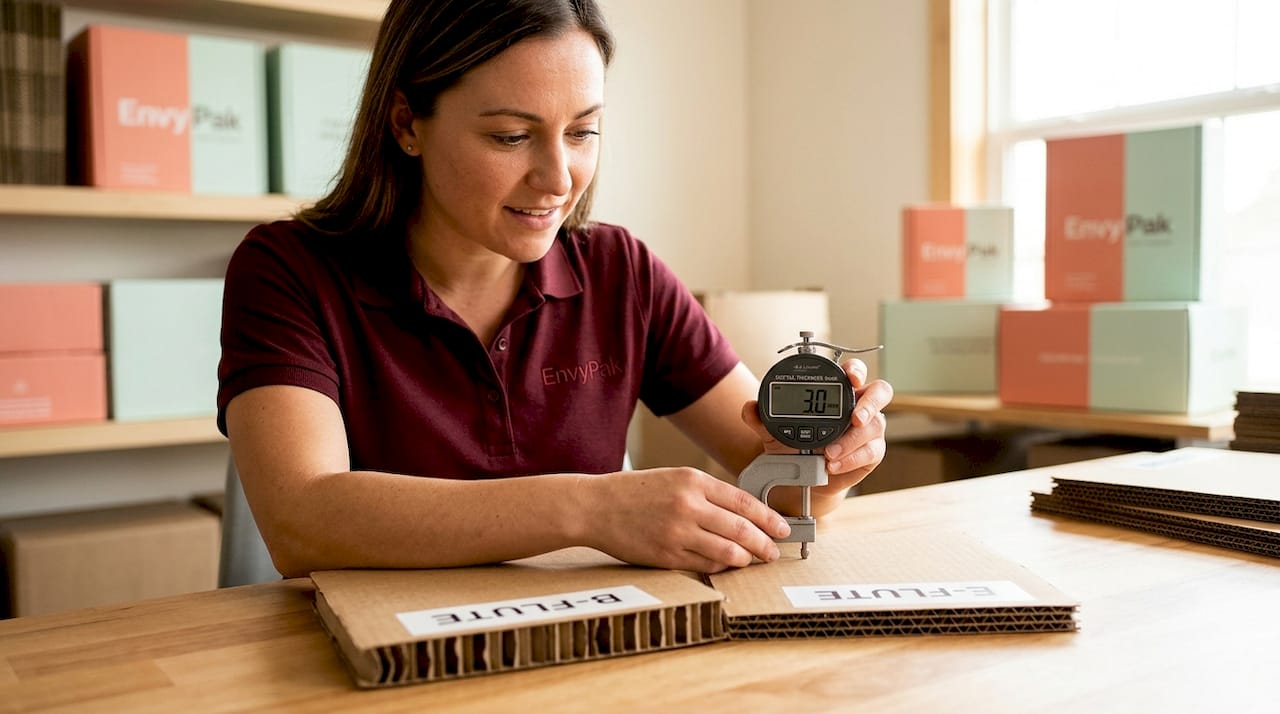
| Packaging change | Cost impact |
|---|---|
| 1.5 cm dimension reduction | 15% postage reduction, 22% freight savings |
| B-flute to E-flute switch | 8% material cost reduction, improved pallet density |
| Oversized parcel (over 1 cubic foot) | Dimensional weight surcharge applied to every piece |
| Optimized cube utilization | Lower per-unit shipping cost across full pallet |
Pro Tip: Before committing to a new mailer spec, mock up the exact dimensions and run them through the USPS postage calculator. A difference of half an inch can mean the difference between flat-rate and dimensional-weight pricing across a 50,000-piece run.
The largest packaging savings come not from cheaper materials but from structural resizing that reduces dimensional weight and improves pallet cube utilization. Cheaper board that adds even 2 mm of thickness can undo the gains from a dimension reduction.
What USPS bulk mailing rules and discounts affect packaging cost reduction?
Understanding USPS rate structures is not optional for anyone serious about reducing postage expenses. The rules directly determine which discounts you qualify for and which surcharges you absorb.
Key USPS rules that affect bulk mailing packaging decisions include:
- Dimensional weight thresholds. USPS Notice 123 applies dimensional weight pricing to parcels over one cubic foot. Packages over two cubic feet face additional charges. Keeping mailer volume below one cubic foot avoids this tier entirely.
- Marketing Mail weight limits. Flat-shaped pieces have a 20-ounce maximum weight, with carrier-route flats allowed up to 24 ounces. Exceeding these limits forces a more expensive mailing class.
- Automation compatibility. Mailpieces that meet USPS thickness, weight, and barcode standards qualify for automation rate discounts. Non-compliant pieces pay manual handling rates, which are meaningfully higher.
- Presort depth. Sorting to 5-digit, 3-digit, or AADC levels generates progressively larger postage discounts. Deeper presort requires better address data, which connects directly to list hygiene.
- Entry point selection. Entering mail at Destination Sectional Center Facility (DSCF) or Destination Delivery Unit (DDU) points reduces postage by bypassing upstream USPS transportation costs. Commingling smaller campaigns into larger drops makes these entry points accessible.
- Permit imprints vs. stamps. Permit imprints eliminate stamp application labor and marginally reduce per-piece cost on high-volume runs. For campaigns above 10,000 pieces, the labor savings alone justify the permit fee.
Postal optimization across address hygiene, presort, USPS compliance, and production can reduce per-piece postage costs by 20 to 40%. That range is wide because the starting point varies, but even a 20% reduction on a 100,000-piece campaign at $0.50 per piece saves $10,000 in a single drop.
How to optimize packaging materials and printing choices for cost savings
Material and print decisions affect both the unit cost of each mailer and the postage class it qualifies for. Getting both right requires treating them as connected variables, not separate line items.
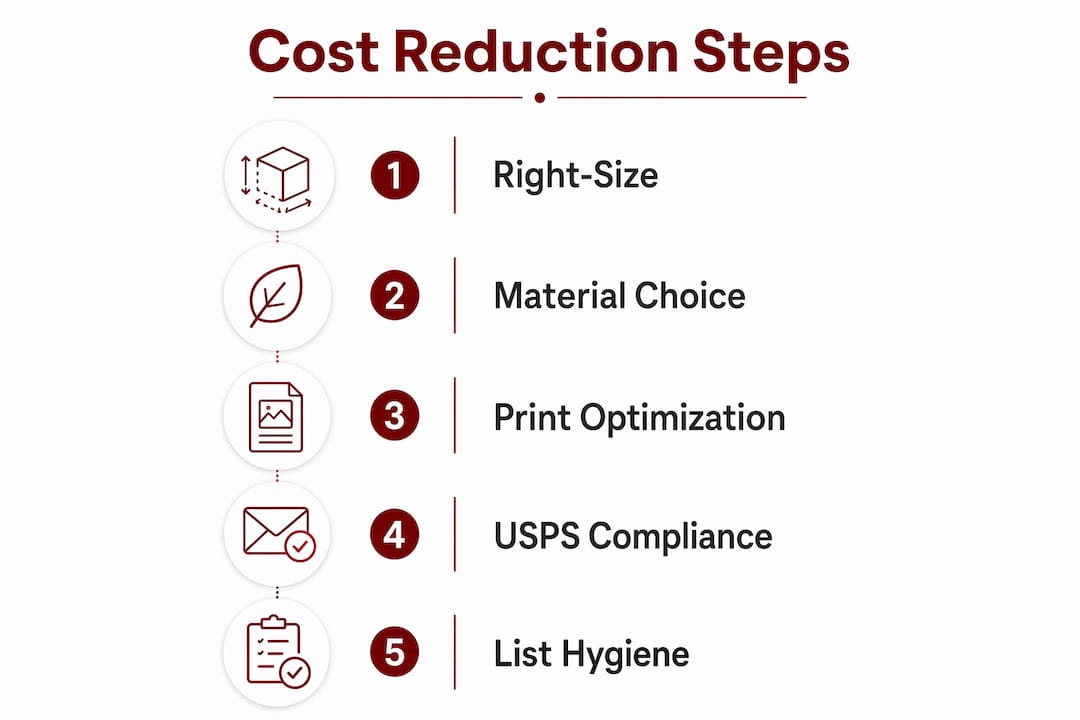
High-density corrugated board allows thinner walls without sacrificing crush resistance. This directly reduces package weight and outer dimensions, keeping pieces within favorable USPS size and weight tiers. The tradeoff is a slightly higher board cost per square foot, but the postage savings typically outweigh that premium within the first campaign run.
Printed ink coverage is an underappreciated cost driver. Heavy full-bleed artwork increases production cost and adds measurable weight to high-volume runs. Controlling print coverage to 60 to 70% of the mailer surface reduces both ink consumption and weight without visibly degrading brand presentation.
Padded mailer unit costs range from $0.15 to $0.24 at 5,000 pieces, rising with heavier padding, full-coverage artwork, or special closures. Bulk pricing only delivers its full benefit when print coverage, size, and weight specifications are held constant across a run. Inconsistent specs force repricing and often eliminate volume discounts.
Additional material and printing considerations worth tracking:
- Standardized envelope sizes reduce die-cut waste and improve compatibility with automated insertion equipment, which qualifies mailings for automation postage discounts.
- Paper padded mailers weigh less than poly bubble alternatives at comparable protection levels for items under two pounds, making them a strong choice for postage-sensitive campaigns.
- Testing two or three mailer configurations before a full-scale run prevents expensive rework. Run 500 to 1,000 pieces of each spec, track damage rates and postage class, then scale the winner.
Pro Tip: Ask your printer for a weight certificate on each mailer spec before committing to a run. Even a 0.3-ounce difference per piece can shift a 50,000-piece campaign into a higher postage tier, costing more than the print savings.
Good packaging design for shipping integrates material weight, print coverage, and dimensional compliance from the first draft, not as an afterthought before production.
What mailing list and process optimizations help reduce overall costs?
List quality is the most overlooked variable in bulk mailing cost reduction. Every undeliverable address wastes a mailer, postage, and labor. At scale, that waste is substantial.
- Apply NCOA and CASS processing before every campaign. Cleaning mailing lists through National Change of Address (NCOA) and Coding Accuracy Support System (CASS) eliminates undeliverable addresses, saving 8 to 12% in postage and wasted packaging materials. For a 100,000-piece campaign, that is 8,000 to 12,000 pieces not printed, not packaged, and not mailed.
- Presort to the deepest available level. Presorting mail and improving address hygiene can produce postage reductions of 15 to 30% or more. Combining multiple campaigns into larger drops reduces per-piece postage by $0.03 to $0.05, which adds up to significant total savings on any meaningful volume.
- Commingle smaller campaigns. If your monthly volume falls below 50,000 pieces, working with a mail service provider that aggregates multiple clients’ mail into larger drops gives you access to DSCF and DDU entry discounts you cannot reach alone.
- Audit for duplicate records. Duplicate addresses waste packaging and postage at a 1:1 ratio. A basic deduplication pass before each campaign costs almost nothing and consistently removes 1 to 3% of records.
- Match list hygiene to packaging spec. If your cleaned list shifts a campaign below a presort threshold, you may need to adjust your mailing strategy. Treat list size and packaging spec as connected decisions, not independent ones.
A coordinated stack of optimizations including list hygiene, presorting, mailpiece design, and entry point choice yields the highest bulk mailing cost reductions. No single tactic delivers the full result.
What common mistakes should marketers avoid when cutting mailing costs?
Cost reduction efforts frequently backfire when marketers optimize one variable without accounting for its downstream effects. These are the mistakes that consistently erase savings:
- Choosing cheaper mailers that increase damage rates. Landed cost per usable shipment includes packaging cost, void fill, labor, damage replacement, and postage class. Less expensive mailers that increase damage rates or require more void fill often cost more per delivered piece than the premium option.
- Ignoring USPS dimensional and weight thresholds. A package that exceeds one cubic foot or crosses a weight limit triggers surcharges that can exceed the entire material cost savings from switching to cheaper board.
- Overpacking envelopes. Stuffed envelopes cause sorting jams in USPS automated equipment, triggering manual handling fees and sometimes job refusals. Automation compatibility is a cost issue, not just an operational one.
- Skipping EDDM compliance checks. EDDM mailpieces must weigh no more than 3.3 ounces, measure no more than 0.75 inches thick, and be bundled in groups of 50 to 100. Missing any of these specs results in job refusal at the post office, wasting the full production cost.
- Failing to test before scaling. Packaging procurement experts recommend tracking full landed cost metrics including damage rates, labor, and postage before committing to a new spec at volume.
Successful bulk mailing packaging cost reduction balances protection, USPS compliance, and presentation rather than simply chasing the lowest unit price.
Key takeaways
The most effective approach to bulk mailing packaging cost reduction combines right-sized dimensions, USPS-aligned materials, clean address data, and deep presort to reduce both postage and material expenses simultaneously.
| Point | Details |
|---|---|
| Right-size first | Reducing dimensions by even 1.5 cm can cut postage by 15% and freight by 22%. |
| Know USPS thresholds | Staying under one cubic foot and weight limits avoids costly dimensional surcharges. |
| Clean your list | NCOA and CASS processing saves 8 to 12% in postage by removing undeliverable addresses. |
| Control material specs | Consistent print coverage and padding specs unlock bulk pricing and automation discounts. |
| Measure landed cost | Track damage rates, labor, and postage together to find the true lowest-cost option. |
Why I think most marketers are solving this problem backwards
Most cost reduction conversations I see start with the unit price of the mailer. That is the wrong starting point. The mailer’s unit cost is usually 10 to 20% of the total cost per delivered piece. Postage is 50 to 60%. Labor, damage replacement, and void fill fill in the rest. Obsessing over a $0.03 savings on board material while ignoring a $0.08 postage surcharge from a slightly oversized package is a common and expensive mistake.
The marketers who consistently reduce mailing costs treat it as a systems problem. They map the full cost stack before touching a single spec. They run small pilots with tracked landed cost metrics before scaling. They monitor USPS rule changes because a threshold shift in one mailing class can invalidate a packaging spec that worked perfectly the prior year.
The other thing I would push back on is the assumption that cost reduction and quality are in tension. With direct mail envelope design, the right spec often improves both. A properly sized, automation-compatible mailer with controlled print coverage costs less to mail and performs better in USPS sorting than an oversized, heavy piece. The discipline required to hit cost targets tends to produce cleaner, more professional mailpieces.
My recommendation: start with a landed cost audit of your last three campaigns. Map every cost component, not just materials. The biggest savings opportunity will almost certainly be in postage or list waste, not in switching to a cheaper mailer.
How Envypak helps you cut bulk mailing costs without cutting corners
Envypak’s crystal clear poly mailers and custom envelopes are built to meet USPS dimensional and weight specifications for bulk mail, which means you get automation-rate eligibility without redesigning your entire mailing program. Each product is machine-insertable, supporting efficient mail preparation and the automation discounts that come with it. Envypak’s clear envelopes are available in bulk pricing tiers with standardized and custom sizing options, so you can control the spec variables that unlock volume discounts. If you are managing a direct mail campaign and need packaging that balances USPS compliance, protection, and presentation, Envypak’s design consultation helps you get there without trial-and-error at scale. Explore the full range of direct mail envelope options to find the right fit for your next campaign.
FAQ
What is the fastest way to reduce bulk mailing postage costs?
Applying NCOA and CASS list hygiene before each campaign removes undeliverable addresses and saves 8 to 12% in postage immediately. Combining that with deeper presort levels can reduce per-piece postage by 15 to 30%.
How does package size affect bulk mailing costs?
Packages exceeding one cubic foot are charged by dimensional weight under USPS Notice 123, which can significantly increase postage. Reducing dimensions to stay below that threshold is one of the highest-return changes available.
What USPS weight limits apply to Marketing Mail flats?
Marketing Mail flat-shaped pieces have a maximum weight of 20 ounces, with carrier-route flats allowed up to 24 ounces. Exceeding these limits forces a more expensive mailing class and increases per-piece cost.
Does cheaper packaging always lower total mailing costs?
No. Less expensive mailers that increase damage rates or require more void fill often raise the landed cost per delivered piece. Tracking the full cost stack including labor, damage replacement, and postage gives a more accurate picture.
What is the benefit of using automation-compatible envelopes?
Mailpieces that meet USPS automation standards for thickness, weight, and barcodes qualify for automation rate discounts, which are lower than manual handling rates. Automation compatibility also reduces the risk of sorting jams and job refusals.