

What Is a Direct Mail Funnel? A Marketer’s Guide

What Is a Direct Mail Funnel? A Marketer’s Guide
A direct mail funnel is a structured marketing system that combines physical mail pieces with digital touchpoints to move targeted recipients through measurable stages from awareness to conversion. Unlike a standalone mailer, a mail-to-landing-page bridge connects offline delivery with online behavior tracking, creating a full-cycle campaign you can attribute and optimize. The industry term for this approach is a “direct mail sales funnel,” and it borrows the same stage-based logic used in digital marketing funnels. For marketing professionals and business owners, understanding this structure is the difference between sending mail and running a campaign.
What is a direct mail funnel and how does it work?
A direct mail funnel works by sequencing four core components: the audience list, the mail piece, the offer, and the response path. Each component feeds the next. A weak list undermines a brilliant offer. A strong offer with no clear response path produces zero measurable outcomes. The combination of all four determines whether your campaign functions as a funnel or just a print run.

The typical funnel sequence starts with a targeted mail piece delivered to a segmented list. That piece carries a specific offer and a response mechanism, most commonly a QR code, a personalized URL (PURL), or a dedicated phone number. When the recipient engages, they enter a digital environment where their behavior is tracked and follow-up is triggered automatically.
Here is how a standard direct mail funnel campaign process unfolds:
- List selection. Define your audience using demographic, behavioral, or CRM data. The tighter the list, the higher the response rate.
- Mail piece creation. Design a piece that communicates the offer clearly and places the response path prominently. Envelope design matters here. Recipients decide in seconds whether to open or discard.
- Offer delivery. The offer must be specific, time-bound, and relevant to the list segment. Generic offers produce generic results.
- Response path activation. The recipient scans a QR code, visits a PURL, or calls a tracked number. This action moves them from offline to online and into your CRM.
- Digital follow-up. Triggered emails, retargeting ads, or sales outreach fire based on engagement timing, not arbitrary schedules.
- Conversion and attribution. The funnel closes when the recipient completes the desired action, and the data ties that conversion back to the original mail piece.
Pro Tip: Plan your in-home delivery window before scheduling any digital follow-up. Recipients typically respond days after delivery, not the same day the mail drops. Triggering emails too early breaks the sequence.
Response lag is one of the most underestimated variables in direct mail campaign planning. Follow-up timing should align with audience-specific delivery windows, not the date the mail leaves the facility.
What are the measurable benefits of direct mail funnels?
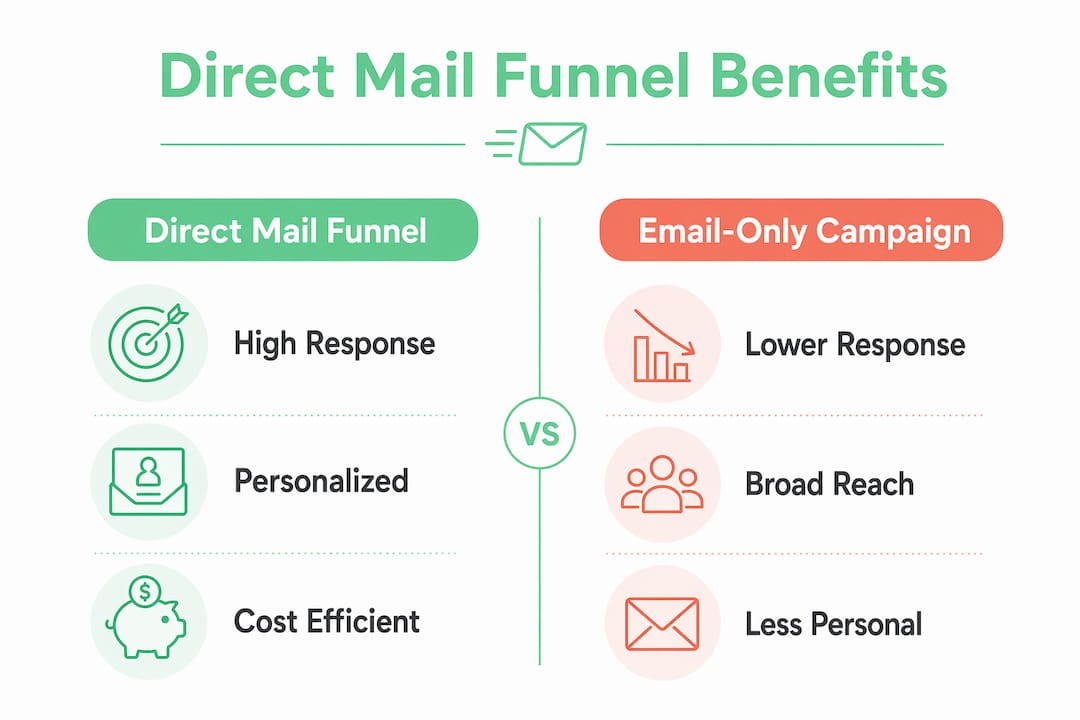
Direct mail funnels consistently outperform digital-only campaigns on response rate. House list response rates for direct mail reach 5 to 9 percent, while prospect list rates land between 2 and 5 percent. Email prospect campaigns, by comparison, average 0.6 to 1.0 percent. That gap is not marginal. It reflects a fundamental difference in attention quality: a physical piece in someone’s hand competes with far less noise than an inbox.
“Physical mail commands a different kind of attention than digital ads. It occupies space in the real world, which means it occupies more mental space too.” This attention advantage translates directly into higher engagement rates when the offer and list are well matched.
The table below compares direct mail funnels against email-only campaigns across key performance dimensions:
| Metric | Direct mail funnel | Email-only campaign |
|---|---|---|
| House list response rate | 5–9% | 1–3% (open-to-click) |
| Prospect response rate | 2–5% | 0.6–1.0% |
| Attribution capability | High (with PURLs/QR codes) | Moderate (pixel-based) |
| Audience attention quality | High (physical engagement) | Low to moderate |
| Cross-channel amplification | Strong (triggers digital follow-up) | Limited |
Attribution is where direct mail funnels have historically struggled, but personalized URLs solve most of that problem. A PURL is a unique web address assigned to each recipient. When they visit it, the system records who they are, when they visited, what device they used, and whether they converted. That data closes the attribution loop that traditional offline marketing leaves open.
Cost efficiency also improves when you build a funnel rather than send a broadcast. Targeting a smaller, better-qualified list reduces print and postage costs while increasing response rates. The math favors precision over volume.
How to integrate direct mail funnel strategies with digital marketing
Direct mail is most effective when it operates mid-funnel, not at the top or bottom. At the top of the funnel, digital channels like paid search and social media are faster and cheaper for building awareness. At the bottom, a sales conversation or a targeted email sequence closes deals more efficiently. The physical mail piece earns its place in the middle, where re-engagement and trust-building matter most.
Effective integration requires coordinating several moving parts:
- Shared campaign identifiers. Every mail piece, landing page, email, and ad in the sequence should carry a common campaign code. This allows your CRM or marketing automation platform to connect touchpoints and build a complete picture of each recipient’s journey.
- Behavioral triggers, not calendar triggers. Digital follow-ups should fire when a recipient engages with the mail piece, not on a fixed date. A triggered email sent 48 hours after a PURL visit converts at a higher rate than a batch email sent to everyone on day seven.
- Retargeting alignment. Upload your mail list to Meta Ads or Google Ads as a custom audience. Recipients who see a digital ad after receiving a physical piece are more likely to convert than cold audiences. This is multichannel reinforcement, not redundancy.
- Consistent creative sequencing. The visual language, offer, and call to action on the mail piece must match what the recipient sees when they land on the digital destination. Disconnected creative breaks trust and increases drop-off.
Pro Tip: Use your CRM’s in-home delivery estimate to set a suppression window. Suppress digital ads and emails until the mail piece is likely in hand. Showing someone a digital ad before they receive the physical piece undermines the physical piece’s impact.
Operational orchestration around shared campaign identifiers is what separates a connected customer journey from a collection of unrelated tactics. Financial advisors and professional service firms, for example, have used this approach to build multi-channel funnels that combine direct mail with email nurture sequences and appointment-booking pages.
What tools and technologies track direct mail funnel success?
Tracking converts a direct mail campaign from a cost center into a measurable revenue driver. The primary tools are PURLs, QR codes, call tracking numbers, and offer codes. Each serves a different segment of your audience and a different attribution need.
| Tracking tool | Best use case | Data captured |
|---|---|---|
| PURL | Desktop and older audiences | Visit time, device, page actions, conversions |
| QR code | Mobile-first audiences | Scan time, device type, landing page behavior |
| Call tracking number | Phone-preferred audiences | Call duration, caller ID, conversion outcome |
| Offer code | Retail and e-commerce | Redemption rate, order value, channel attribution |
PURLs capture visit timestamps, device types, page actions, and conversion events, enabling marketers to attribute revenue directly to individual mail pieces. This level of granularity addresses the core weakness of traditional offline marketing: the inability to know who responded and why.
QR codes complement PURLs for mobile audiences. A recipient who scans a QR code on their phone and lands on a mobile-optimized page is tracked just as precisely as a PURL visitor. The key is that both tools must point to a destination that is instrumented with your CRM or marketing automation platform. Without that connection, you capture clicks but lose the conversion data.
CRM integration is the final piece. When a PURL visit or QR scan triggers a record update in Salesforce, HubSpot, or Klaviyo, your sales team sees the engagement in real time and can follow up with context. That context, knowing that a specific person received a specific mail piece and visited a specific page, makes follow-up conversations more relevant and more likely to convert. For a deeper look at connecting these data points, Envypak’s guide on tracking direct mail ROI covers the attribution process in practical terms.
Key takeaways
A direct mail funnel works because it combines the attention advantage of physical mail with the precision and measurability of digital marketing, making it one of the highest-ROI approaches in a multichannel strategy.
| Point | Details |
|---|---|
| Four-component framework | Every funnel requires a list, mail piece, offer, and response path to be measurable. |
| Response rate advantage | Direct mail achieves 5–9% on house lists, far exceeding email’s 0.6–1.0% prospect rate. |
| Mid-funnel placement | Direct mail performs best as a re-engagement tool, not a top-of-funnel awareness play. |
| PURL attribution | Personalized URLs tie each mail piece to an individual recipient, closing the offline attribution gap. |
| Timing discipline | Digital follow-ups must align with in-home delivery windows, not arbitrary send dates. |
Why most direct mail funnels fail before they start
I have reviewed hundreds of direct mail campaigns over the years, and the failure pattern is almost always the same. Marketers treat the mail piece as the campaign. They spend weeks on copy and design, approve a list, drop the mail, and then wait. No triggered follow-up. No PURL. No retargeting. Just a piece of paper and hope.
The uncomfortable truth is that a beautifully designed mail piece sent to the right list with a compelling offer will still underperform if the response path is weak or the digital follow-up is absent. The physical piece is not the campaign. It is the opening move.
What I have found actually works is treating the mail piece as a trigger, not a destination. Its job is to create enough curiosity or urgency to move the recipient one step forward, typically to a landing page or a phone call. Everything after that step is where the conversion happens. When you design the funnel backward from the conversion event and work toward the mail piece, the sequencing decisions become obvious.
The other mistake I see constantly is ignoring response lag. Marketers schedule a follow-up email for the day after the mail drop, before most recipients have even opened their mailbox. Audience-specific delivery windows exist for a reason. Use them. A triggered email that arrives 48 hours after a PURL visit feels like a natural continuation of a conversation. An email that arrives before the mail piece feels like noise.
Direct mail is not a legacy channel. It is an underutilized precision tool that most marketers are using incorrectly. When you build a real funnel around it, the direct mail result stories stop being surprises and start being repeatable outcomes.
— James
How Envypak supports your direct mail funnel
Building a direct mail funnel starts with a mail piece that gets opened. Envypak’s crystal clear mailing envelopes are engineered to make your offer visible before the recipient even breaks the seal, which directly increases open rates and first impressions. When your envelope stands out in a stack of standard white mailers, your funnel gets a stronger start.
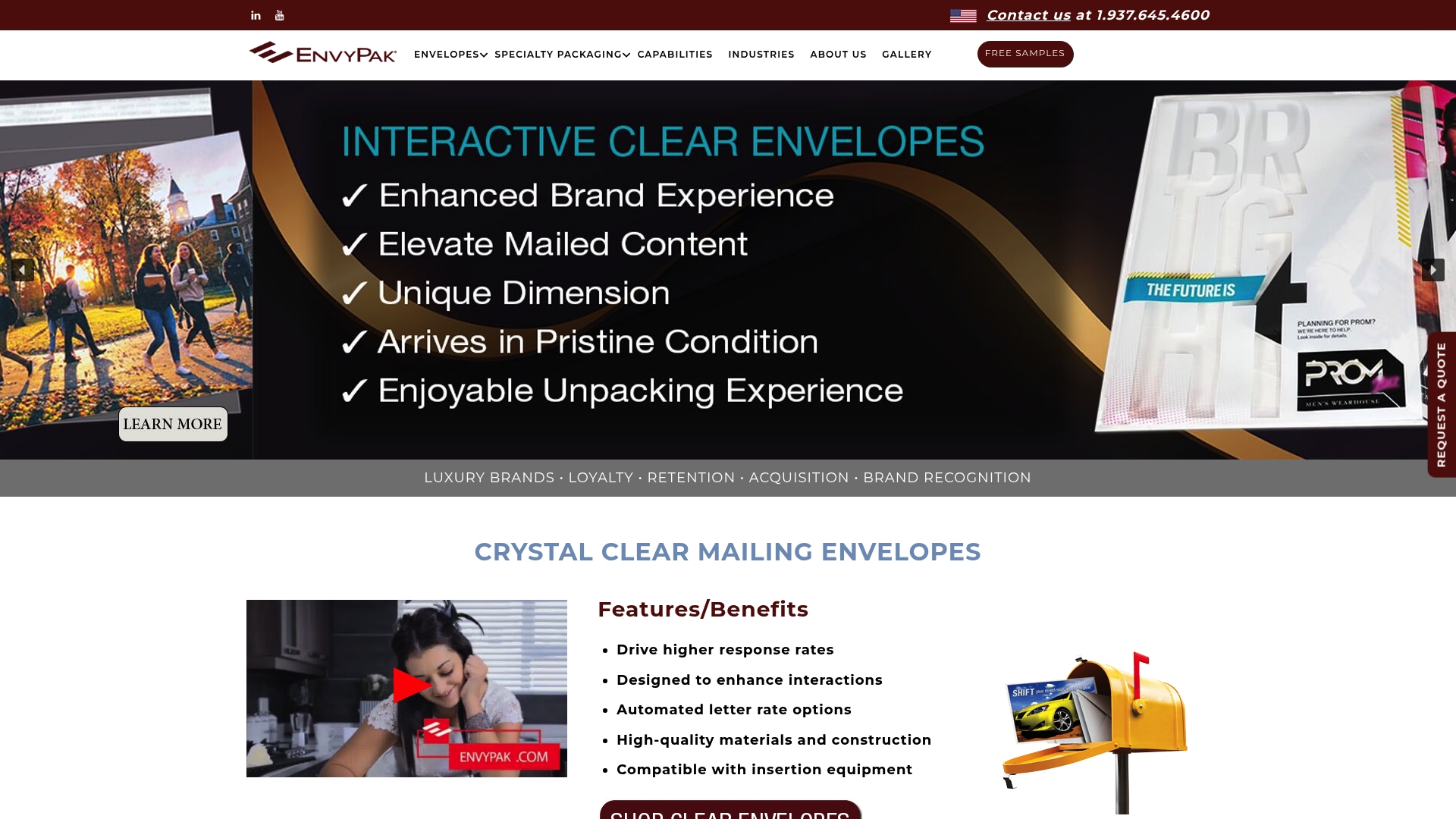
Envypak’s envelopes are automation-compatible, meaning they integrate with high-volume mail processing without sacrificing presentation quality. Whether you are running a segmented prospect campaign or a personalized house list sequence, Envypak’s clear envelopes and custom mailer options give your mail piece the visual impact it needs to earn attention. Eco-friendly materials and reusable construction also align with sustainability goals that increasingly matter to both brands and their audiences.
FAQ
What is a direct mail funnel in simple terms?
A direct mail funnel is a marketing system that uses physical mail pieces to move recipients through stages from awareness to conversion, typically by connecting the mail piece to a digital response path like a landing page or phone number.
How does a direct mail funnel differ from a regular mailer?
A regular mailer is a one-way broadcast with no structured follow-up. A direct mail funnel includes a tracked response path, triggered digital follow-ups, and CRM integration that turns each mail piece into a measurable step in a customer journey.
What response rates can I expect from a direct mail funnel?
House list campaigns typically achieve 5 to 9 percent response rates, while prospect list campaigns land between 2 and 5 percent. Both figures significantly outperform email prospect response rates, which average 0.6 to 1.0 percent.
What is a PURL and why does it matter for tracking?
A PURL is a personalized URL assigned to each mail recipient. When they visit it, the system captures visit data including timestamp, device, and conversion events, allowing marketers to attribute revenue directly to individual mail pieces.
When should direct mail be used in a marketing funnel?
Direct mail performs best mid-funnel, where its physical presence re-engages prospects who have shown prior interest but have not yet converted. It is less cost-effective as a pure top-of-funnel awareness tool compared to digital channels.