

What Is a Call to Action Mailer? A 2026 Guide

A call to action mailer is a direct mail piece engineered to prompt the recipient to take one specific, measurable action right away. Unlike general awareness mailers, a CTA mailer combines persuasive copy, a clear response mechanism, and a compelling incentive to drive immediate behavior. Think of it as a printed sales conversation that ends with a firm ask. Direct mail achieves a 3.7% response rate with house lists, far outpacing digital channels at 0.62%. That gap explains why marketers who understand what a call to action mailer is gain a measurable edge over those who rely on digital alone.
What is a call to action mailer and what makes it work?
A call to action mailer is defined by four components working together: a specific action verb, a clear response mechanism, a reason to act now, and low friction for the recipient. Remove any one of these and the mailer becomes a brochure, not a conversion tool.

Effective direct mail CTAs follow a precise formula. A strong example: “Call (845) 255-5722 by March 31 for a free estimate.” That single sentence contains all four components. The verb is “Call,” the mechanism is the phone number, the deadline creates urgency, and the free estimate removes financial risk.
Common mistakes marketers make include:
- Vague verbs: “Contact us” or “Reach out” give the recipient no clear path. “Call,” “Visit,” and “Scan” are direct and unambiguous.
- Missing deadlines: Without a time limit, recipients defer action indefinitely.
- Too many options: Offering phone, email, website, and QR code simultaneously splits attention and reduces response.
- Buried CTAs: A CTA hidden in body copy gets ignored.
Pro Tip: Write your CTA before you write anything else on the mailer. Every headline, image, and offer should funnel the reader toward that single ask.
Response mechanisms vary by audience: older recipients prefer phone calls for immediate action, while research-oriented audiences respond better to QR codes and URLs. Matching the mechanism to the audience is not optional. It is the difference between a response and a recycled mailer.
How does a CTA mailer fit within a direct mail strategy?
A call to action mailer is not a standalone tactic. It operates within a campaign structure where list quality, offer strength, and creative execution each carry defined weight.
The 40/40/20 rule is the standard framework for direct mail campaigns. List quality drives 40% of campaign outcome. Offer strength drives another 40%. Creative design and the CTA account for the remaining 20%. That breakdown does not diminish the CTA’s role. It clarifies where to invest first.
| Campaign Factor | Weight | What It Means for CTA Mailers |
|---|---|---|
| List quality | 40% | Sending to the wrong audience makes even a perfect CTA worthless |
| Offer strength | 40% | A weak offer cannot be saved by clever copy or design |
| Creative and CTA | 20% | Strong design and a clear CTA extract maximum value from a good list and offer |
“A mailer that looks great but lacks a strategy is just expensive paper. The CTA is the point where strategy becomes measurable action. Without it, you have no way to know if the campaign worked.”
Marketers often mistake individual components for strategy. A true mailer strategy ties the target audience, the campaign objective, and the CTA together into one coherent system. Each element must serve the others.
Attribution windows also matter more than most marketers realize. Significant conversions occur between weeks 3 and 6 after a mail drop. Cutting measurement off at two weeks produces misleading data and causes marketers to undervalue campaigns that are still generating returns.
What distinguishes CTA mailers from digital CTAs?
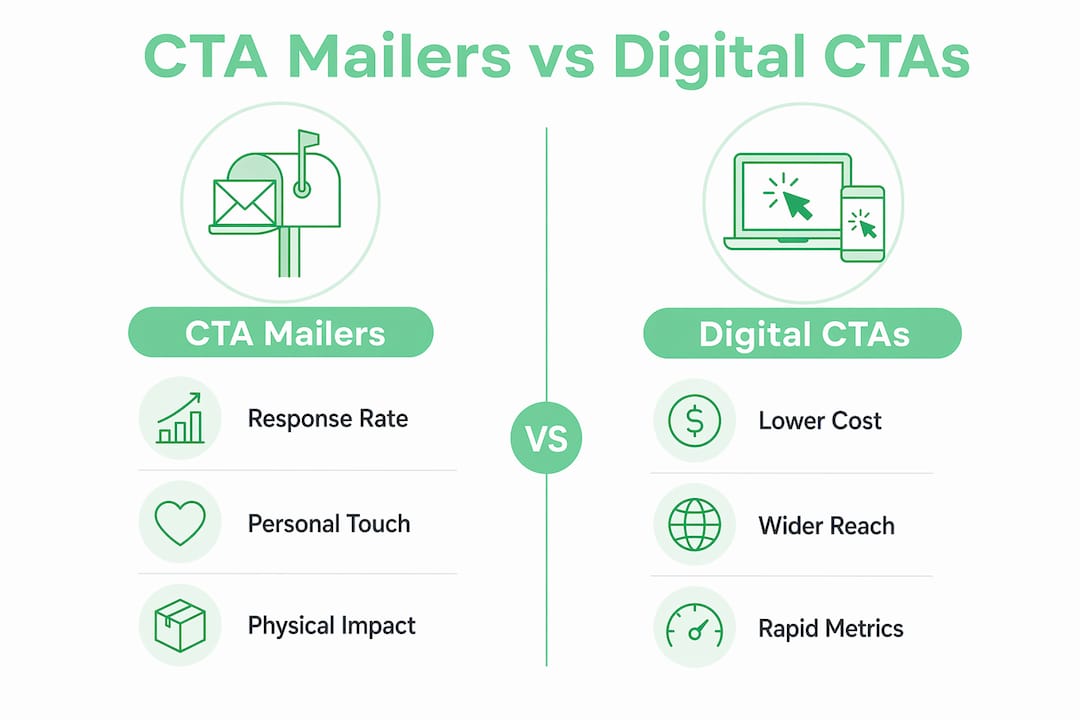
Physical mail and digital CTAs share the same goal but operate through fundamentally different psychology. A printed mailer occupies physical space in a home or office. It cannot be deleted with one click, filtered by an algorithm, or lost in a crowded inbox.
Coordinating direct mail with digital outreach amplifies response likelihood and gives recipients multiple paths to act. A mailer that includes a QR code linking to a dedicated landing page captures both the immediate responder and the researcher who needs more information before committing.
The table below compares how CTA mailers and digital CTAs perform across key dimensions:
| Dimension | CTA mailer | Digital CTA |
|---|---|---|
| Response rate | Up to 3.7% (house list) | 0.62% combined average |
| Audience reach | Defined by mailing list | Defined by targeting algorithm |
| Tactile engagement | High: physical object held and read | None |
| Response mechanism | Phone, URL, QR code, reply card | Click, form, chat |
| Attribution ease | Requires unique codes or URLs | Native tracking available |
The most effective integrated campaigns use mail to create awareness and urgency, then direct recipients to a digital destination for conversion. A QR code on a mailer that leads to a personalized landing page combines the physical credibility of print with the tracking precision of digital. Understanding how to craft effective CTAs across both channels is what separates average campaigns from high-performing ones.
How to design a mailer that actually drives response
Designing an effective CTA mailer requires discipline. Most failed mailers suffer from the same problem: too much information competing for attention. The design process should work backward from the CTA.
Follow these steps to build a mailer that converts:
- Write the CTA first. Define the exact action, mechanism, and deadline before designing anything else.
- Lead with a benefit headline. The headline must communicate a clear benefit in under eight words. “Save $200 on Your First Service” beats “Welcome to Our Business.”
- Make the CTA the most prominent element. The CTA must be the most visible element on the mailpiece. If the mailer has multiple panels, repeat the CTA on each one.
- Personalize where possible. Using the recipient’s name or referencing their location increases engagement. Personalization signals relevance, and relevance drives response.
- Limit choices to one. Give recipients one action to take. Multiple CTAs create decision paralysis and lower overall response rates.
- Add urgency with a deadline or limited quantity. Fear of missing out messaging and scarcity prevent deferral. “Only 50 spots available” or “Offer expires April 15” both work.
- Build in tracking. Assign a unique phone extension, promo code, or dedicated URL to each mailer version. Without tracking, you cannot measure what worked.
Pro Tip: Test two versions of your CTA with different verbs or deadlines on a small segment before mailing the full list. The data from a small test often reveals which version will outperform by a wide margin.
Direct mail design best practices consistently point to white space, contrast, and font size as the three visual levers that determine whether a CTA gets read or ignored. A CTA printed in small gray text on a busy background will not convert, regardless of how strong the offer is.
Real examples of CTA mailers that delivered results
The most instructive proof of what a call to action mailer can do comes from documented campaign data, not theory.
A single direct mail campaign of 11,385 pieces generated $586,601 in revenue, accounting for 14% of total sales over a six-week attribution window. That result came from a well-targeted list, a strong offer, and a CTA that gave recipients a clear next step. The six-week window is the critical detail. Campaigns measured at two weeks would have missed a substantial portion of those conversions.
Key lessons from high-performing CTA mailers include:
- Targeting precision beats volume. Smarter targeting and personalization drive ROI more reliably than mailing to a larger, less qualified list.
- The offer and the CTA must align. A mailer offering a discount that requires three steps to redeem will underperform a mailer where the discount is immediate upon calling.
- Response mechanism must match the audience. A QR code CTA sent to a demographic that rarely uses smartphones will produce poor results regardless of offer quality.
- Attribution windows must be long enough. Closing the measurement window at two weeks misses the bulk of conversions in many categories.
High-converting mailer examples consistently share three traits: a single clear CTA, a time-bound offer, and a response path matched to the audience. These are not design choices. They are structural requirements.
Key Takeaways
A call to action mailer succeeds when list quality, offer strength, and a single clear CTA work together within a tracked, time-bound campaign.
| Point | Details |
|---|---|
| Four-component CTA structure | Every effective CTA needs an action verb, response mechanism, reason to act now, and low friction. |
| 40/40/20 rule | List quality and offer strength each drive 40% of outcome; creative and CTA drive the remaining 20%. |
| Attribution window length | Track campaigns for at least six weeks to capture the full range of conversions. |
| Match mechanism to audience | Use phone CTAs for older demographics and QR codes or URLs for research-oriented recipients. |
| Design CTA first | Build every headline, image, and offer to funnel the reader toward one specific action. |
Why most marketers underestimate the CTA mailer
After working with direct mail campaigns across multiple industries, I’ve noticed a consistent pattern: marketers spend 80% of their budget on design and printing, then treat the CTA as an afterthought. The result is a beautiful mailer that generates no measurable response.
The CTA is not decoration. It is the only part of the mailer that produces revenue. A mediocre design with a sharp CTA will outperform a stunning design with a vague one every time. I’ve seen campaigns with modest budgets outperform expensive productions simply because the CTA was specific, urgent, and matched to the right audience.
The other mistake I see constantly is premature campaign abandonment. A marketer mails 5,000 pieces, checks results at two weeks, sees modest numbers, and declares the campaign a failure. The data shows that conversions often peak between weeks three and six. Patience and proper attribution windows are not optional. They are part of the methodology.
The CTA importance in marketing is not a new concept, but its application in physical mail is consistently underexecuted. The marketers who treat the CTA as the centerpiece of their mailer strategy, not a finishing touch, are the ones who see direct mail deliver consistent ROI year after year.
— James
How Envypak supports direct mail campaigns that convert
Envypak specializes in premium crystal clear mailing envelopes designed to increase open rates and make CTA mailers impossible to ignore before the recipient even opens them.
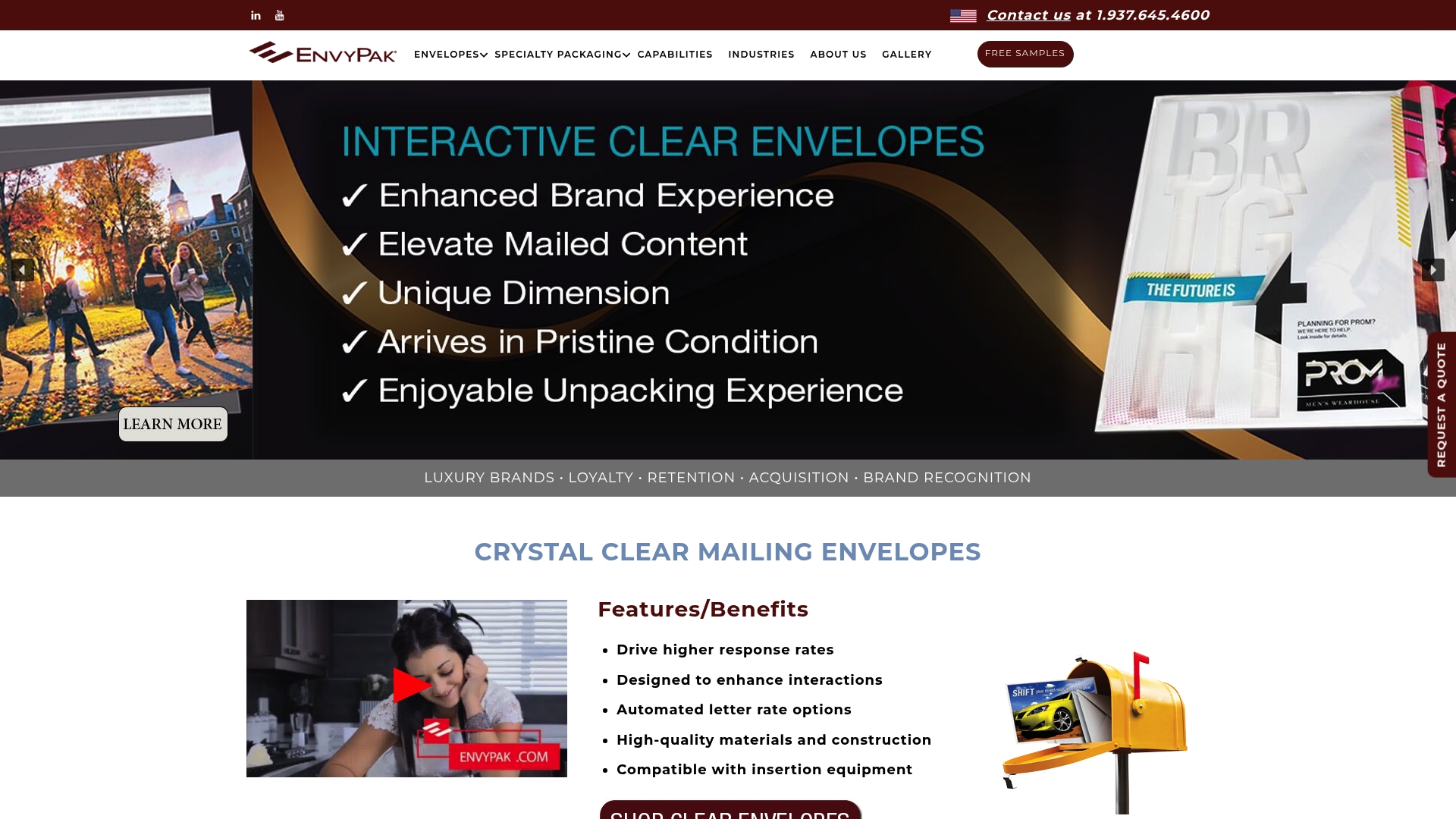
When your mailer’s CTA is visible through a clear envelope, the response mechanism reaches the recipient before they’ve broken the seal. Envypak’s envelopes are automation-compatible, eco-friendly, and built to make your offer stand out in a crowded mailbox. Whether you’re mailing a time-sensitive promotion or a personalized acquisition piece, custom envelopes and mailers from Envypak give your CTA the visibility it needs to drive action. Choosing the right format starts with the right envelope. Selecting the right envelope size is one of the most overlooked decisions in direct mail campaign planning, and Envypak makes it straightforward.
FAQ
What is a call to action mailer?
A call to action mailer is a direct mail piece designed to prompt the recipient to take one specific action, such as calling a phone number, scanning a QR code, or visiting a URL. It combines a clear action verb, a response mechanism, a deadline, and a low-friction path to act.
What are the four components of an effective CTA mailer?
The four components are a specific action verb, a clear response mechanism, a reason to act now, and low friction for the recipient. A complete example is: “Call (845) 255-5722 by March 31 for a free estimate.”
How does direct mail response rate compare to digital?
Direct mail achieves a 3.7% response rate with house lists versus a 0.62% combined average for digital channels. That gap makes direct mail one of the highest-performing response channels available to marketers.
How long should I track a direct mail campaign?
Track campaigns for at least six weeks after the mail drop. Significant conversions regularly occur between weeks three and six, and closing the attribution window earlier produces misleading performance data.
How do I choose the right response mechanism for my mailer?
Match the mechanism to your audience. Older demographics respond better to phone calls, while research-oriented and tech-savvy recipients prefer QR codes and URLs linked to dedicated landing pages.