

Types of High-Impact Mailer Designs for Marketers

High-impact direct mail formats are defined by their ability to drive measurable response through format choice, physical presence, and visual hierarchy. The types of high-impact mailer designs marketers rely on in 2026 span six core categories: postcards, letters and enveloped mailers, self-mailers, brochures, catalogs, and dimensional mail. Each format creates a different physical experience for the recipient, and that experience directly shapes whether the piece gets read or recycled. Choosing the wrong format for your message is one of the most common and most expensive mistakes in direct mail.
1. What are the top types of high-impact mailer designs?
Direct mail formats in 2026 break into six distinct categories, each suited to a different campaign goal, message length, and budget level. Understanding what separates them is the first step toward matching format to objective.
- Postcards: The fastest format to scan and the most cost-effective to produce. Postcards work best for short, punchy offers where the message fits in 40–100 words. They require no envelope, which removes one barrier between your message and the reader’s eyes.
- Letters and enveloped mailers: The right choice when your message needs room to breathe. A letter inside an envelope signals personal communication, which raises open rates. Oversized envelopes achieve the highest overall response rates of any format, outperforming postcards and standard letter envelopes.
- Self-mailers: Folded card-stock pieces that mail without an envelope. Bi-fold, tri-fold, and accordion styles each offer a different unfolding experience, making them strong for mid-length storytelling. They cost less than enveloped mail but deliver more real estate than a postcard.
- Brochures and tri-folds: A premium presentation format favored by financial services, luxury real estate, and healthcare brands. The folded structure naturally creates a reveal sequence that guides the reader through a narrative.
- Catalogs and booklets: The highest-content format in direct mail. Catalogs create a browsing experience that keeps the piece in the home longer than any other format, which increases the chance of a delayed response.
- Dimensional and specialty mail: Pop-up mailers, custom kitted boxes, padded mailers, and specialty tubes. These formats disrupt the recipient’s routine by adding a physical, three-dimensional element that no flat piece can replicate.
2. How do interactive and engagement-focused mailers enhance campaign response?
Interactive mailers work by requiring the recipient to do something. That act of participation creates a stronger memory trace than passive reading. Puzzles, contests, and giveaways are the three most common mechanisms, and each one ties physical engagement to a conversion action.

The design rules for interactive mailers are strict. Every interactive element must connect directly to the call to action. A puzzle that entertains but does not lead to a URL, a QR code, or a phone number is a wasted production cost. Interactive formats increase engagement only when the interaction links clearly to conversion, not just to entertainment.
Operationally, the entry method must be frictionless. QR codes and short-form URLs outperform phone numbers and mail-in forms because they reduce steps. Setting a deadline on the contest or giveaway adds urgency without requiring extra design space.
Pro Tip: Test your interactive mailer with five people who have never seen it. If they cannot find the CTA within ten seconds of engaging with the puzzle or contest, simplify the layout before you print.
Key design principles for interactive mailers:
- Use one dominant interactive element per piece. Multiple puzzles or two separate contests split attention and reduce completion rates.
- Place the QR code or URL on the same panel as the interactive element, not on the back.
- State the deadline and prize value in the same visual zone as the CTA.
- Keep the entry method to two steps or fewer. More steps mean fewer completions.
3. What USPS and production factors affect your mailer design choices?
USPS mailing standards set hard limits that directly affect which formats are viable at a given budget. USPS Marketing Mail flat-shaped pieces carry a weight limit of 20 oz for standard pieces and 24 oz for carrier route pieces. Exceeding those thresholds triggers overweight fees that can reach $200 per applicable item. That number can destroy the unit economics of a high-volume campaign overnight.
Dimensional mail is where production costs and postage costs collide most aggressively. A custom box that ships as a parcel rather than a flat pays parcel postage rates, which are significantly higher. Structure engineering for dimensional mailers solves this problem by designing pieces that ship flat and spring open upon delivery, keeping the piece within flat-rate thresholds while still delivering a three-dimensional experience.
Pro Tip: Build a physical prototype and weigh it before finalizing your design. Catching a weight issue at the prototype stage costs nothing. Catching it after printing 50,000 pieces costs everything.
Production considerations by format:
- Postcards: Minimum 3.5 x 5 inches, maximum 4.25 x 6 inches for letter-rate postage. Heavier card stock improves perceived quality but adds weight.
- Self-mailers: Must meet USPS sealing requirements. Tabs or wafer seals are required on open edges to prevent jams in automated processing.
- Catalogs and booklets: Classified as flats. Weight accumulates fast with page count, so paper stock selection is a direct budget decision.
- Dimensional mail: Validate dimensions and weights during mechanical prototyping. Ignoring USPS weight limits risks unexpected fees and campaign budget overruns that are impossible to recover mid-campaign.
4. How do different mailer designs compare on response rates?
Response rate benchmarks give marketers a concrete basis for format decisions. The average direct mail response rate across industries is 4.4% for prospect lists. House lists perform significantly better, reaching 5–9%, which shows that audience quality amplifies format performance.
| Format | Typical Response Rate | Best Use Case | Relative Cost |
|---|---|---|---|
| Oversized envelope | Highest of all formats | Complex offers, personalized messaging | Medium |
| Postcard | 5.7% | Quick offers, event promotions | Low |
| Letter-sized envelope | 4.3% | Detailed messaging, financial services | Low to medium |
| Dimensional mail | 4–6x postcard rate | B2B, ABM, executive outreach | High |
| Self-mailer | Varies by design | Mid-length storytelling, retail | Low to medium |
| Catalog | Long-tail response | Product browsing, e-commerce | High |
Dimensional mailers deliver 4 to 6 times higher response rates than standard postcards. That multiplier only justifies the production cost when the lifetime value of the target audience is high enough to absorb it. For B2B account-based marketing campaigns targeting enterprise buyers, the math works. For a mass consumer offer at $20 average order value, it does not.
Design success is measured by response rate, not visual sophistication. A clean postcard with a strong headline and a single CTA will consistently outperform a visually complex piece that buries the offer. Effective direct mail design uses a fast-scan visual hierarchy that leads the eye from headline to offer to CTA in roughly 1.5 seconds. That is the window you have before the piece goes in the recycling bin.
5. Which mailer format fits your campaign goal and budget?
Matching format to message complexity is the single most reliable predictor of direct mail performance. A format that is too simple for a complex offer loses the sale. A format that is too elaborate for a simple offer wastes budget.
Here is how to align format with scenario:
- Low budget, high volume: Postcards and oversized postcards. They require no envelope, no folding, and no insertion. Production and postage costs stay low, making them the right tool for broad geographic campaigns and event promotions.
- Mid-level storytelling: Self-mailers in bi-fold or tri-fold format. They give you four to six panels of content without the cost of an envelope. Retail brands, nonprofits, and service businesses use them to walk prospects through a narrative before presenting the offer.
- High-value B2B and ABM targets: Dimensional mail, custom boxes, and specialty tubes. Dimensional formats create a physical event that bypasses gatekeepers and stimulates internal sharing in office environments. The piece gets passed around, which multiplies impressions beyond the original recipient.
- Complex messaging: Catalogs and booklets. When your offer requires product comparison, detailed specifications, or a full product line, a catalog keeps the conversation going long after the initial delivery.
- Creative alternatives: Clear envelopes that show the contents before opening. This format borrows the curiosity mechanism from dimensional mail at a fraction of the cost, making it a strong middle-ground option for campaigns that need visual impact without a dimensional budget.
Pro Tip: If you are unsure which format to use, run a two-cell test. Send postcards to half your list and self-mailers to the other half with identical offers. The response data will tell you more than any planning session.
Key takeaways
The most effective direct mail campaigns match format to message complexity, audience value, and budget before a single design decision is made.
| Point | Details |
|---|---|
| Format drives response | Oversized envelopes and dimensional mail consistently outperform standard postcards on response rate. |
| Dimensional mail earns its cost | Use dimensional formats only for high-value B2B or ABM targets where lifetime value justifies production spend. |
| USPS limits are non-negotiable | Validate weight and dimensions at the prototype stage to avoid fees that can reach $200 per piece. |
| Interactive elements need a clear CTA | Puzzles and contests only lift response when they connect directly to a conversion action, not just engagement. |
| Design hierarchy beats design complexity | A 1.5-second readable headline and single CTA outperforms visually elaborate pieces that bury the offer. |
What I have learned from testing mailer formats in the field
The most common mistake I see marketers make is choosing a format based on what looks impressive in a presentation rather than what the data supports. Dimensional mail is genuinely powerful, but I have watched teams blow their entire quarterly budget on custom boxes for a list of 500 prospects when a well-designed oversized envelope would have delivered comparable results at a tenth of the cost.
The 1.5-second readability rule changed how I review every piece before it goes to print. I hold the mailer at arm’s length and look away. Then I look back and time how long it takes to read the headline and find the CTA. If I cannot do it in under two seconds, the design goes back for revision. That single test has improved response rates on more campaigns than any design trend I have followed.
My honest advice on interactive mailers: they work, but only when the team has the discipline to keep the design clean. Every time I have seen a puzzle or contest element added to a piece that already had three competing visuals, the response rate dropped. The interaction has to be the centerpiece, not a feature buried in a crowded layout.
Partner with your production vendor before you finalize the design. I have seen beautiful dimensional concepts fail at the prototype stage because the structural engineering was not feasible at the target postage rate. That conversation costs nothing at the concept phase and saves weeks of rework later. Check out high-converting mailer examples if you want a benchmark for what strong execution actually looks like across formats.
Envypak’s clear and custom mailers for direct mail campaigns
Marketers who want visual impact without dimensional mail production costs have a direct path forward with Envypak’s crystal clear mailing envelopes. The contents are visible before the recipient even opens the piece, which creates the curiosity effect that drives open rates without adding weight or complexity.
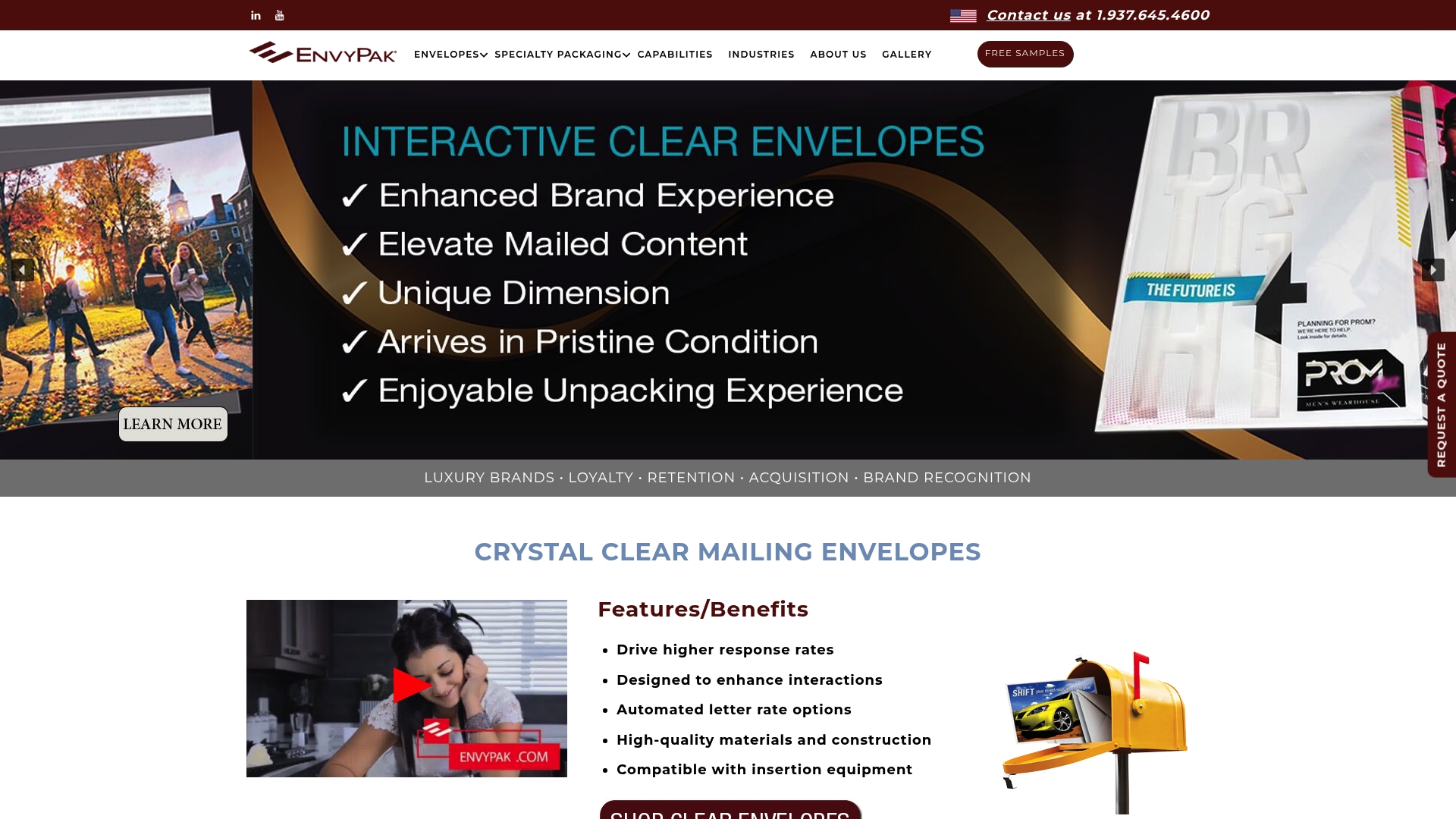
Envypak offers clear envelopes, custom envelope and mailer options, self-mailers, and specialty packaging built for direct marketing campaigns. All materials are eco-friendly and automation-compatible, which means they move through USPS processing without triggering manual handling fees. If you are building a campaign that needs to stand out in the mailbox without breaking the production budget, Envypak’s product line is worth a close look.
FAQ
What mailer format gets the highest response rate?
Oversized envelopes achieve the highest overall response rates of any direct mail format, followed by postcards at 5.7% and letter-sized envelopes at 4.3%. Dimensional mailers deliver 4 to 6 times the response rate of standard postcards but carry significantly higher production costs.
When does dimensional mail make financial sense?
Dimensional mail makes financial sense for high-value B2B or account-based marketing campaigns where the lifetime value of a converted prospect is large enough to absorb the higher production and postage costs. For mass consumer campaigns with low average order values, postcards or oversized envelopes deliver better ROI.
What is the 1.5-second rule in direct mail design?
The 1.5-second rule states that a recipient should be able to read the headline and locate the call to action within 1.5 seconds of picking up the piece. Mailers that fail this test are discarded before the offer is read, regardless of how strong the offer actually is.
How do USPS weight limits affect mailer design choices?
USPS Marketing Mail flat-shaped pieces have a 20 oz weight limit for standard pieces, with overweight fees that can reach $200 per applicable item. Designers working with dimensional or catalog formats must validate weight at the prototype stage to avoid budget overruns.
What makes interactive mailers effective?
Interactive mailers are effective when the participation mechanism, such as a puzzle or contest, connects directly to a conversion action like a QR code scan or URL visit. Interactive formats that entertain without linking to a CTA increase engagement but do not improve response rates.