

The Role of Machine-Readable Envelopes in Direct Mail

Machine-readable envelopes are specially designed mailpieces that meet USPS standards for automated optical character recognition and mechanical sorting, enabling faster delivery and lower postage costs. The role of machine-readable envelopes extends well beyond the post office. For marketing professionals, these envelopes connect physical mail to data-driven workflows, USPS automation pricing, and AI-powered document processing. Understanding the standards behind them is the difference between a campaign that qualifies for discounts and one that gets flagged for manual handling.
What role do machine-readable envelopes play in USPS automation?
Machine-readable envelopes are the entry point to USPS automated processing. Letter-size pieces meeting automation standards qualify for automation pricing and are processed on USPS optical character readers (OCR). That qualification directly reduces your postage costs on every piece you mail.
USPS OCR systems read the delivery address and scan the Intelligent Mail Barcode (IMB) to sort mail at high speed. When an envelope fails to meet machine-readable standards, it gets pulled from the automated line and handled manually. Manual handling adds cost, slows delivery, and breaks the tracking chain your marketing attribution depends on.
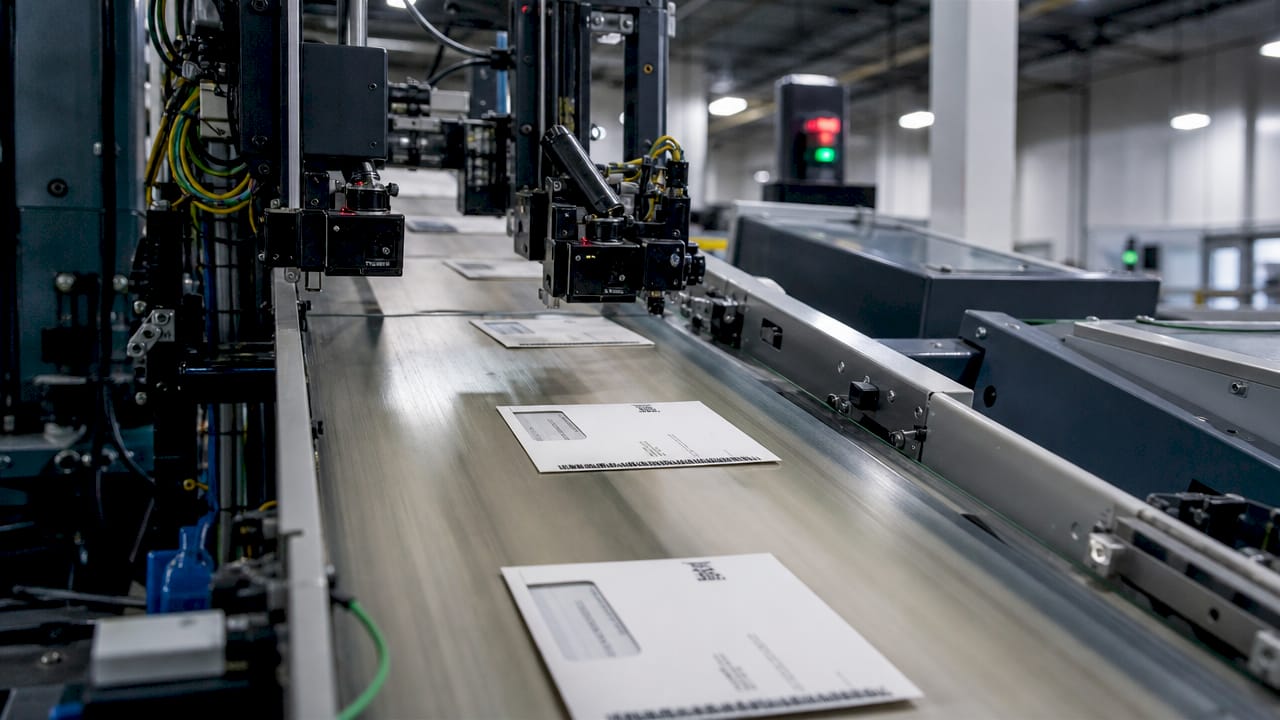
The IMB is the backbone of this system. It encodes routing data, mailer ID, and sequence information into a single barcode printed on the envelope face. Barcode and address machine readability, combined with correct presort procedures, ensures the postal network scans each piece for marketing tracking. Without that scan, you lose delivery confirmation and campaign attribution data.
What USPS standards define machine-readable envelopes?
USPS standards for machine-readable envelopes are specific and non-negotiable. The USPS Quick Service Guide 201a defines the OCR read area for letter-size mail. The delivery address must sit within a zone bounded at 1/2 inch from the left and right edges, with the top of the address block no higher than 2-3/4 inches from the bottom edge and the bottom of the address block no lower than 5/8 inch from the bottom edge.
Physical dimensions matter just as much as address placement. USPS evaluates machinability based on several criteria:
- Aspect ratio: The length-to-height ratio must fall within the acceptable range. Pieces outside this range are classified as nonmachinable.
- Thickness: Envelopes that are too thin or too thick fail automated processing.
- Rigidity: Overly stiff mailpieces cannot pass through sorting equipment.
- Weight: Pieces that exceed weight thresholds for their class face surcharges.
- Barcode clear zones: The IMB requires a clear zone free of any printing or design elements.
Violating any of these criteria triggers a nonmachinable surcharge or removes your piece from automation pricing entirely. The financial impact compounds fast across large mailing volumes.
Pro Tip: Embed hard non-printing guide zones directly into your envelope design templates. This prevents any design element from creeping into OCR read areas or barcode clear zones before the file ever goes to print.
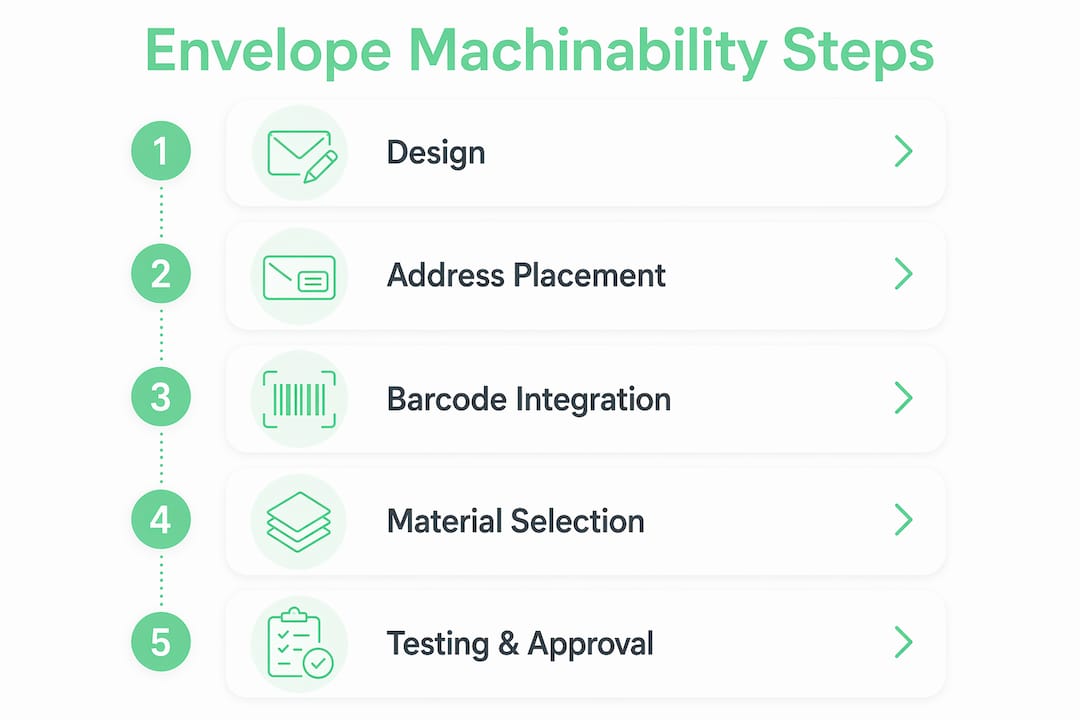
Common design pitfalls include placing a logo or graphic in the lower-left corner of the envelope face, using colored backgrounds that reduce OCR contrast, and printing return addresses too close to the delivery address zone. Each of these forces manual processing. Checking your design against the USPS OCR read area before production saves money and prevents campaign delays.
How do physical properties affect machine readability?
Physical envelope properties are where most marketers get surprised. Marketers often assume machine readability is only about barcodes or address formatting. Physical machinability criteria are equally critical for USPS processing. A perfectly addressed envelope can still fail automation if the material or construction triggers a machinability hazard.
USPS identifies several physical nonmachinable triggers:
- Closures: Clasps, buttons, or string ties catch on sorting equipment.
- Bulges: Inserts that create uneven thickness cause jams.
- Windows: Improperly placed or oversized windows can interfere with OCR scanning.
- Seams: Raised seams on the address side obstruct optical reading.
- Colored films: Dark or reflective films reduce barcode scan accuracy.
Designing for machine inserting and automated sealing adds another layer of complexity. Envelopes used in high-volume automated inserting lines must maintain consistent flap geometry and paper stock weight. Inconsistent stock causes misfeeds that damage pieces and delay production runs.
The good news is that creative envelope design and mailability are not mutually exclusive. Clear poly envelopes, for example, can meet USPS machinability standards while giving recipients a full view of the contents before opening. Envypak’s machine inserting and sealing guide covers the specific tolerances that keep creative designs compliant.
Pro Tip: Run any new envelope design through a machinability hazard checklist before committing to a print run. Check aspect ratio, closure type, window placement, and insert thickness against USPS nonmachinable criteria to avoid unexpected surcharges.
Material choice also affects OCR performance. White or light-colored stock with high contrast black printing gives OCR systems the cleanest read. Glossy coatings on the address panel can create glare that reduces scan accuracy. Matte finishes on the address area are the safer choice for automation compliance.
What is the role of machine-readable envelopes in document AI and marketing automation?
Machine-readable envelopes are the physical front end of a data pipeline that feeds modern marketing systems. Traditional OCR reads characters and outputs raw text. Document AI understands context and meaning, outputting structured, labeled data ready for downstream marketing systems. That distinction matters enormously for campaign workflows.
Here is how machine-readable envelopes connect to marketing automation:
- Address capture: OCR reads the delivery address and feeds it into your CRM or mailing list for real-time validation and deduplication.
- IMB tracking: The Intelligent Mail Barcode triggers delivery scans that feed into campaign attribution dashboards, confirming which recipients received a piece.
- Document AI classification: When reply mail or returned pieces are processed, document AI extracts intent signals, offer codes, and response data automatically.
- Triggered campaigns: Delivery confirmation from IMB scans can trigger follow-up emails, retargeting ads, or sales outreach within hours of confirmed delivery.
- Data enrichment: Address data captured from machine-readable envelopes feeds AI-driven marketing pipelines that append demographic and behavioral data for future segmentation.
Machine-readable envelopes are not just a postal compliance requirement. They are the physical trigger for a chain of digital marketing events that improve attribution, personalization, and campaign ROI.
USPS supports this integration through its Integrated Technology Promotion program. Mailpieces must be approved through the USPS My Products Portal before claiming eligible technology discounts. That approval process covers implementation compliance, not all mailing requirements, so you still need to meet standard automation criteria separately.
How can marketers design envelopes that maximize compliance and campaign impact?
Compliance and creativity work together when you build the right design process. The following comparison shows how compliant and non-compliant design choices affect both postal outcomes and campaign performance.
| Design element | Compliant approach | Non-compliant approach |
|---|---|---|
| Address placement | Within USPS OCR read zone, high-contrast black on white | Placed outside read zone or on colored background |
| IMB barcode | Clear zone maintained, correct size and placement | Barcode crowded by graphics or placed on envelope back |
| Closures | Pressure-sensitive seal or wafer seal approved by USPS | Clasp, string, or button closure |
| Windows | Sized and placed within USPS guidelines | Oversized or positioned over address zone |
| Insert thickness | Consistent, within machinable thickness range | Bulging insert creating uneven profile |
Pre-approval through the USPS My Products Portal is the most reliable way to confirm your envelope qualifies for automation pricing and technology discounts. Approval confirms that your specific mailpiece design meets the physical and addressing criteria USPS requires. Envypak’s clear envelopes carry USPS automation approval, which removes the guesswork from compliance for marketers running high-volume campaigns.
Effective envelope designs combine compliance with visual impact. A clear front panel that reveals a full-color insert creates immediate visual engagement without placing any design element in the OCR read zone. Keeping the address panel clean and the barcode zone clear leaves the rest of the envelope face open for branding. You can find practical examples of this balance in Envypak’s direct mail envelope design guide.
Pro Tip: Request a physical sample of any new envelope design and run it through your inserting equipment before the full production run. Catching a machinability issue at the sample stage costs far less than reprinting an entire campaign.
The benefits of automating direct mail campaigns go beyond postage savings. Automation-compatible envelopes reduce production time, improve delivery speed, and feed cleaner data into your marketing systems. Every dollar saved on postage through automation pricing is a dollar available for creative, targeting, or volume.
Key Takeaways
Machine-readable envelopes are the physical foundation of both postal automation compliance and data-driven direct mail marketing.
| Point | Details |
|---|---|
| USPS OCR read zone compliance | Place the delivery address within the exact boundaries defined in USPS Quick Service Guide 201a. |
| Physical machinability matters | Aspect ratio, rigidity, closures, and insert thickness all affect automation eligibility, not just address formatting. |
| IMB drives marketing attribution | The Intelligent Mail Barcode enables delivery tracking that feeds campaign attribution and triggered follow-up workflows. |
| Document AI extends envelope value | Machine-readable envelopes feed structured data into AI-driven marketing systems for segmentation and personalization. |
| Pre-approval reduces risk | Submit mailpieces through the USPS My Products Portal before claiming technology discounts to confirm compliance. |
Why I think most marketers underestimate the envelope
After years of watching direct mail campaigns succeed and fail, the pattern is consistent. Marketers spend weeks on copy, creative, and offer strategy, then treat the envelope as an afterthought. That approach costs real money.
The physical machinability criteria are where I see the most expensive mistakes. A beautifully designed envelope with a clasp closure or an oversized window gets pulled from automation and charged a surcharge on every single piece. At scale, that surcharge erases the postage savings the campaign was designed to capture.
The more interesting shift I see in 2026 is how the envelope is becoming a data asset, not just a container. The IMB scan data feeding into marketing dashboards, combined with document AI processing reply mail, means the physical envelope now generates digital signals. That connection between the mailbox and the marketing stack is genuinely new, and most campaign teams are not yet built to use it.
My advice is to treat envelope compliance as a campaign launch requirement, the same way you treat list hygiene or offer approval. Build the machinability checklist into your production workflow. Get USPS pre-approval on any new envelope format before you commit to volume. And if you are using clear envelopes, confirm automation compatibility before assuming it is included.
The marketers who will win with direct mail in the next few years are the ones who understand that the envelope is the first data point in the campaign, not just the packaging.
Envypak’s automation-compatible envelopes for direct mail marketers
Envypak builds envelopes specifically for marketers who need both visual impact and postal compliance. Its crystal clear mailing envelopes carry USPS automation approval, which means they qualify for automation pricing without requiring you to navigate the compliance process from scratch.
Envypak’s envelopes are designed for machine inserting and automated sealing, so they work with high-volume production lines without machinability issues. The clear construction lets your insert do the visual selling before the recipient even opens the piece. Envypak also offers custom envelope options for campaigns that need specific sizing or branding. If you are building a direct mail program that needs to qualify for USPS technology discounts while standing out in the mailbox, Envypak’s product line is worth a close look.
FAQ
What makes an envelope machine-readable?
An envelope is machine-readable when its delivery address falls within the USPS OCR read zone, the Intelligent Mail Barcode is correctly placed with a clear zone, and the physical dimensions meet USPS machinability criteria for aspect ratio, thickness, and rigidity.
How does machine-readable design reduce postage costs?
Letter-size mailpieces that meet USPS automation standards qualify for automation pricing, which is lower than non-automation rates. Pieces that fail machinability criteria are assessed a nonmachinable surcharge instead.
What is the USPS OCR read zone for letter-size mail?
The OCR read zone for letter-size mail requires the delivery address to sit within 1/2 inch of the left and right edges, with the address block between 5/8 inch and 2-3/4 inches from the bottom edge of the envelope.
Can creative envelope designs still be machine-readable?
Yes. Clear envelopes, branded designs, and window envelopes can all meet USPS machinability standards when closures, window placement, insert thickness, and address zone placement follow USPS guidelines. Pre-approval through the USPS My Products Portal confirms compliance for specific designs.
How does the Intelligent Mail Barcode support marketing attribution?
The IMB encodes routing and mailer identification data that USPS scanners read at each processing point. Those scans generate delivery confirmation data that marketers use to trigger follow-up campaigns and measure direct mail response rates.