

The Role of Transparency in Direct Mail Campaigns

Transparency in direct mail is defined as the practice of openly disclosing campaign data, costs, tracking methods, and delivery outcomes to both recipients and internal stakeholders. The role of transparency in direct mail goes far beyond honesty. It creates a measurable accountability chain that connects every dollar spent to a verifiable result. Marketers who embed transparency into their workflows report stronger vendor relationships, higher recipient trust, and campaigns that are genuinely easier to optimize. Tools like USPS Informed Delivery and Intelligent Mail barcodes (IMb) have made this level of visibility practical at scale, and the data shows it pays off.
How is transparency operationalized in direct mail campaigns?
Transparency in direct mail is not a single action. It is a workflow discipline applied at every stage of a campaign, from list preparation through final delivery confirmation.
The most concrete starting point is cost reporting. Itemized, verifiable pricing broken down by printing, data, postage, and finishing gives marketers the ability to compare vendors on equal terms and catch inflated line items before they erode ROI. Without this breakdown, you are trusting a black box. With it, you can negotiate, benchmark, and audit.
Data quality is the second pillar. Clean, validated mailing lists directly determine whether your piece reaches the right person at the right address. Errors like misspellings, duplicate records, and outdated addresses are not minor inconveniences. They are budget leaks that compound across every campaign cycle.
Tracking is the third pillar, and it is where modern direct mail has made the most dramatic gains:
- Intelligent Mail barcodes (IMb): USPS scans these at multiple points in the delivery stream, giving you confirmed in-home dates rather than estimated windows.
- QR codes: Printed on the mailpiece, they create a direct bridge between physical mail and digital response, with scan data flowing back to your analytics platform.
- PURLs (personalized URLs): Each recipient gets a unique web address, making individual response tracking precise and cookieless.
- Informed Delivery integration: Digital previews sent before physical arrival add a measurable pre-arrival impression layer.
Cookieless measurement via IMb, QR codes, and PURLs gives direct mail a transparency advantage over many digital channels, where third-party cookie deprecation has left attribution models unreliable. This is not a minor technical footnote. It means direct mail now offers cleaner, more defensible ROI data than display advertising in most cases.
Pro Tip: Before signing any direct mail vendor contract, request a written list of every tracking identifier they will use and confirm exactly what data flows back to your team. Vague dashboard access is not the same as verifiable tracking.

What benefits does transparency bring to direct mail outcomes?
The evidence connecting transparency to campaign performance is specific and quantifiable. Clean data drives a 20 to 30% improvement in response rates and a 15 to 25% reduction in wasted mail spend. That means a campaign sending 50,000 pieces with a clean list could effectively perform like a 60,000 to 65,000 piece campaign at the same budget. The financial case is not subtle.
Beyond response rates, transparency builds stakeholder confidence. When a CMO or CFO can see a report showing exactly which ZIP codes received mail, when it arrived, and how many recipients scanned a QR code, the conversation about direct mail budget shifts from faith to evidence. That shift matters enormously in organizations where digital channels have historically dominated because of their perceived measurability.
“A paradigm shift in marketing demands brands only invest if they can see campaign delivery clearly, driving direct mail’s renewed transparency advantage.” — NaviStone, 2026
Physical transparency signals also carry weight. Tamper-evident mailers provide visible integrity cues that tell recipients the package arrived exactly as it was sent. For financial services, healthcare, and high-value product categories, this is not optional. It is a trust signal that reduces disputes and increases confidence in the brand sending the mail.
| Transparency element | Measurable impact |
|---|---|
| Clean, validated data | 20 to 30% higher response rates; 15 to 25% less wasted spend |
| IMb and QR tracking | Confirmed delivery dates and individual response attribution |
| Tamper-evident packaging | Reduced recipient disputes; stronger brand trust in sensitive categories |
| Informed Delivery previews | Pre-arrival digital impressions that lift overall campaign engagement |
The cumulative effect of these elements is a campaign that recipients trust and stakeholders can defend. That combination is rare in marketing, and it is the core reason the importance of transparency in marketing has become a central topic in 2026 planning conversations.
How does USPS Informed Delivery enhance transparency and engagement?
USPS Informed Delivery is a free digital service that sends subscribers a daily email preview of their incoming addressed mail. It reaches 72.9 million users with a 60.1% daily open rate, which makes it one of the highest-performing email touchpoints in existence. For context, the average marketing email open rate sits well below 30%. Informed Delivery’s daily digest nearly doubles that benchmark without any additional postage cost.
For marketers, the practical opportunity is significant. Here is how to activate it effectively:
- Register your campaign with USPS. Submit your mailpiece images and any supplemental content through the Informed Delivery campaign portal before your drop date.
- Add a color ride-along image. The standard grayscale scan of your envelope can be supplemented with a full-color image that appears in the digest email, giving recipients a richer preview.
- Include a clickable URL or CTA. Informed Delivery allows you to attach a link directly to the preview, so recipients can act before the physical piece arrives.
- Coordinate mailpiece design with Informed Delivery eligibility. Only addressed mail qualifies, so standard flats and letter-size pieces work. Confirm eligibility during the design phase, not after print.
- Track digital engagement separately. Clicks from the Informed Delivery email are distinct from QR scans on the physical piece. Measuring both gives you a complete picture of how recipients engage across the two channels.
Informed Delivery converts direct mail into a two-channel experience, setting recipient expectations and increasing immediate engagement through digital previews. That pre-arrival impression is not just a nice bonus. It primes the recipient to recognize and open the physical piece when it arrives, which directly lifts response rates.
Pro Tip: Use the Informed Delivery click data as an early signal of campaign performance. If click rates on the preview are low, you have time to adjust your follow-up strategy before the physical mail cycle completes.
What are the best transparency strategies for direct mail marketers?
Implementing transparency in direct mail is a practice that requires deliberate choices at the planning, execution, and reporting stages. The marketers who do it well treat it as an ongoing operating standard, not a one-time audit.
Data hygiene as a continuous process. Data hygiene is an ongoing practice with benefits that compound over time. Deliverability improvements show up immediately, but better audience segmentation and targeting precision build across months of consistent list maintenance. Schedule NCOA (National Change of Address) updates, deduplication runs, and suppression list checks on a fixed calendar, not just before a major campaign.
Demand contractual tracking disclosures from vendors. Transparent tracking requires contractually documented identifiers including IMb, QR codes, and PURLs, with clear data flows back to your team. A vendor who cannot specify exactly what tracking data you will receive and in what format is a vendor who cannot support genuine campaign accountability. This is a non-negotiable requirement for any serious direct mail program.
Design mailpieces that enable predictable recipient actions. Every piece should have one clear, measurable response path. A QR code, a PURL, a phone number with a unique extension, or an Informed Delivery CTA. Multiple unmeasured calls to action create attribution confusion. One tracked path creates clean data.
Here is a comparison of transparent versus opaque direct mail approaches:
| Campaign element | Opaque approach | Transparent approach |
|---|---|---|
| Cost reporting | Single bundled invoice | Itemized by printing, data, postage, finishing |
| List quality | Purchased list, no validation | NCOA-updated, deduplicated, suppression-applied |
| Delivery tracking | Estimated in-home window | IMb scan confirmations with actual delivery dates |
| Response measurement | General sales lift | QR scans, PURL visits, Informed Delivery clicks |
| Vendor accountability | Dashboard access only | Contractual data export with raw tracking identifiers |
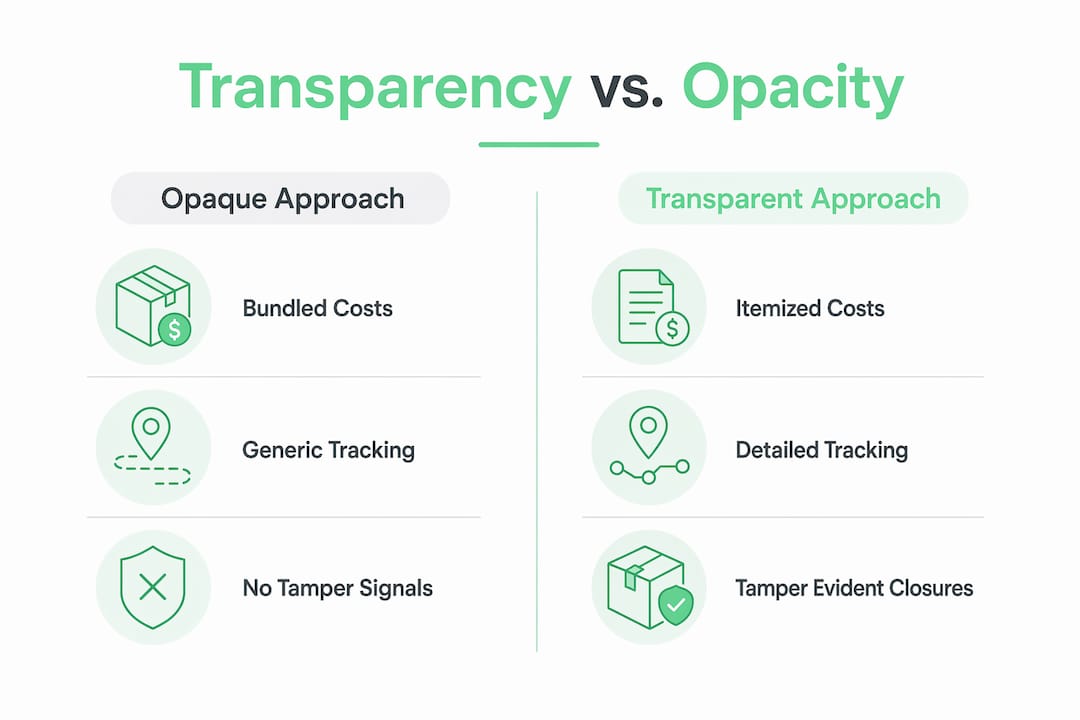
The difference between these two columns is not just operational. It is the difference between a campaign you can learn from and one you simply repeat. You can explore direct mail ROI tracking in detail to build out the measurement framework that matches your reporting needs.
For sensitive or high-value mailings, incorporate tamper-evident closures as delivery integrity signals. These are not aesthetic choices. They are trust mechanisms that reduce recipient disputes and reinforce the message that your brand handles their information and their deliveries with care.
Key takeaways
Transparency in direct mail works because it connects every campaign element to a verifiable outcome, giving marketers the data they need to optimize spend, build recipient trust, and justify investment to stakeholders.
| Point | Details |
|---|---|
| Itemized cost reporting | Break vendor invoices into printing, data, postage, and finishing to enable fair comparisons and catch waste. |
| Data hygiene drives ROI | Clean lists produce 20 to 30% higher response rates and cut wasted spend by up to 25%. |
| Tracking must be contractual | Require documented IMb, QR, and PURL identifiers from vendors to prevent dashboard opacity. |
| Informed Delivery amplifies reach | USPS’s free preview tool reaches 72.9 million users with a 60.1% open rate, adding a digital layer at no extra postage cost. |
| Tamper-evident packaging builds trust | Visible integrity features reduce disputes and signal brand confidence in sensitive mailing categories. |
Why transparency is the competitive edge most direct mail programs are missing
I have reviewed a lot of direct mail programs over the years, and the most common failure mode is not poor creative or bad targeting. It is opacity. Marketers accept a single bundled invoice, trust an estimated delivery window, and measure success by a vague lift in inbound calls. Then they wonder why they cannot get budget approval for the next campaign.
The shift I have seen in high-performing programs is that they treat direct mail like a digital channel in terms of accountability. They want scan data, click data, and delivery confirmation the same way a paid search manager wants impression share and conversion rates. That expectation is now completely achievable. USPS Informed Delivery, IMb tracking, and PURLs give you that level of visibility without adding meaningful cost or complexity.
The mistake I see most often is treating data hygiene as a pre-campaign task rather than a standing practice. Marketers clean their list before a big drop and then let it sit for 18 months. Address decay runs at roughly 10 to 15% annually in most consumer databases. A list that was clean in January is meaningfully degraded by the following fall. The marketers who win on direct mail effectiveness treat list maintenance like they treat their CRM. It is never finished.
The other underused transparency tool is Informed Delivery. Most marketers know it exists. Very few have actually registered a campaign and measured the pre-arrival click data. That gap is a real competitive advantage for anyone willing to spend the 30 minutes it takes to set up a campaign in the USPS portal.
Transparency is not just an ethical posture. It is a performance strategy. The programs that can show exactly what happened, to whom, and when are the programs that get renewed, scaled, and trusted.
— James
How Envypak supports transparent, high-trust direct mail
Building transparency into your direct mail program starts with the physical piece itself. Envypak’s crystal clear envelopes give recipients an immediate visual signal of openness, letting the contents speak before the envelope is even opened. For campaigns where security matters, Envypak’s custom envelopes and mailers can be configured with tamper-evident features that reinforce delivery integrity. Every format is automation-compatible, which means your IMb tracking and USPS Informed Delivery eligibility are preserved from design through delivery. If you are building a campaign that needs to earn trust at first glance, choosing the right envelope is where that work begins.
FAQ
What is transparency in direct mail?
Transparency in direct mail means openly disclosing all campaign costs, data sources, tracking methods, and delivery outcomes to both recipients and internal stakeholders. It includes itemized vendor pricing, verified delivery data via IMb scans, and measurable response tracking through QR codes and PURLs.
How does data hygiene affect direct mail transparency?
Clean, validated mailing data is the foundation of transparent campaign reporting. Accurate list maintenance produces 20 to 30% higher response rates and reduces wasted spend by 15 to 25%, making it easier to report honest ROI to stakeholders.
What is USPS Informed Delivery and why does it matter for transparency?
USPS Informed Delivery is a free digital preview service that reaches 72.9 million subscribers with a 60.1% daily open rate. It adds a measurable digital impression layer to every addressed mail campaign, giving marketers pre-arrival engagement data at no additional postage cost.
How do I make my direct mail vendor accountable for transparency?
Require contractual documentation of every tracking identifier your vendor uses, including IMb numbers, QR code parameters, and PURL structures, with confirmed data export rights. Vague dashboard access without raw data export does not constitute verifiable transparency.
Are tamper-evident mailers worth the added cost?
For financial services, healthcare, and high-value product categories, tamper-evident mailers reduce recipient disputes and reinforce brand trust. The cost premium is typically justified by the reduction in customer service friction and the positive signal it sends about how your brand handles sensitive deliveries.