

Direct Mail Advertising Format Selection: 2026 Guide

Direct mail advertising format selection is the process of matching your mailer type to your campaign’s message, audience, and budget to maximize response. The wrong format wastes print and postage spend. The right one can be the difference between a 1% response and a 5% response on the same list. With all-in production costs ranging from under $0.60 for a postcard to $5.00 or more for a dimensional mailer, format decisions carry real financial weight. This guide gives marketing professionals and business owners a clear framework for choosing formats that perform.
What is direct mail advertising format selection?
Direct mail advertising format selection is the structured process of evaluating mailer types against campaign goals, audience characteristics, and cost constraints before committing to print. The industry term for this discipline is format strategy, and it sits at the intersection of creative planning and media buying. Marketers who skip this step often default to postcards because they are cheap, or to catalogs because they look impressive. Neither instinct is wrong on its own, but format choice without audience data is guesswork.
Mailing list quality determines 40–60% of campaign success. That single fact reframes the entire format decision. A premium dimensional mailer sent to a poorly segmented list will underperform a simple postcard sent to a tightly defined prospect file. Format selection only works when it follows audience and offer definition, not the other way around.
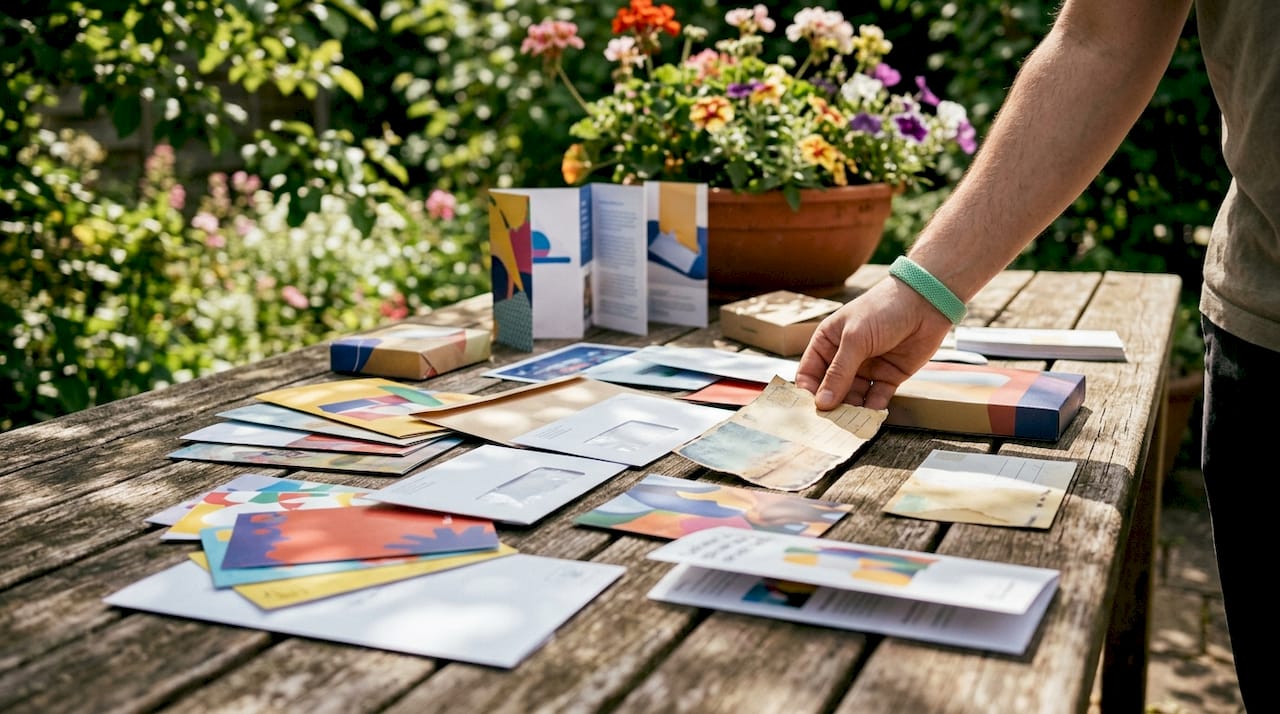
The six core formats in active use are postcards, letters, self-mailers, brochures, catalogs, and dimensional mailers. Each carries a distinct cost profile, engagement mechanic, and best-use case. Understanding those differences is the foundation of any sound direct mail strategy.
What are the main direct mail formats and their costs?
The table below maps each format to its 2026 cost range and primary use case. These figures reflect all-in production and mailing costs per piece.
| Format | Cost per piece | Best use case |
|---|---|---|
| Postcard | Under $0.60 | High-volume awareness, event promotion |
| Letter | $0.60–$1.00 | Personalized offers, donor appeals |
| Self-mailer | $0.60–$1.00 | Product launches, service announcements |
| Small brochure | $0.60–$1.00 | Multi-product overviews, retail promotions |
| Larger brochure or short catalog | $1.00–$1.50 | Seasonal campaigns, mid-range B2B |
| Full catalog | $1.50–$5.00 | E-commerce, high-SKU retail |
| Dimensional mailer | $5.00 and up | High-value B2B prospecting, VIP outreach |
Postcards carry a structural advantage no other format matches: a 100% open rate because there is no envelope to discard. Letters reach 70–80% open rates, while handwritten or handwritten-style pieces hit 90–95%. That gap matters when you are calculating expected response volume before a campaign launches.
Paper stock reinforces message tone but does not drive response on its own. Uncoated stock signals a personal, tactile feel, while duplex stock communicates premium importance. The offer, headline, and call-to-action placement drive response more than paper choice does. Treat stock selection as a supporting decision, not a primary one.
Self-mailers fold and seal without an outer envelope, which reduces production cost and speeds delivery. They work well for service announcements and product launches where the visual needs to unfold in stages. Brochures give you more real estate for product detail but require an outer envelope, which adds cost and one more barrier to engagement.
Pro Tip: If your campaign goal is pure awareness at volume, postcards are the default. If your goal is a considered response from a high-value prospect, a letter or dimensional mailer will outperform on ROI even at five times the cost per piece.
How do audience and goals shape your format choice?
Format selection follows audience definition. That sequence is non-negotiable. A B2C retail campaign targeting past buyers on a warm house list calls for a different format than a B2B campaign targeting CFOs at companies with $50 million or more in revenue.
Consumer audiences respond well to postcards and self-mailers for awareness campaigns. They respond better to personalized letters when the offer requires trust, such as financial services or healthcare. High-net-worth individuals and senior executives respond to formats that signal effort and exclusivity. A dimensional mailer that arrives in a rigid box or tube gets opened because it feels important before the recipient reads a single word.
High-value B2B accounts with contract values of $10,000 or more justify dimensional or premium brochure formats on pure math. If closing one account returns $10,000 and a dimensional mailer costs $8 per piece including postage, sending 200 pieces costs $1,600. One conversion pays for the entire campaign with room to spare.
Mixing formats across a campaign sequence also improves overall results. A blended approach using postcards for first-touch volume and letters or handwritten pieces for warm-list follow-up consistently outperforms single-format campaigns. The postcard creates awareness. The letter closes.
- Consumer warm list: Postcard or self-mailer for first touch, personalized letter for follow-up
- B2B cold prospecting: Letter with a strong offer, dimensional mailer for high-value targets
- High-net-worth individuals: Premium brochure or dimensional mailer with personalized copy
- Reactivation campaigns: Handwritten-style letter or oversized postcard with a time-sensitive offer
Understanding content format types across channels also sharpens format instincts. The same logic that governs which digital content format matches an audience’s intent applies directly to physical mail.
What are the key steps for evaluating and selecting a format?
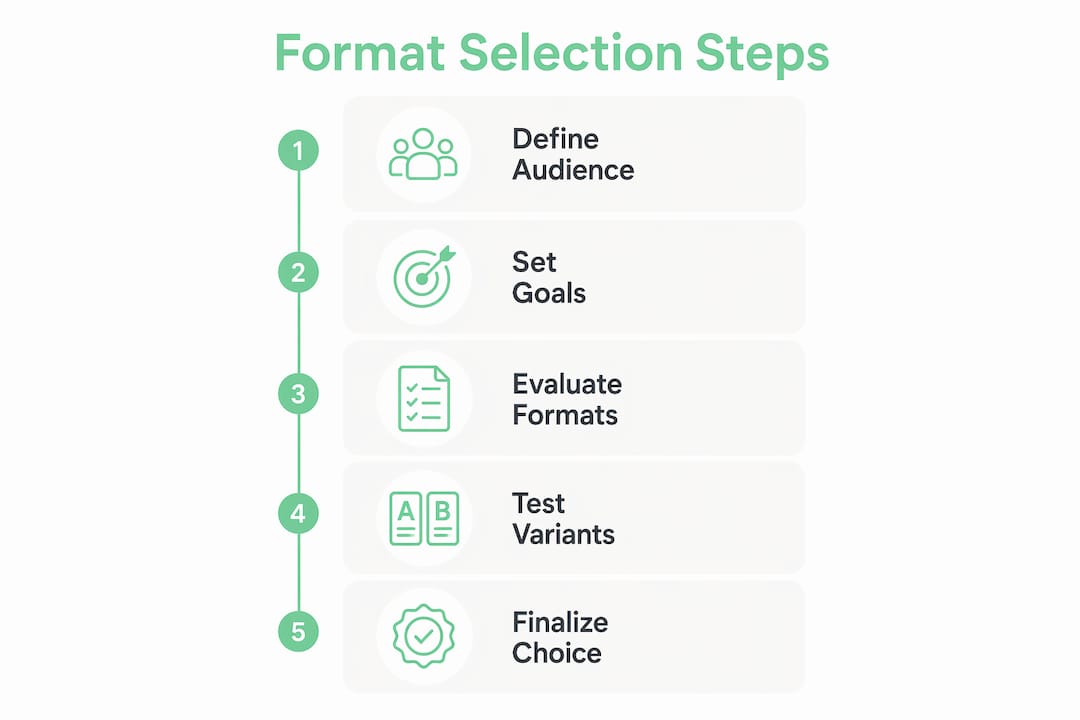
The selection process has a clear sequence. Skipping steps costs money.
- Define your audience and offer first. Know who you are mailing, what you are offering, and what a conversion is worth. This single step determines your maximum cost-per-piece budget.
- Match format to offer value. Low-value, high-volume offers go to postcards or self-mailers. High-value, low-volume offers go to letters, premium brochures, or dimensional mailers.
- Calculate all-in cost per piece. Include design, printing, list rental, and postage. Production costs vary significantly by format, so model the full budget before choosing.
- Test with a small batch before full rollout. Testing 1,000–5,000 pieces before committing to a large run gives you real response data instead of assumptions. Most campaigns that fail at scale would have revealed their weakness at the test stage.
- Build your follow-up sequence before the mail drops. Most direct mail failures trace back to a missing follow-up plan, not a weak format or poor design. Lock in your follow-up email, phone outreach, or retargeting ads before a single piece goes in the mail.
- Process your list through NCOA hygiene. A 30-day campaign timeline with dedicated list hygiene phases, including National Change of Address matching at roughly 94%, reduces waste and improves deliverability.
Pro Tip: Run two format variants in your test batch, not just two creative versions of the same format. A postcard versus a letter test tells you far more than two postcard designs tested against each other.
The comparison below summarizes format tradeoffs for quick reference.
| Format | Pros | Cons |
|---|---|---|
| Postcard | Low cost, 100% open rate, fast production | Limited copy space, no envelope for perceived value |
| Letter | High trust, personalized feel, flexible copy | Envelope barrier, higher cost than postcard |
| Self-mailer | No envelope needed, visual impact | Less personal, can feel promotional |
| Dimensional mailer | Highest engagement, bypasses gatekeepers | Highest cost, slower production |
For deeper guidance on design decisions that affect response, direct mail design best practices cover headline placement, CTA positioning, and format-specific layout rules.
How do high-impact format innovations boost results in 2026?
Standard formats compete in a crowded mailbox. Non-standard formats create a different problem for the recipient: they cannot ignore them.
Dimensional mailers with 3D elements, rigid tubes, or custom boxes bypass mental filters that recipients apply to flat mail. In B2B environments, they also bypass physical gatekeepers. A receptionist who discards a standard envelope will hand-deliver a rigid box to the addressee. That physical escalation is the point.
Oversized formats work on a simpler mechanic. They sit on top of the mail stack instead of inside it. Oversized mailers get noticed because size signals importance before the recipient reads anything. The USPS defines oversized postcards as pieces larger than 4.25 by 6 inches, and they consistently outperform standard-size postcards on response rate for the same offer.
Clear envelopes represent a third category of format innovation. Envypak’s crystal clear mailing envelopes let the recipient see the contents before opening. That transparency removes the uncertainty that causes people to discard unopened mail. When a recipient can see a personalized letter, a gift card, or a premium brochure through the envelope, open rates rise because curiosity is already engaged.
- 3D dimensional mailers: Best for B2B prospecting and VIP reactivation where cost per piece is justified by deal size
- Oversized postcards and flats: Best for consumer campaigns where visual impact at the mailbox matters
- Clear envelopes: Best for campaigns where the contents themselves are the hook, removing the envelope as a barrier
- Interactive mailers: Best for campaigns requiring recipient participation, such as scratch-off offers or pop-up elements
For creative applications of these formats, high-impact mailer designs and direct mail engagement tactics offer practical examples with measurable results. Pairing format innovation with AI-driven content personalization also sharpens targeting at scale, which amplifies the return on premium format investment.
Key Takeaways
Format selection drives direct mail ROI when it follows audience definition, offer value, and a tested sequence rather than budget defaults or creative preference.
| Point | Details |
|---|---|
| Audience first, format second | Define who you are mailing and what a conversion is worth before choosing any format. |
| List quality dominates results | Mailing list quality determines 40–60% of campaign success, outweighing format choice alone. |
| Test before scaling | Run 1,000–5,000 pieces to validate format response before committing to a full campaign budget. |
| Follow-up is non-negotiable | Plan your follow-up email, phone, or retargeting sequence before the mail drops, not after. |
| Non-standard formats break through | Dimensional mailers and clear envelopes bypass gatekeepers and discard behavior that flat mail cannot. |
What I’ve learned from watching marketers choose the wrong format
Format selection mistakes follow a predictable pattern. Marketers pick the format they like visually, or the one that fits the budget without checking whether it fits the audience. A beautifully designed catalog sent to a cold B2B list is expensive noise. A plain letter sent to a warm consumer list with a strong offer will outperform it every time.
The insight that changed how I think about this: the format is a delivery mechanism, not the message. Marketers who obsess over paper stock and print finish while neglecting offer clarity and follow-up planning are optimizing the wrong variable. I have seen campaigns with mediocre design and a sharp offer outperform campaigns with award-winning creative and a vague call to action.
Testing is where most campaigns fail to invest. Running two format variants on a small batch feels like extra work before the “real” campaign. In practice, it is the only way to know whether your audience responds better to a postcard or a letter. Assumptions built on industry averages will cost you more than a 2,000-piece test ever will.
The marketers who consistently get direct mail right treat format selection as a data problem, not a creative one. They define the audience, model the economics, test at small scale, and adapt. Creativity matters inside that framework. Outside it, creativity is just expensive decoration.
— James
Envypak’s clear mailer solutions for direct mail campaigns
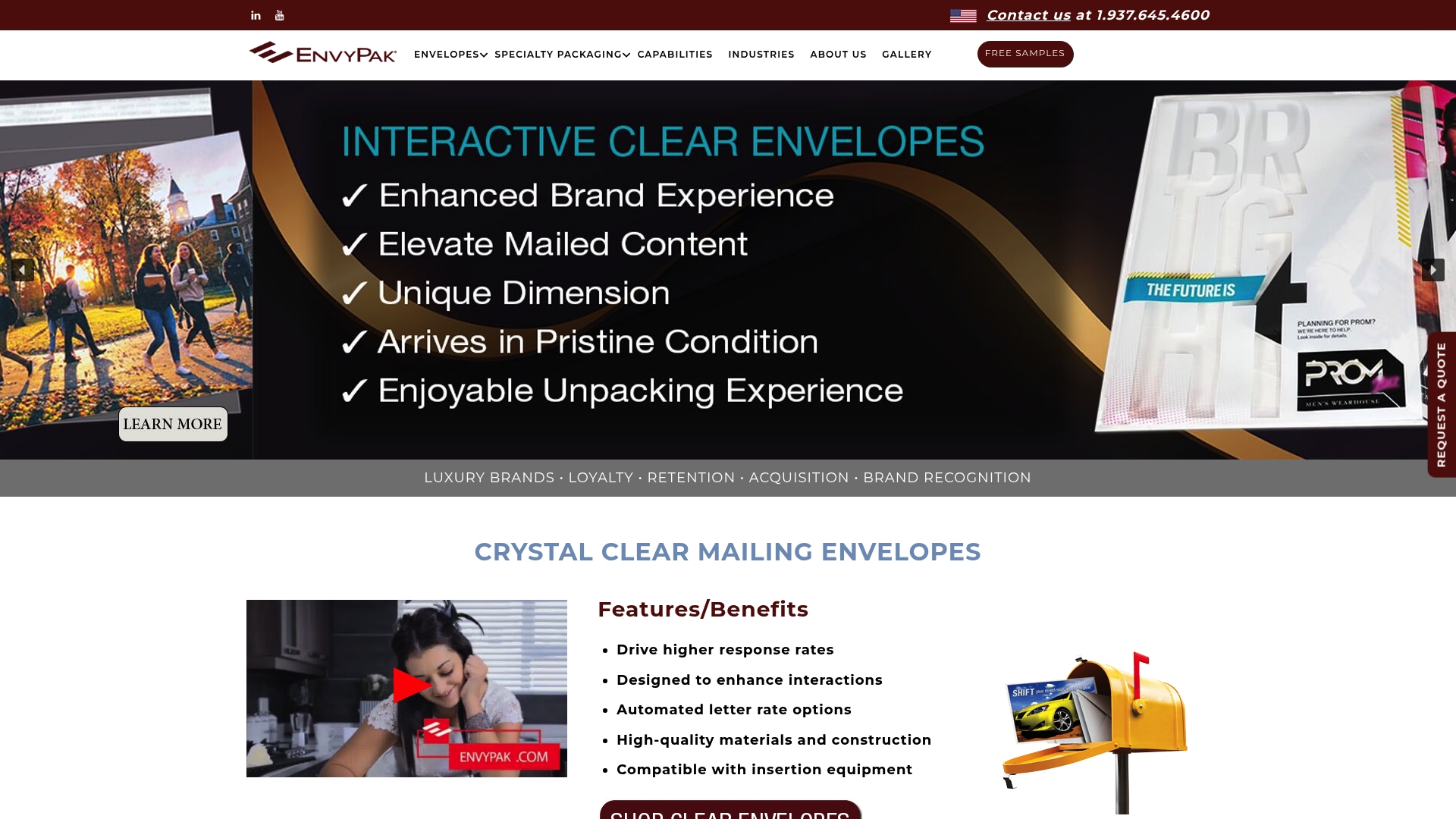
Envypak’s crystal clear envelopes give your direct mail pieces a visibility advantage the moment they land in the mailbox. Recipients see the contents before they decide whether to open, which removes the discard reflex that flat, opaque mail triggers. Envypak envelopes are built from eco-friendly, automation-compatible materials, so they move through postal processing without special handling costs. For campaigns where the contents are the hook, such as personalized letters, gift cards, or premium brochures, a clear envelope turns the packaging into part of the pitch. Explore custom envelope options to find the right size and format for your next campaign.
FAQ
What is direct mail advertising format selection?
Direct mail advertising format selection is the process of choosing the right mailer type based on your campaign goals, audience profile, and budget. The format should follow audience and offer definition, not precede it.
Which direct mail format has the highest open rate?
Postcards carry a 100% open rate because there is no envelope to discard. Handwritten or handwritten-style letters reach 90–95%, while standard letters average 70–80%.
How much does direct mail cost per piece in 2026?
All-in production and mailing costs range from under $0.60 for postcards to $5.00 or more for dimensional mailers. Letters, self-mailers, and small brochures typically fall in the $0.60–$1.00 range.
How many pieces should I test before a full campaign rollout?
Test with 1,000–5,000 pieces before scaling. That sample size generates reliable response data and reveals format performance without committing the full campaign budget.
Why do most direct mail campaigns fail?
Most direct mail failures trace back to a missing follow-up plan rather than poor design or format choice. Locking in follow-up email, phone outreach, or retargeting ads before the mail drops is the single highest-impact step most marketers skip.