

Boost Direct Mail ROI Strategies That Work in 2026

Direct mail ROI is defined as the measurable return generated from physical mail campaigns relative to total production and postage costs. The best strategies to boost direct mail ROI combine precise audience targeting, variable data personalization, format selection, and closed-loop measurement. The average direct mail response rate in 2026 sits at 4.4%, compared to 0.12% for email. That gap is not an accident. It reflects the physical medium’s ability to command attention in ways digital channels cannot. Marketing teams that apply the right mix of list quality, creative format, and tracking discipline consistently outperform those that treat direct mail as a set-and-forget channel.
How to boost direct mail ROI strategies with the right list
List quality drives direct mail ROI more than any other single factor. A brilliant creative piece mailed to the wrong audience produces nothing. Response rates below 0.5% after multiple campaign touches almost always point to a list problem, not a creative problem. That benchmark is the clearest signal a marketing team can get that the audience, not the message, needs fixing.

Build lists with stacked motivation criteria
Single-criterion targeting, such as selecting by zip code alone, produces weak lists. Stacking multiple criteria, such as geography, purchase history, income band, and recency of behavior, identifies recipients with overlapping motivations to respond. Rigorous list hygiene, regular data refresh, and stack-based audience construction find the most motivated segments. The result is a smaller, more responsive list that costs less to mail and converts at a higher rate.
Apply NCOA processing and CASS certification
Undeliverable addresses waste postage and inflate your cost per response. NCOA (National Change of Address) processing updates records when recipients move. CASS (Coding Accuracy Support System) certification validates address formats before mail goes to print. Prioritizing list hygiene and CASS certification before investing in creative design prevents wasted spend on mail that never reaches a real person.
- Pull your raw list from your CRM or data provider.
- Run NCOA processing to update moved addresses.
- Submit the list for CASS certification to validate deliverability.
- Apply segmentation criteria to isolate your highest-motivation segments.
- Set aside a hold-out control group of roughly 10% before mailing.
Pro Tip: Refresh your list every 90 days. Address data degrades faster than most teams expect, and a stale list quietly erodes ROI with every campaign.
What personalization techniques actually increase direct mail response?
Personalization that moves the needle goes well beyond printing a recipient’s first name at the top of a letter. Effective personalization adapts the entire message, including the offer, the image, and the call to action, based on where the recipient sits in the customer lifecycle. A reactivation offer sent to a lapsed customer looks nothing like an upsell offer sent to an active buyer. Treating those two audiences identically is one of the most common and costly mistakes in direct mail.
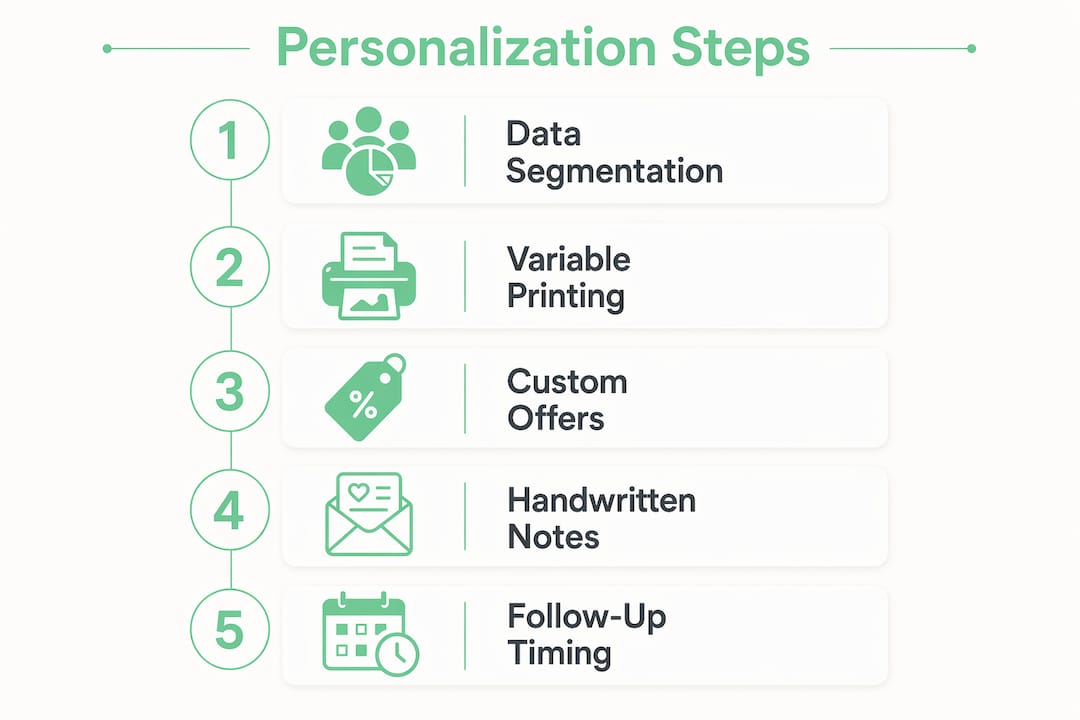
Variable data printing (VDP) makes this level of personalization operationally practical. Variable data printing doubles ROI by enabling tailored offers and reducing wasted mail spend. Each piece in a VDP run can carry a unique image, offer, and message while running through the same print production process.
Key personalization techniques that increase response rates:
- Lifecycle segmentation: Separate audiences by onboarding stage, churn risk, or purchase frequency before writing a single word of copy.
- Offer matching: Send discount offers to price-sensitive segments and premium or exclusive offers to high-value customers. Research shows 44% of marketers find discounts most effective, while 31% find free gifts most effective.
- PURLs (personalized URLs): Give each recipient a unique web address that pre-populates their information and tracks their visit back to the specific mail piece.
- Unique promo codes: Assign one code per recipient or segment to close the attribution loop between mail and purchase.
- Image personalization: Match the hero image to the recipient’s known preferences or past purchases.
Pro Tip: If your personalization strategy only changes the name field, you are not personalizing. You are mail merging. Real personalization changes the offer and the reason to act.
Which direct mail formats generate the highest response rates?
Format selection is the second most controllable lever after list quality. Switching from standard postcards to letters or handwritten-style mail pieces can increase response rates by 30–100%. That range is wide because the lift depends on the audience and the offer, but even the low end of that range represents a significant return on a modest format upgrade.
Three-dimensional mail pieces, specialty packaging, and interactive mailers create a physical experience that flat mail cannot replicate. A package that requires the recipient to open, unfold, or interact with it generates more engagement time than a postcard that can be discarded in seconds. Engagement time correlates directly with recall and response.
| Format type | Best use case | Response lift potential |
|---|---|---|
| Standard postcard | High-volume, low-cost awareness | Baseline |
| Letter with envelope | Offers requiring explanation or trust | Moderate |
| Handwritten-style piece | Re-engagement, high-value prospects | High |
| 3D or specialty package | Premium offers, event invitations | Highest |
Format also signals value. A thick envelope or a box communicates that what is inside is worth the recipient’s time before they even open it. Matching format to campaign intent matters. A $10 coupon does not need a specialty package. A $5,000 B2B proposal does.
Creative design choices that improve engagement:
- Use a teaser line on the outer envelope to create curiosity before the piece is opened.
- Keep the primary call to action above the fold on any letter or insert.
- Use color contrast to direct the eye toward the response mechanism.
- Explore creative direct mail ideas that pair visual impact with clear messaging.
Poor coordination and slow production loops dilute campaign effectiveness. Approving creative and list simultaneously, rather than sequentially, cuts weeks off production timelines.
How do you measure direct mail success and optimize over time?
Measuring direct mail success requires tracking three core metrics: response rate, conversion rate, and return on ad spend (ROAS). Response rate tells you how many recipients took any action. Conversion rate tells you how many of those actions produced revenue. ROAS tells you whether the campaign paid for itself. Marketing teams that focus on these three metrics rather than vanity metrics build the executive buy-in needed to sustain direct mail budgets.
Attribution is the hardest part of measuring direct mail success. Physical mail does not carry a pixel. The solution is to build tracking into the piece itself.
- Assign unique QR codes to each campaign or segment. QR codes with brand logos increase engagement by 12% compared to plain codes.
- Use PURLs to track individual recipient visits and tie them to mail records.
- Set up unique phone numbers per campaign using call tracking platforms.
- Create a hold-out control group of 10% who receive no mail, then compare their purchase behavior to the mailed group.
- Run A/B tests on one variable at a time. Testing one variable with a minimum of 1,000 pieces per test cell is necessary for statistically reliable results.
| Metric | Formula | What it tells you |
|---|---|---|
| Response rate | Responses ÷ pieces mailed | Audience and creative fit |
| Conversion rate | Conversions ÷ responses | Offer and landing page strength |
| ROAS | Revenue ÷ total mail spend | Overall campaign profitability |
| Cost per response | Total spend ÷ responses | Efficiency vs. prior campaigns |
Track response decay over time. Most direct mail responses arrive within the first two weeks of delivery. Planning a second touch to arrive as the first wave decays captures a second wave of conversions from the same list investment.
How does combining direct mail with digital channels amplify ROI?
Direct mail and digital advertising reinforce each other when coordinated around the same audience and timing. Combining direct mail with targeted digital ads can increase sales lift by over 80%. That figure reflects what happens when a recipient sees a brand in their mailbox and then encounters the same message in their social feed within days.
Practical ways to coordinate direct mail with digital:
- Retargeting ads: Upload your mailing list to Meta Ads or similar platforms to serve display ads to the same audience during and after mail delivery.
- Email follow-up: Send a follow-up email two to three days after estimated mail delivery to reinforce the offer.
- SMS reminders: For audiences who have opted in, an SMS reminder sent on the offer deadline date recovers late responders.
- Digital response data feeding list refinement: Segment recipients who clicked digital ads but did not convert, then mail them a stronger offer.
Timing is the critical variable. Digital ads served before mail lands prime the audience. Ads served after mail lands reinforce the message. Both approaches outperform digital-only campaigns because the physical piece creates a memory anchor that digital impressions alone cannot.
Key Takeaways
The most effective approach to direct mail ROI combines list hygiene, lifecycle personalization, format selection, closed-loop attribution, and coordinated digital follow-up.
| Point | Details |
|---|---|
| List quality is foundational | Response rates below 0.5% signal a list problem; fix data before fixing creative. |
| Personalization requires context | Variable data printing doubles ROI when offers match customer lifecycle stage. |
| Format signals value | Switching to letters or specialty packaging can lift response rates by 30–100%. |
| Measurement closes the loop | Use QR codes, PURLs, and control groups to attribute revenue to specific mail pieces. |
| Digital amplifies mail | Pairing direct mail with targeted digital ads can increase sales lift by over 80%. |
What I’ve learned from watching direct mail campaigns succeed and fail
The teams that consistently get strong returns from direct mail share one habit: they treat the list as the product. Creative gets all the attention in planning meetings. List hygiene gets none. That is backwards. I have watched beautifully designed campaigns mail to addresses that had not been updated in three years, and the results were predictably poor. The creative was not the problem.
The second pattern I see is teams that test too many variables at once. They change the offer, the format, and the headline in the same test, then cannot explain why one version outperformed the other. Testing one variable at a time with adequate sample sizes is not a suggestion. It is the only way to build knowledge that compounds across campaigns.
The shift I find most exciting right now is the move from static personalization to dynamic personalization driven by real behavioral data. Marketers who connect their CRM purchase history to their print production workflow are producing mail pieces that feel genuinely relevant. That relevance is what drives the direct mail engagement numbers that justify the channel to skeptical executives.
My honest advice: run your first control group test this quarter. The incremental lift data you generate will be the most persuasive budget argument you can make.
— James
How Envypak helps marketing teams put these strategies into practice
Marketing teams that apply the strategies in this article need packaging that matches their ambition. Envypak’s crystal clear mailing envelopes give direct mail pieces immediate visual impact before the recipient even opens the package. The contents are visible through the envelope, which creates curiosity and reduces the chance of the piece being discarded as junk mail.
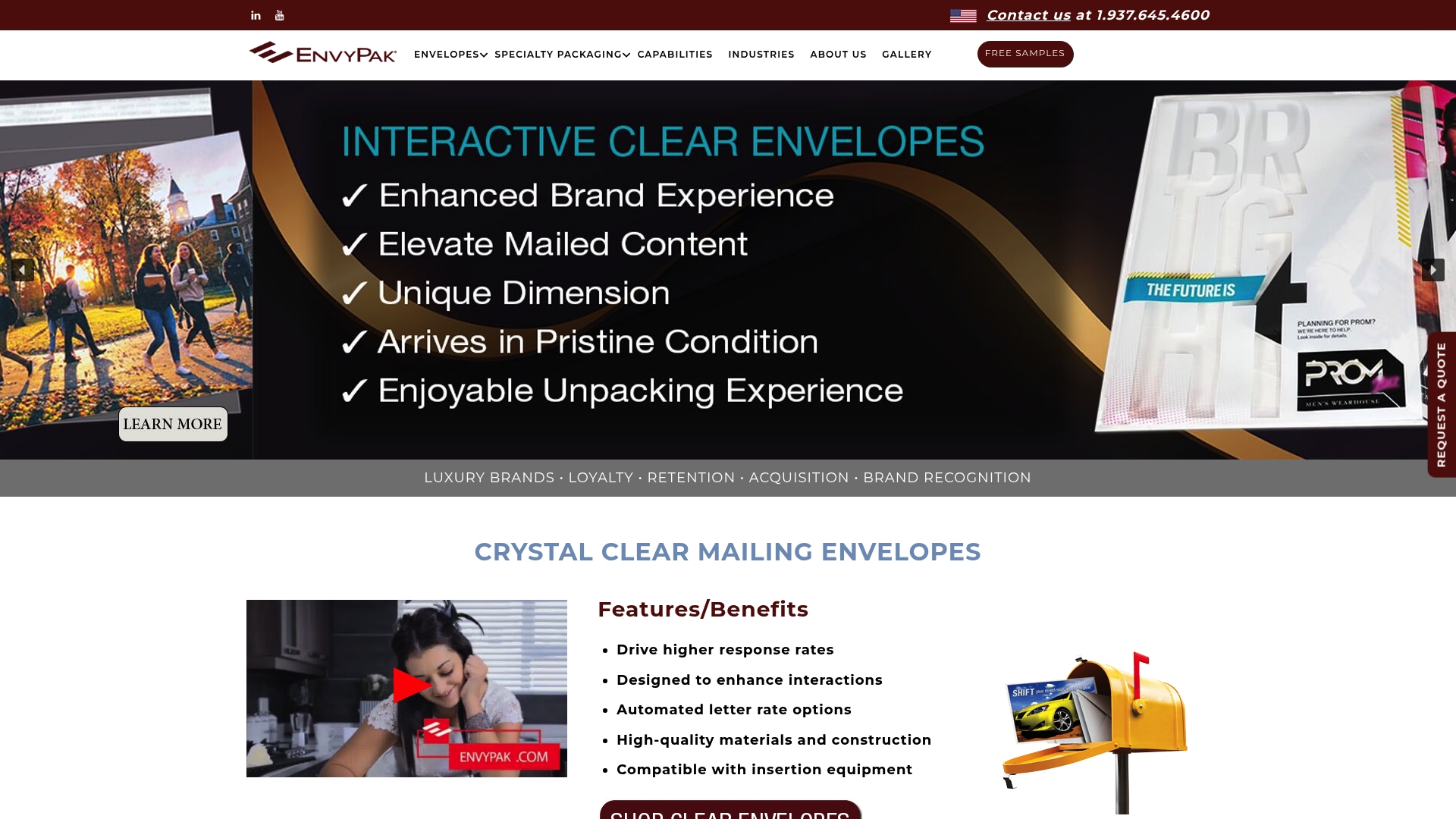
Envypak’s envelopes are automation compatible, which means they work with high-volume production runs without slowing fulfillment. The materials are eco-friendly and recyclable, which aligns with the sustainability expectations of modern consumers. For campaigns that call for specialty formats, Envypak’s specialty packaging options give marketing teams the format differentiation that drives the response rate lifts covered in this article. Visit Envypak to find the packaging format that fits your next campaign.
FAQ
What is a good response rate for direct mail in 2026?
The average direct mail response rate in 2026 is 4.4%. Rates below 0.5% after multiple touches typically indicate a list quality problem rather than a creative issue.
How does variable data printing increase direct mail ROI?
Variable data printing tailors the offer, image, and call to action for each recipient based on their data profile. Research shows it can double ROI by reducing wasted mail spend and increasing message relevance.
How many pieces do I need for a valid A/B test?
A minimum of 1,000 pieces per test cell is required for statistically reliable results. Testing fewer pieces produces data that cannot be trusted to guide future decisions.
What tracking tools work best for measuring direct mail success?
QR codes with brand logos, personalized URLs (PURLs), and unique phone numbers per campaign are the most practical tools for closing the attribution loop between mail delivery and conversion.
Does combining direct mail with digital advertising improve results?
Coordinating direct mail with targeted digital ads can increase sales lift by over 80%. Timing digital ads to run during and after mail delivery produces the strongest combined effect.