

What Is a Mailing House Service? A Guide for Marketers

A mailing house service is a company that manages every step of a mass mailing campaign on behalf of a business, from document production and personalization through to sorting, postage, and final delivery. These providers handle direct mail marketing, transactional mail, and compliance documents such as billing statements, insurance notices, and regulatory filings. Many carry certifications like SOC 2 and HIPAA, which matter most when sensitive data moves through the production process. For marketing professionals and business owners, understanding what a mailing house does is the first step toward running direct mail campaigns that are faster, cheaper, and more compliant than anything an in-house team can execute alone.
What specific services does a mailing house provide?
Outsourcing mailing services consolidates sorting, franking, dispatch, fulfillment, and returns under one managed provider. That single point of accountability removes the administrative burden that typically falls on internal marketing or operations teams. The full scope of what a mailing house does is broader than most business owners expect.
Document production and personalized printing
Mailing houses produce printed materials at scale using digital printing technology, including variable data printing. Variable data printing lets each piece carry a unique name, offer, or image without slowing the production line. A retailer sending 50,000 catalogs can print each one with the recipient’s first name and a product recommendation based on past purchases.

Insertion, folding, polywrapping, and labeling
After printing, mailing houses fold documents, insert them into envelopes, apply labels, and polywrap items that need weather protection. These tasks run on automated equipment that processes thousands of pieces per hour. Manual handling at that volume would be prohibitively slow and expensive for most businesses.
Address management and list hygiene
Mailing list cleansing, deduplication, and data management are core services that improve deliverability and protect campaign ROI. Dirty address data generates undeliverable mail, which wastes postage and can trigger USPS penalties. A mailing house runs your list through NCOA (National Change of Address) databases and removes duplicates before a single piece goes to press.
- Document production: Digital and offset printing with variable data capability
- Personalization: Name, offer, and image customization at the individual piece level
- Insertion and assembly: Automated folding, stuffing, and sealing
- Polywrapping: Protective wrapping for catalogs, magazines, and oversized mailers
- Address management: NCOA processing, deduplication, and format standardization
- Postage and dispatch: Sorting, franking, and carrier handoff
- Fulfillment and returns: Inventory management and return mail processing
Pro Tip: Ask your mailing house for a sample address hygiene report before your first campaign. The percentage of undeliverable addresses in your existing list will tell you exactly how much postage you have been wasting.
How do mailing houses work with postage and cost savings?
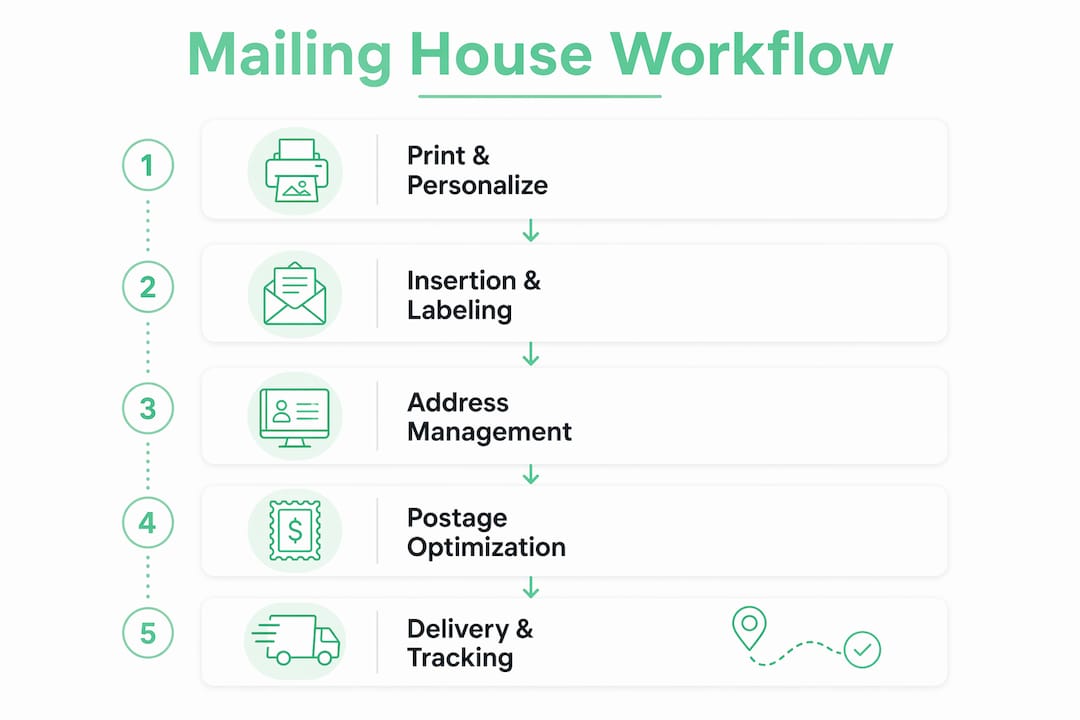
Postage is typically the largest single cost in a direct mail campaign. Mailing houses reduce that cost through two mechanisms: bulk rate access and commingling.
Bulk postage rates and USPS commingling
Mailing houses leverage USPS bulk postage rates and commingling to give even small businesses access to automation discounts that are impossible to reach individually. Commingling means the provider combines mail volumes from multiple clients into a single presorted stream. That combined volume qualifies for deeper USPS discounts than any single client could achieve alone.
Franking vs. stamps
Managed mailing providers apply postage via franking machines, which reduces per-item cost and administrative overhead compared to stamps. Franking is standard practice for any business sending more than a handful of letters per day. The machine prints the exact postage value directly onto the envelope, eliminating overpayment and the labor cost of applying individual stamps.
Presorting and automation discounts
Presorting mail by ZIP code before handing it to USPS qualifies the mailing for automation discounts. Mailing houses presort as a standard step in their workflow. A business mailing 10,000 pieces independently would need to sort and bundle that mail manually to qualify for the same discount.
| Postage method | Who qualifies | Key benefit |
|---|---|---|
| Retail stamps | Any sender | No minimum volume required |
| Metered/franked mail | Businesses with franking machines | Reduced per-piece cost |
| USPS bulk/presort rates | High-volume mailers (typically 200+ pieces) | Significant per-piece discount |
| Commingled mail | Mailing house clients | Deepest discounts via pooled volume |
Pro Tip: If your campaign volume is under 5,000 pieces, commingling through a mailing house is almost always cheaper than applying for your own USPS bulk mail permit, which carries annual fees and minimum volume requirements.
What are the compliance and security considerations?
Compliance is where mailing house selection becomes a risk management decision, not just a vendor choice. Businesses in healthcare, finance, education, and legal services send mail that is governed by federal regulations. Choosing the wrong provider can expose the business to audit failures and data breach liability.
Matching certifications to your industry
Compliance documents require providers with certifications relevant to the document type, such as HIPAA for healthcare and FERPA for education. A hospital sending patient statements needs a mailing house that holds HIPAA certification, not just one that claims to handle sensitive mail. The certification proves the provider has audited controls over how data is stored, printed, and destroyed.
Securing the same compliance certifications as the client is critical for mailing house vendors to pass audits and satisfy regulators. Businesses frequently underestimate this requirement. When a regulator audits your data handling, your mailing vendor’s practices are part of the review.
Key certifications to verify
- SOC 2: Covers data security controls for financial and general business data
- HIPAA: Required for any provider handling protected health information
- FERPA: Applies to providers processing student education records
- PCI DSS: Relevant when payment card data appears in mailing documents
Data security during production
A compliant mailing house restricts access to print floors, uses encrypted file transfer for client data, and shreds or securely destroys all printed waste. These controls prevent sensitive information from leaving the facility on a discarded test sheet. Ask any prospective vendor for their data destruction policy in writing before signing a contract.
How can mailing house services enhance marketing and customer engagement?
A mailing house does more than move paper. It gives marketing teams the production infrastructure to run campaigns that would be impossible to execute in-house at any meaningful scale.
Variable data printing and personalization
Mailing houses provide personalized direct mail through variable data printing and targeted segmentation, which increases response rates and marketing ROI beyond what generic bulk mail achieves. Personalization goes beyond inserting a first name. A financial services firm can print a different product offer on each piece based on the recipient’s account tier, location, or recent activity.
Personalized content improves conversion rates across marketing channels, and direct mail is no exception. When a recipient receives a piece that speaks directly to their situation, the response rate climbs.
Targeted list segmentation
Mailing houses work with your customer data to segment lists by geography, purchase history, demographics, or behavioral signals. Segmentation means a single campaign can carry five different messages to five different audience groups, all produced and mailed in one production run. That efficiency is what separates a mailing house from a local print shop.
Here is a practical sequence for building a targeted direct mail campaign through a mailing house:
- Define your audience segments based on data you already hold: purchase history, location, or engagement level.
- Clean and validate your mailing list using the provider’s NCOA and deduplication tools before production begins.
- Brief the creative team on variable data fields so the design accommodates personalized text and image zones.
- Approve a physical proof of each version before the full run goes to press.
- Schedule the mail drop to align with your broader campaign calendar, including email and digital touchpoints.
- Track response rates by version using unique phone numbers, URLs, or QR codes printed on each piece.
Multi-channel integration
Mailing houses increasingly coordinate with digital marketing solutions to create campaigns where physical mail and digital channels reinforce each other. A direct mail piece can carry a QR code that drives the recipient to a personalized landing page. That connection between physical and digital touchpoints lifts overall campaign performance. For examples of how this works in practice, creative direct mail campaigns that combine physical and digital elements consistently outperform single-channel approaches.
Key Takeaways
A mailing house service reduces direct mail costs, improves compliance, and enables personalization at a scale no in-house team can match without specialized equipment and vendor certifications.
| Point | Details |
|---|---|
| End-to-end management | Mailing houses handle printing, addressing, sorting, postage, and returns in one workflow. |
| Postage savings via commingling | Pooling client mail volumes unlocks USPS bulk discounts unavailable to individual senders. |
| Compliance certifications matter | Match your vendor’s certifications (SOC 2, HIPAA, FERPA) to your industry’s regulatory requirements. |
| Personalization drives response | Variable data printing lets each piece carry a unique message, lifting engagement beyond generic bulk mail. |
| List hygiene protects ROI | Address cleansing and deduplication before production prevents wasted postage and USPS penalties. |
What I’ve learned from watching businesses get mailing houses wrong
Most businesses treat mailing house selection like buying office supplies. They compare price per piece, pick the lowest number, and sign a contract. That approach works fine until a compliance audit arrives or a campaign mails to 8,000 outdated addresses.
The single biggest mistake I see is skipping the certification check. A vendor can print beautifully and deliver on time, but if they lack SOC 2 or HIPAA certification and your industry requires it, you own the liability. Regulators do not accept “our vendor didn’t tell us” as a defense. Verify certifications before you share a single data file.
The second mistake is treating the mailing house as a production vendor rather than a campaign partner. The best providers will flag list quality problems, suggest better presort strategies, and push back on creative that won’t run cleanly through automated equipment. If your vendor never asks questions about your campaign goals, that is a warning sign.
Cost transparency is the third area where things go wrong. Postage, data processing, and fulfillment are often billed separately from the base print price. Get a fully itemized quote that covers every production step, including address cleansing, franking, and return mail handling. A low headline price that hides postage costs will always disappoint.
The mailing houses worth working with treat your campaign data as carefully as your own IT team would. They have documented data destruction policies, restricted print floor access, and encrypted file transfer protocols. Those details are not bureaucratic overhead. They are the difference between a vendor and a partner.
— James
How Envypak supports your direct mail campaigns
The envelope your mail arrives in shapes the recipient’s first impression before they read a single word. Mailing house production quality means nothing if the outer packaging undersells the content inside.
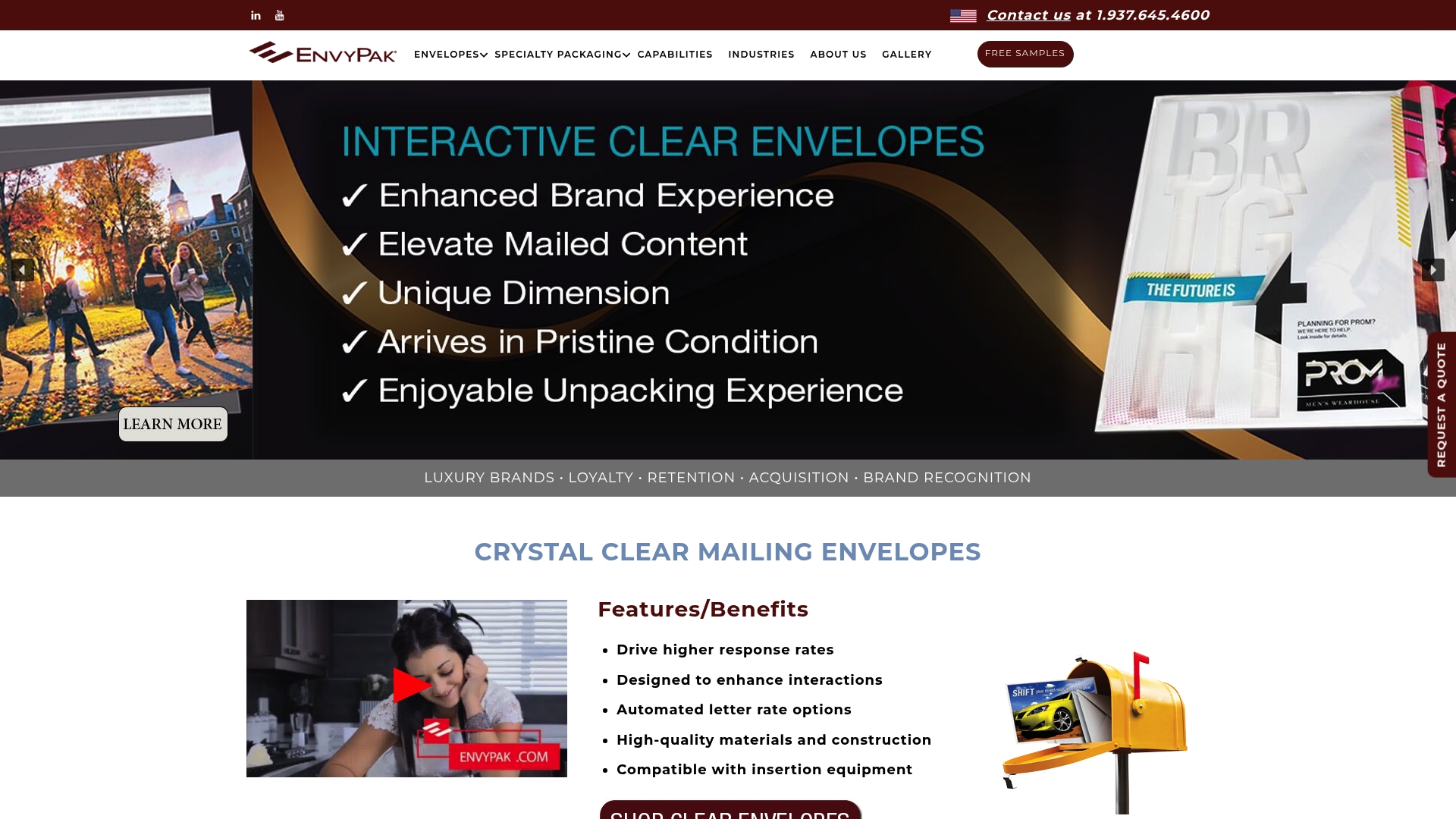
Envypak’s crystal clear polypropylene envelopes are built for automation compatibility, so they run cleanly through mailing house equipment without jams or rejects. The transparent design puts your printed piece on display before the envelope is even opened, which directly supports open rates. Envypak also offers custom envelopes and mailers designed to complement professional mailing house workflows, along with interactive mailers that create engagement opportunities the moment the piece lands in a recipient’s hands. All materials are eco-friendly and reusable, aligning with sustainability goals that matter to both brands and their customers.
FAQ
What is a mailing house service in simple terms?
A mailing house service is a company that handles the full production and delivery process for large-scale mail campaigns, including printing, addressing, sorting, and postage, on behalf of a business.
How does a mailing house reduce postage costs?
Mailing houses combine mail volumes from multiple clients through a process called commingling, which qualifies the pooled mail for USPS bulk and automation discounts that individual businesses cannot access on their own.
What certifications should a mailing house hold?
The required certifications depend on your industry. Healthcare mailers need a HIPAA-certified provider, education mailers need FERPA compliance, and businesses handling financial data should require SOC 2 certification from their vendor.
What is the difference between a mailing house and a standard print shop?
A print shop produces printed materials. A mailing house manages the entire downstream process after printing, including address validation, presorting, postage application, carrier handoff, and returns handling.
Can small businesses benefit from mailing house services?
Small businesses benefit most from commingling, since they cannot qualify for USPS bulk rates independently. A mailing house gives a business mailing 500 pieces access to the same postage discounts as a company mailing 500,000.