

Retargeting Customers via Direct Mail: 2026 Guide

Retargeting customers via direct mail is the practice of sending personalized physical mail to recent website visitors who did not convert, using identity resolution technology to match anonymous browsers to real household addresses. Direct mail achieves a 161% ROI, far outpacing email at 93% and social media at 81%. That gap exists because physical mail lands in a less saturated environment than a digital inbox. 95% of marketers report that aligning direct mail with digital channels improves campaign performance. When you combine the reach of online advertising with the tangibility of physical mail, you create a multi-channel sequence that is genuinely hard to ignore.
What does retargeting customers via direct mail actually require?
Direct mail retargeting, also called DMRT (Direct Mail Retargeting), is not simply mailing a list you already own. It requires three distinct layers: data infrastructure, postal compliance, and creative assets.
Data and identity resolution

Your CRM alone cannot power a DMRT campaign. Most website visitors never submit a form or log in, so their identity is unknown. Bridging anonymous visitors to physical addresses requires specialized third-party identity resolution technology that matches device signals to household records while staying within privacy regulations. Without this layer, you are mailing only to people you already know, which defeats the purpose.
List hygiene and postal compliance
Once you have a mailing list, it must be clean. USPS requires NCOA processing (National Change of Address) for presort mail discounts. Skipping this step means 8–12% of your list is likely outdated, sending mail to wrong addresses and burning budget. NCOA processing should run on any list not refreshed within the past 12 months.
Creative assets and offer development
Your mail piece needs a clear, deadline-bound offer. Generic mailers without urgency are, as direct mail practitioners put it, expensive paper. The offer must match the intent signal that triggered the mail. A visitor who browsed a product page needs a different message than one who abandoned a cart.
- Visitor tracking pixel installed on your website
- Third-party identity resolution partner selected and contracted
- NCOA processing scheduled before every send
- Offer copy with a specific deadline and call to action
- Print-ready creative files in the correct format for your mail piece
Pro Tip: Run your list through NCOA processing at least 48 hours before your print deadline. Last-minute address corrections can delay your entire mail drop.
How to execute a direct mail retargeting campaign step by step
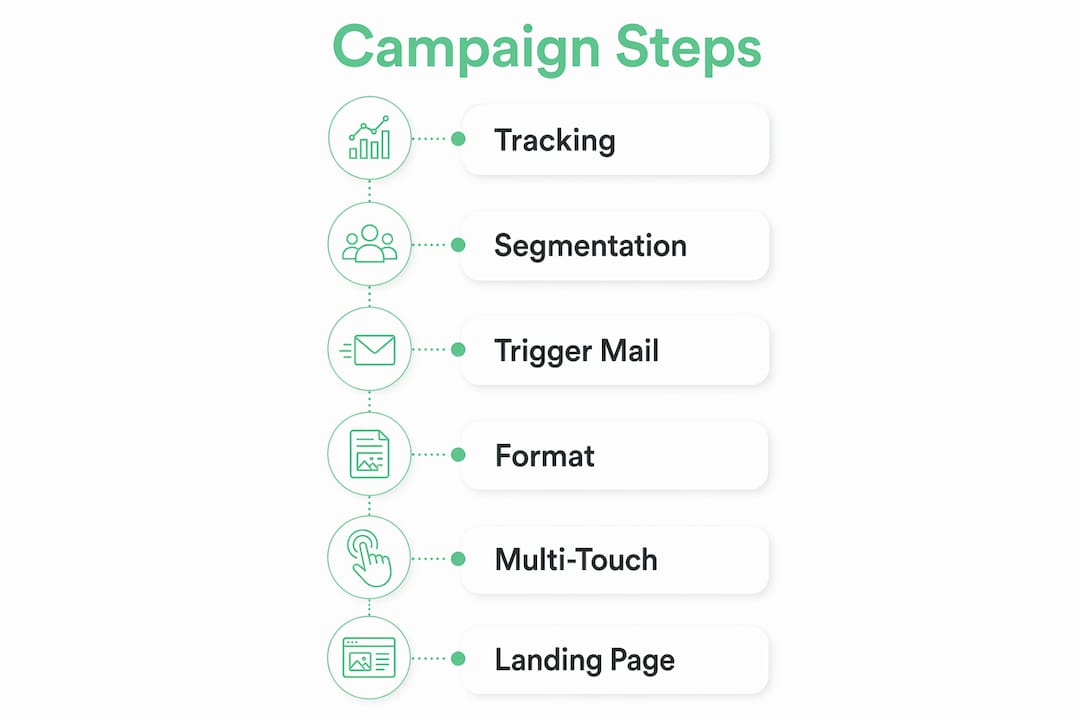
Execution follows a logical sequence. Each step builds on the one before it, and skipping any step creates gaps that hurt your results.
Step 1: Install visitor tracking and connect identity resolution
Place a tracking pixel on your website before you do anything else. The pixel captures behavioral signals from visitors. Your identity resolution partner then matches those signals to physical mailing addresses. This match typically covers a portion of your total visitors, not all of them, so set realistic volume expectations upfront.
Step 2: Segment your audience by behavior
Not every visitor deserves the same mail piece. Segment by the pages visited, time spent, and actions taken. A visitor who viewed a pricing page is closer to a purchase decision than someone who read a blog post. Personalizing mail content dynamically based on that behavior consistently outperforms generic messaging. Segmentation is where most campaigns either win or lose before a single piece is printed.
Step 3: Trigger mail within 24–48 hours of the visit
Speed matters in DMRT. The goal is to reach the prospect while your brand is still fresh. Mail triggered rapidly within days of a website visit performs significantly better than mail sent weeks later. Work with a print and mail partner who can process triggered sends on a daily or near-daily basis, not on a weekly batch schedule.
Step 4: Choose your mail format strategically
Different formats serve different stages of the funnel. Postcards work well for top-of-funnel awareness and quick offers. Letter packages with inserts carry more detail for considered purchases. Premium formats, such as oversized mailers or pieces in crystal-clear envelopes, command attention at the mailbox before the recipient even opens them. See high-impact mailer designs for format options matched to campaign goals.
Step 5: Build a multi-touch sequence with rotating formats
A single mail piece rarely closes a sale. Plan a sequence of two to four touches. Rotating mail formats across multiple touches, such as a postcard followed by a letter followed by a premium piece, avoids mail fatigue and keeps the message feeling fresh. Sending the same format repeatedly produces diminishing returns with each additional touch.
Step 6: Connect mail to a digital landing page
Every mail piece should drive recipients to a dedicated landing page, not your homepage. Use a personalized URL (PURL) or a QR code to connect the physical piece to a digital destination. This creates a trackable path from mailbox to conversion. Automating direct mail campaigns with triggered sends and digital landing pages also reduces manual workload significantly.
Pro Tip: Test two versions of your offer on the first touch. Split your audience 50/50 between a percentage discount and a dollar-amount discount. The winner informs every subsequent touch in the sequence.
| Format | Best use case | Typical cost tier |
|---|---|---|
| Postcard | Quick offers, top-of-funnel awareness | Low |
| Letter with insert | Considered purchases, detailed messaging | Medium |
| Oversized or premium mailer | High-value prospects, re-engagement | High |
| Clear envelope package | Brand visibility, premium positioning | Medium to high |
How do you measure and optimize direct mail retargeting campaigns?
Measurement is where most direct mail campaigns fall short. Marketers who skip tracking setup before printing have no way to verify what worked.
Key metrics to track
Response rate, cost per acquisition, and ROI are the three numbers that matter most. Direct mail response rates average 4.4%, which is 37 times higher than the 0.12% average for email. House-file campaigns can reach response rates as high as 15.6%. Knowing your baseline lets you judge whether a campaign is performing or underperforming.
Tracking mechanisms
Setting up PURLs or QR codes before printing is the single most important technical step in measurement. A PURL is a unique web address printed on each mail piece, tied to the recipient’s record. A QR code serves the same function for mobile-first recipients. Both methods let you attribute conversions directly to specific mail touches. For a deeper look at what to track, the direct mail metrics guide covers the full measurement framework.
Aligning with digital metrics
Marketing executives increasingly treat direct mail as a follow-up to digital outreach within unified measurement systems. That means your direct mail conversions should feed into the same reporting dashboard as your paid search and social results. When you can see direct mail ROI alongside digital marketing ROI in one view, budget allocation decisions become much clearer.
- Response rate: percentage of recipients who took a defined action
- Cost per acquisition: total campaign cost divided by conversions
- ROI: revenue generated minus campaign cost, divided by campaign cost
- PURL or QR code redemption rate: tracks digital engagement from physical mail
- Lift analysis: compares conversion rates between mailed and non-mailed control groups
What are the most common challenges in direct mail retargeting?
Even well-planned campaigns run into predictable problems. Knowing them in advance saves budget and time.
Anonymous visitor identification gaps
Identity resolution technology does not match 100% of visitors. Match rates vary by provider and audience. Set your volume expectations based on realistic match rates, not total site traffic. If your match rate is lower than expected, review your pixel implementation and confirm it fires on all key pages.
Database decay and postal compliance failures
Mailing lists decay faster than most marketers expect. People move, change addresses, and update contact details constantly. 8–12% of mailing lists not refreshed within 12 months contain undeliverable addresses. Every undeliverable piece is wasted spend. NCOA processing before each campaign send is non-negotiable.
Mail fatigue from repetitive formats
Sending the same postcard four times in a row trains recipients to ignore it. Rotating formats across a sequence solves this. Each new format resets attention. Think of it as a conversation that changes tone with each message, not a repeated announcement.
Privacy and data compliance
Identity resolution must comply with applicable privacy laws, including state-level regulations like the California Consumer Privacy Act (CCPA). Work only with identity resolution partners who document their compliance practices. Confirm that your data use agreements cover the specific ways you plan to use matched records.
Pro Tip: Build a suppression list from day one. Remove anyone who has already converted, opted out, or asked not to be contacted. Mailing to existing customers with a new-customer offer is a fast way to damage trust.
- Verify pixel fires on all key pages before launch
- Run NCOA processing within 48 hours of your print deadline
- Rotate formats across every two to three touches
- Confirm identity resolution partner compliance documentation
- Maintain and update your suppression list before every send
What I’ve learned from watching direct mail retargeting campaigns succeed and fail
The campaigns I have seen succeed share one trait: the marketers treated data hygiene as the foundation, not an afterthought. They ran NCOA before every send, verified their pixel before launch, and built suppression lists from the start. The campaigns that failed almost always cut corners on exactly those steps.
The second pattern I have noticed is that marketers underestimate how much the offer matters. A beautifully designed mail piece with a weak offer still underperforms. Direct mail offers must be as compelling and urgent as digital ads to justify the production cost. If you would not click on the offer as a digital ad, do not print it.
The third lesson is about tracking setup. Marketers who skip PURLs or QR codes because they seem like extra work end up with campaigns they cannot learn from. You cannot optimize what you cannot measure. Set up tracking before you finalize your creative, not after.
My honest opinion is that direct mail retargeting is underused precisely because it requires more coordination than a digital campaign. That coordination is the barrier that keeps your competitors out of the mailbox. Direct mail engagement is one of the few channels where physical presence still creates a genuine competitive advantage.
How Envypak supports your direct mail retargeting campaigns
Physical presentation affects whether your mail gets opened or recycled. Envypak’s crystal-clear mailing envelopes make the contents visible before the recipient even picks up the piece, which drives open rates and creates a premium first impression at the mailbox.
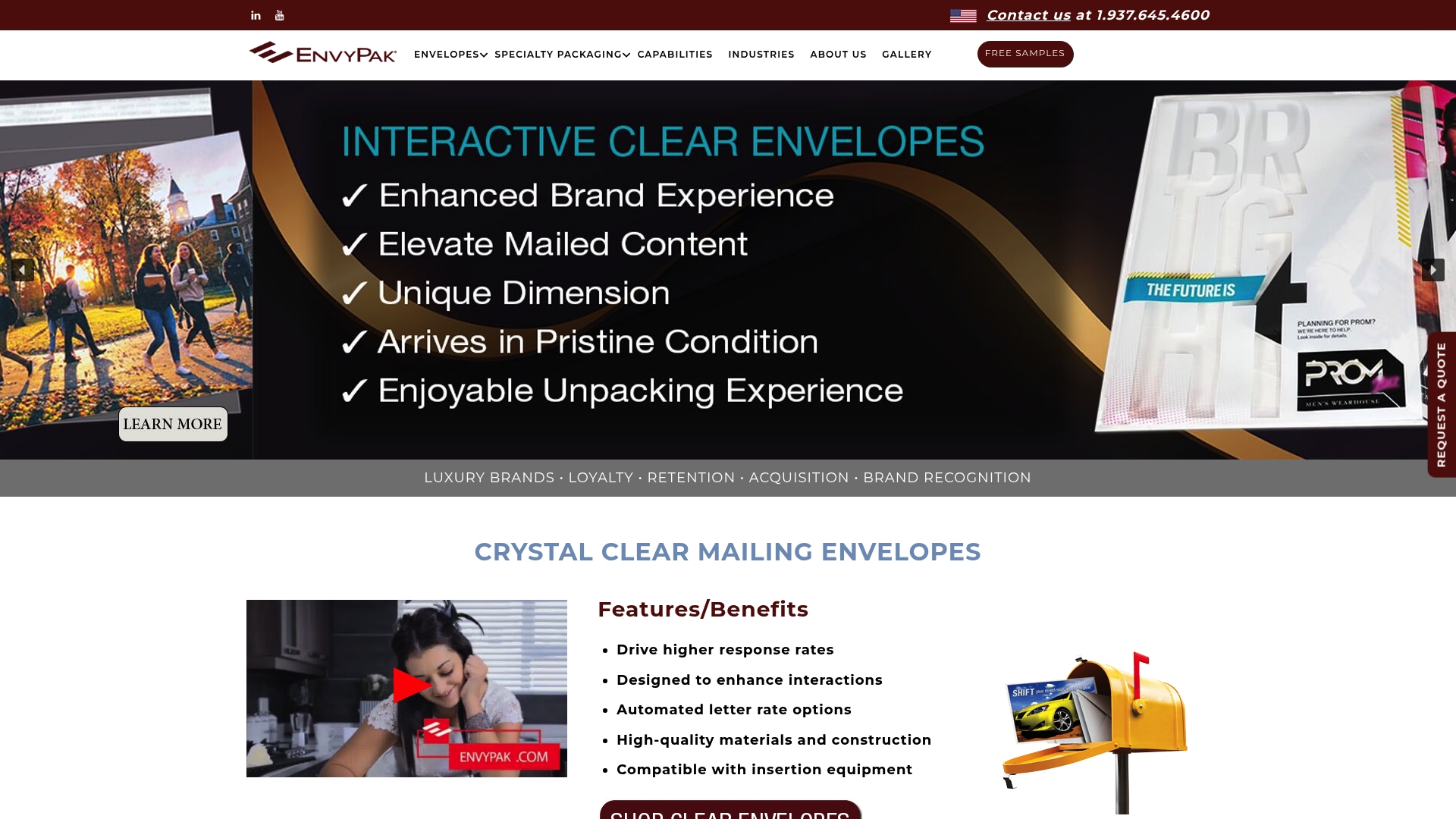
Envypak’s envelopes are automation-compatible, meaning they work with high-volume mail processing equipment without slowing your triggered send schedule. They are also made from eco-friendly, recyclable materials, which matters to recipients who notice sustainable packaging choices. Whether you are running a postcard sequence or a premium letter package, Envypak’s clear envelopes for direct mail give your campaign a visual edge that generic paper envelopes simply cannot match. For campaigns where presentation is part of the offer, explore Envypak’s custom envelope options to match your brand identity precisely.
FAQ
What is direct mail retargeting?
Direct mail retargeting is the practice of sending personalized physical mail to website visitors who did not convert, using identity resolution technology to match anonymous browsers to household mailing addresses. It is also called DMRT.
How quickly should mail be sent after a website visit?
Mail triggered within 24–48 hours of a website visit performs best, while the brand is still fresh in the recipient’s mind. Most effective DMRT programs use daily triggered send schedules rather than weekly batches.
What response rates can direct mail retargeting achieve?
Direct mail averages a 4.4% response rate, 37 times higher than email’s 0.12% average. House-file campaigns can reach response rates as high as 15.6%.
How do you track ROI from a direct mail retargeting campaign?
Use personalized URLs (PURLs) or QR codes printed on each mail piece to attribute digital conversions back to specific mail touches. Set these up before printing, not after. For a full framework, the direct mail ROI guide covers every metric worth tracking.
Is direct mail retargeting compliant with privacy laws?
Yes, when executed correctly. Identity resolution partners must comply with applicable regulations, including CCPA and similar state-level privacy laws. Always confirm your partner’s compliance documentation before signing a data use agreement.
Key takeaways
Retargeting customers via direct mail works because it combines behavioral data from digital channels with the physical presence and high response rates of direct mail, creating a multi-channel sequence that outperforms either channel alone.
| Point | Details |
|---|---|
| Identity resolution is required | Third-party technology matches anonymous visitors to household addresses; your CRM alone is not enough. |
| NCOA processing protects your budget | 8–12% of lists not refreshed in 12 months contain bad addresses; run NCOA before every send. |
| Trigger mail within 24–48 hours | Speed is critical; mail sent while the brand is fresh in the visitor’s mind converts at a higher rate. |
| Rotate formats across touches | Sending the same piece repeatedly causes mail fatigue; alternate postcards, letters, and premium formats. |
| Set up tracking before printing | PURLs and QR codes must be in place before your creative is finalized to measure ROI accurately. |