

Personalized Direct Mail Campaign Guide for 2026

A personalized direct mail campaign is defined as a printed mail program that uses variable data printing to deliver recipient-specific content, including customized text, images, and offers, to each individual piece. This approach consistently outperforms generic mail by 2–3 times on response rates, with generic mail averaging around 4.4%. The gap exists because relevant content earns attention. This guide walks marketing professionals and business owners through every stage of building a personalized direct mail campaign, from list hygiene and segmentation to creative design, production, and measurement.
What are the core elements of a personalized direct mail campaign guide?
Every effective personalized direct mail campaign starts with three foundations: a clean mailing list, a segmentation strategy, and variable data printing technology. Skip any one of these and the campaign underperforms, regardless of how strong the creative is.
List quality and NCOA processing
Your mailing list is the single most important asset in the campaign. List hygiene failures are the most common cause of wasted spend, because undeliverable mail costs postage, printing, and production without any chance of return. Running your list through NCOA (National Change of Address) processing checks USPS filed address changes from the last 48 months and updates records before you print a single piece. CASS (Coding Accuracy Support System) certification further validates address formats for postal compliance. Both steps are mandatory for high-volume campaigns.
Variable data printing and production minimums
Variable data printing (VDP) is the technology that makes true personalization possible. It allows each printed piece to carry unique text, images, or offers without stopping the press. Production minimums for small-to-mid-volume personalized campaigns typically begin at around 200 mailers, making VDP accessible even for regional or niche campaigns. The marginal cost of customizing each piece at that scale is minimal compared to the response lift you gain.
Key data fields for segmentation
Strong personalization requires more than a name and address. The data fields that drive the best results include:
- Purchase history: What the recipient bought, when, and how often
- Geographic location: ZIP code, region, or proximity to a store or event
- Life stage: Age, household composition, or recent life events like moving
- Behavioral signals: Website visits, past campaign responses, or loyalty status
- Demographic data: Income range, occupation, or homeownership status
Pro Tip: Before building your segmentation model, audit your CRM for data completeness. A field that is empty for 40% of your list cannot drive reliable personalization.
Postal requirements also shape production planning. Presort processing groups mail by ZIP code to qualify for bulk postage discounts. Coordinating presort with your mail vendor before the job goes to print saves both time and postage cost.
How to design personalized direct mail creatives that drive engagement?
Design is where personalization becomes visible to the recipient. The mistake most marketers make is treating personalization as a name swap. True personalization means multiple versions tailored by demographic, location, and behavior. A recipient who recently moved gets a different offer than a loyal repeat buyer, even if both pieces carry the same brand.

Levels of personalization
Personalization exists on a spectrum. Understanding where your campaign sits helps you set realistic production and budget expectations.
- Segmentation level (4–20 versions): Different headlines, offers, or images for each audience segment. This is the sweet spot for most B2C and B2B campaigns. Segment-level personalization can deliver a 50–100% or greater response lift over generic mail.
- One-to-one level: Each piece carries a unique image, personalized URL (PURL), and QR code tied to that specific recipient. This approach generates the largest response lifts but requires careful VDP workflows and production coordination.
- Name insertion only: Adds the recipient’s name to a standard template. This produces measurable but modest lifts. The real gains come when offers align to behavior, not just when the envelope says “Dear Sarah.”
Matching offers to life events
Life-event triggered targeting, especially reaching new movers within the first 0–30 days post-move, yields significantly higher conversion probabilities than cold list campaigns. A new homeowner is actively buying furniture, appliances, and services. An offer that speaks directly to that moment outperforms a generic discount every time.
Headlines, calls to action, and response mechanisms
Your headline must reflect the personalization. If you are targeting recent buyers, the headline should reference that relationship. Generic headlines waste the data you invested in. For calls to action, give recipients at least two response paths: a PURL tied to their record and a QR code that pre-fills a landing page with their information. Both mechanisms let you track individual response behavior and feed data back into your CRM.
Pro Tip: Test your QR codes on five different devices before the job goes to print. A broken QR code on a 10,000-piece run is an expensive mistake.
For imagery, match visuals to the segment. A campaign targeting homeowners in the Southwest should not use stock photography of urban apartments. Relevant imagery reinforces the message before the recipient reads a single word. You can find additional design best practices that cover layout, typography, and envelope presentation.
What is the step-by-step process to plan and execute a campaign?
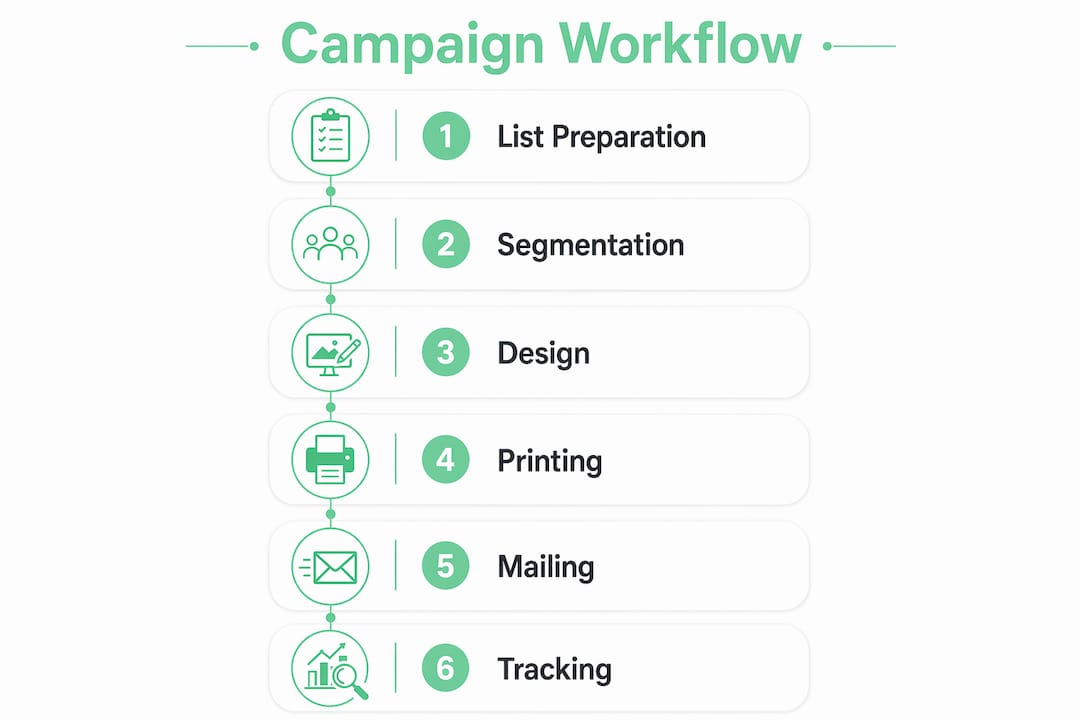
A clear workflow prevents the most common production errors and keeps your campaign on schedule. Follow these steps in order.
- Set campaign objectives. Define your primary metric before anything else. Are you driving store visits, online purchases, or phone inquiries? Your objective shapes every downstream decision.
- Select and segment your audience. Pull your list, apply your segmentation criteria, and confirm data completeness for each segment. Remove duplicates and suppress recent opt-outs.
- Run NCOA and CASS processing. Submit your list to a certified address hygiene service before building your data file for the printer.
- Build your variable data file. Map each data field to its corresponding design element. Work with your print vendor to confirm the file format and field naming conventions they require.
- Design and proof each version. Print physical proofs for every version, not just the base template. Errors in variable logic do not always appear on screen.
- Run a test cell. Best practice testing involves changing only one variable at a time in small test cells covering 10–20% of the list before full rollout. This isolates what actually drives response.
- Coordinate presort and induction. Work with your mail vendor to schedule presort processing and postal induction. Confirm drop dates align with your campaign timing.
- Set up tracking. Assign unique PURLs, QR codes, and dedicated phone numbers to each segment or version. Without these, you cannot isolate which personalization elements drove conversion.
- Mail the full run. After the test cell confirms performance, release the remaining volume.
- Measure and report. Pull response data by segment, version, and channel. Compare against your baseline to calculate lift.
| Campaign stage | Key action | Common error to avoid |
|---|---|---|
| List preparation | NCOA and CASS processing | Skipping hygiene on “recent” lists |
| Creative build | Proof every version physically | Testing only the base template |
| Test cell | Isolate one variable per test | Changing multiple elements at once |
| Tracking setup | Assign unique codes per segment | Using a single generic URL |
| Measurement | Report lift by segment | Reporting only total response rate |
Which common challenges arise and how do you avoid them?
Most personalized direct mail campaigns fail for predictable reasons. Knowing the pitfalls in advance lets you build safeguards into your workflow.
- Stale mailing lists: A list that has not been cleaned in six months will have significant address decay. NCOA processing is not optional. Run it within 30 days of your mail date.
- Name-only personalization: Inserting a first name without changing the offer or imagery produces weak results. The highest-impact personalization aligns offers to recipient behaviors, demographics, or life stage.
- Testing too many variables at once: Changing the headline, offer, and image in the same test cell makes it impossible to know what drove the result. Test one element per cell.
- No tracking infrastructure: Campaigns without unique response codes cannot prove ROI. Tracking with unique vanity URLs, personalized QR codes, and dedicated phone numbers is the only way to measure which elements drive conversion.
- Overcomplicated personalization logic: Building 50 versions when your data only supports 5 clean segments creates production errors and delays. Match your personalization depth to your data quality.
“The most critical factors for direct mail success are mailing list quality and offer relevance. Creative design, while important, ranks third.”
Pro Tip: Set a data quality threshold before you build your segments. If a key field like purchase date is missing for more than 25% of a segment, that segment is not ready for behavioral personalization.
Automation reduces these risks significantly. CRM integration and trigger-based workflows let you send personalized mail at the moment a behavior occurs, such as a cart abandonment or a policy renewal date, without manual list pulls. That timing advantage is difficult to replicate with batch campaigns.
Key Takeaways
A personalized direct mail campaign succeeds when list quality, offer relevance, and variable data printing work together, not when any single element is perfected in isolation.
| Point | Details |
|---|---|
| List hygiene is non-negotiable | Run NCOA and CASS processing within 30 days of your mail date to minimize undeliverable pieces. |
| Personalization goes beyond names | Match offers and imagery to recipient behavior, life stage, or demographics for the strongest response lift. |
| Test one variable at a time | Use 10–20% test cells with a single changed element to isolate what actually drives response. |
| Track every response channel | Assign unique PURLs, QR codes, and phone numbers per segment to measure conversion accurately. |
| Automation scales relevance | CRM-triggered campaigns reach recipients at the right moment without manual list management. |
What I have learned about direct mail personalization after years in the field
The most common mistake I see marketing professionals make is spending 80% of their budget on creative and 20% on list quality. That ratio should be reversed. A beautifully designed mail piece sent to a stale list with a generic offer will underperform a plain postcard sent to a clean, well-segmented list with a relevant offer. Every time.
The second lesson took me longer to internalize: personalization depth should match data quality. I have watched teams build 30-version VDP campaigns on CRM data that had 40% field completion rates. The result was a production nightmare and inconsistent output. Start with four or five clean segments and execute them well. You will outperform the team that built 30 versions on bad data.
Automation changed how I think about scale. Once you connect your CRM to a trigger-based mail workflow, you stop thinking in campaign cycles and start thinking in customer moments. A new mover gets a piece within 10 days of filing their address change. A lapsed customer gets a win-back offer 90 days after their last purchase. The ROI of automated campaigns consistently outperforms batch-and-blast approaches because the timing is right, not just the message.
My last piece of advice: measure lift, not just response rate. Your baseline matters. A 6% response rate on a cold list is excellent. A 6% response rate on a warm reactivation list is a failure. Know your benchmark before you call the campaign a success.
How Envypak supports your personalized direct mail campaigns
The physical envelope is the first thing your recipient sees, and it determines whether your personalized content gets opened or discarded.
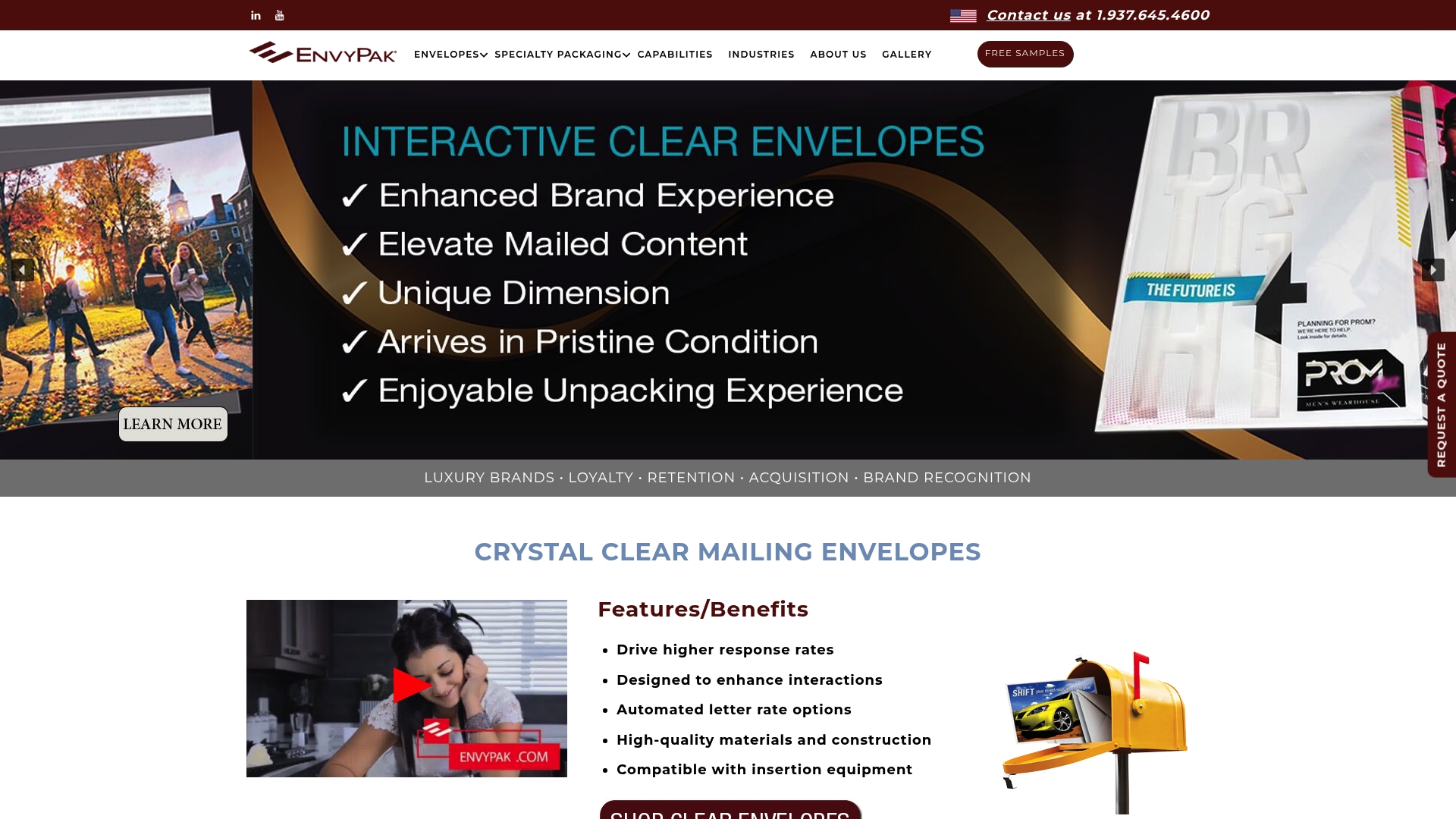
Envypak’s crystal clear mailing envelopes let your personalized design show through before the recipient even opens the piece, turning the envelope itself into a response driver. Built from eco-friendly materials and engineered for automation compatibility, Envypak envelopes work with high-volume VDP production runs without slowing your line. For campaigns that need a custom presentation, Envypak also offers custom envelopes and mailers sized and branded to your specifications. When your list is clean, your offer is relevant, and your piece arrives in packaging that demands attention, your response rates reflect it.
FAQ
What is variable data printing in direct mail?
Variable data printing (VDP) is a digital printing method that changes text, images, or offers on each piece without stopping the press. It is the core technology behind one-to-one personalized direct mail campaigns.
How many mail pieces do I need for a personalized campaign?
Personalized campaigns typically start at around 200 mailers, which is the point where variable data printing becomes cost-effective for small-to-mid-volume runs.
Why does list hygiene matter so much for direct mail?
Undeliverable mail wastes postage and printing costs with zero chance of response. NCOA processing updates addresses against 48 months of USPS change-of-address filings, reducing returns and wasted spend.
What response rate can I expect from personalized direct mail?
Personalized campaigns achieve response rates 2–3 times higher than generic mail, which averages around 4.4%. Segment-level personalization can deliver a 50–100% or greater lift over a generic baseline.
How do I measure the success of a personalized direct mail campaign?
Assign unique PURLs, QR codes, and dedicated phone numbers to each segment or version. Track responses by code to calculate lift per segment and identify which personalization elements drove the most conversions.