

Direct Mail Response Rate Boosters That Work in 2026

Direct mail response rate boosters are the specific tactics that lift campaign reply rates above industry averages, and the gap between average and optimized campaigns is substantial. House lists generate 4.4% average response rates, which is 36 times higher than email’s 0.12%. That benchmark matters because it sets your floor, not your ceiling. The real performance drivers are list quality, personalization depth, offer design, timing, and coordinated digital follow-up. Each factor compounds the others. A well-timed, personalized piece sent to a clean list consistently outperforms a generic mailer sent to a bloated database, regardless of how good the creative looks.
1. How does list selection and hygiene boost direct mail response rates?
List quality is the single biggest variable in direct mail performance. A brilliant offer sent to the wrong audience produces nothing. A mediocre offer sent to the right audience still converts.
House lists consistently outperform cold prospect lists by a wide margin. House lists generate 5–9% response rates, while cold prospect lists average closer to 2.7–2.9%. That gap exists because existing customers already trust your brand. Prospect lists require you to earn attention from scratch.

Data accuracy is equally critical. USPS NCOA validation reduces waste by 5–15% and improves effective response rates by removing undeliverable addresses before you pay postage. CASS (Coding Accuracy Support System) processing standardizes address formats to meet USPS requirements and qualify for bulk mail discounts.
Segmentation turns a clean list into a precision tool. Grouping contacts by lifecycle stage, purchase behavior, or geographic cluster lets you tailor messaging to where each recipient actually is. Segmentation by lifecycle moments like renewals, reactivations, and anniversaries can boost responses by 20–30%. That improvement comes from relevance, not luck.
- Run NCOA and CASS processing before every major drop
- Suppress addresses inactive for more than 18 months
- Segment by recency, frequency, and monetary value (RFM)
- Time drops around known lifecycle triggers for each segment
- Deduplicate across all data sources before finalizing the list
Pro Tip: Suppress your existing customers from cold prospect campaigns. Mailing them twice wastes budget and can irritate buyers who already converted.
2. What personalization tactics most effectively increase direct mail engagement?
Personalization is the fastest way to lift response rates without changing your offer. Recipients respond to mail that feels written for them, not printed for a million people.
Adding a recipient’s name to the headline alone can increase response rates by up to 135%. That number surprises most marketers because it seems too simple. The reason it works is psychological: the brain flags its own name as relevant and pauses to read.
Advanced personalization goes further. Variable data printing (VDP) lets you swap out names, images, offers, and even property-specific data for each individual piece without slowing production. Advanced personalization with targeted messaging and imagery can improve responses by as much as 500%. That ceiling is reserved for highly targeted campaigns with rich customer data, but even partial personalization moves the needle significantly.
The cost objection is real but manageable. Personalization adds a 20–50% cost premium per piece. It lowers cost per lead overall because fewer pieces are wasted on uninterested recipients. The math works in your favor when your list is clean and your segments are tight.
- Use first name in the headline, not just the salutation
- Match imagery to recipient demographics or past purchases
- Reference local details like city name, nearby location, or regional event
- Personalize the offer amount or product recommendation by segment
- Test one personalization variable at a time to isolate what drives lift
Pro Tip: Pull personalization data from your CRM before the design phase. Waiting until production forces workarounds that reduce accuracy and slow your timeline.
For a deeper look at personalized direct mail and why it works at the psychological level, Envypak’s resource library covers the mechanics in detail.
3. Which creative design, offers, and formats best boost response rates?
The physical format of your mail piece determines whether it gets read or recycled. Format is not a secondary decision. It is a primary response driver.
Postcards achieve near 100% read rates because there is nothing to open. Letters, by contrast, see 20–40% discarded before the envelope is opened. That means a significant portion of your letter campaign never gets seen, regardless of what is inside. Postcards eliminate that barrier entirely.
Oversized mailers and self-mailers capture attention in a crowded mailbox. They stand out physically, which increases the chance of a first glance. That first glance is all you need to pull a reader into your offer. Budget permitting, testing an oversized format against a standard postcard reveals which format your specific audience responds to.
Offer design separates campaigns that convert from those that generate awareness. Specific, time-limited offers outperform generic calls to action by 2–3 times. “20% off, expires june 30” beats “call us today” every time. Urgency and specificity together create the conditions for immediate action.
QR codes bridge the physical and digital experience. A QR code directing to a mobile-friendly landing page removes friction from the response process. Recipients do not need to type a URL or remember a phone number. One scan takes them directly to the conversion point. The landing page must match the offer on the mail piece exactly. Any mismatch kills conversion.
| Format | Open/Read Rate | Best Use Case |
|---|---|---|
| Postcard | Near 100% | Short offers, brand awareness, local campaigns |
| Standard letter | 60–80% | Detailed offers, B2B, financial services |
| Oversized mailer | High (attention-driven) | Product launches, high-value offers |
| Self-mailer | Moderate to high | Catalogs, multipage offers, event promotions |
A/B testing creative elements is not optional for serious campaigns. Test one variable per split: headline versus headline, image versus image, offer versus offer. Running multiple variables simultaneously makes it impossible to identify what drove the result. For direct mail design best practices that translate directly to higher response, Envypak’s design guides cover format selection and layout in practical terms.
4. How does timing and multi-channel integration amplify direct mail response rates?
Timing is where most campaigns leave money on the table. Sending the right piece to the right person at the wrong moment produces weak results even when everything else is correct.
Direct mail pieces have an average in-home lifespan of 17 days. That is dramatically longer than a digital ad impression, which disappears in seconds. The extended lifespan means your piece has multiple opportunities to be seen and acted upon. Cutting off response tracking at 7 days misses a significant portion of conversions.
Multi-channel integration multiplies the effect of each individual touch. Combining direct mail with digital follow-up can increase response rates by up to 118%. The mechanism is reinforcement: a recipient who sees your brand in the mailbox and then encounters a retargeted ad online registers the message as familiar and credible. Familiarity reduces resistance to response.
Digital retargeting alongside direct mail yields 63% higher response rates compared to mail alone. The sequence matters. Mail first, then digital follow-up within 48–72 hours of estimated delivery, produces the strongest lift. Reversing the order reduces the effect.
- Schedule email follow-up 2–3 days after estimated mail delivery
- Run retargeted digital ads to the same mailing list using address-based targeting
- Use USPS Informed Delivery to place a digital preview of your mail piece in recipients’ inboxes before it arrives
- Follow up with a phone call referencing the specific mail piece
Follow-up phone calls referencing the mail piece lift response rates by 40–60%. That is one of the highest-leverage tactics in direct mail, and it is consistently underused. The call does not need to be a hard sell. Confirming receipt and offering to answer questions is enough to move hesitant responders.
Pro Tip: Use omnichannel marketing sequencing tools to automate email and ad follow-up based on mail delivery confirmation. Manual coordination introduces delays that reduce the reinforcement effect.
Key Takeaways
The most effective direct mail response rate boosters combine clean list data, individual personalization, format-matched creative, and coordinated multi-channel follow-up to produce results that no single tactic achieves alone.
| Point | Details |
|---|---|
| List hygiene is foundational | Run NCOA and CASS processing before every drop to cut waste and protect response rates. |
| Personalization multiplies results | Adding recipient names and variable imagery can lift response by 135–500% depending on depth. |
| Format determines first contact | Postcards achieve near 100% read rates; letters lose 20–40% of recipients before opening. |
| Multi-channel follow-up is non-negotiable | Combining mail with digital retargeting lifts response by up to 63% over mail alone. |
| Measure beyond the first week | Direct mail response windows last 17 days; cutting tracking early undercounts true campaign performance. |
What I have learned from watching direct mail campaigns succeed and fail
The campaigns that underperform almost never fail because of weak creative. They fail because of execution errors in targeting, data quality, and timing. I have seen beautifully designed mailers sent to lists that had not been cleaned in two years. The creative was excellent. The response rate was terrible. The list was the problem.
The obsession with average response rates is a distraction. The break-even response rate is the number that actually matters. For some local service businesses, breaking even requires less than 0.3% response. For high-ticket B2B offers, you might need only two or three conversions from a thousand pieces to generate a strong return. Chasing a 4.4% average when your economics only require 0.5% is a waste of energy.
The other mistake I see constantly is abandoning campaigns too early. True direct mail impact is often undercounted because delayed responses and indirect influences like brand searches or referrals prompted by the mail piece do not show up in direct response tracking. A campaign that looks flat at day 10 may be generating real conversions at day 20 through channels that are not attributed back to the mail drop.
My practical advice: fix your list first, test one offer variable per campaign, and build a multi-touch sequence before you spend anything on creative. The sequence is what turns a decent campaign into a consistently profitable one.
Envypak’s role in executing high-response direct mail campaigns
The physical quality of your mail piece affects whether it gets opened and read. Envypak’s crystal clear mailing envelopes let your offer show through the envelope before the recipient even opens it, which removes the first barrier to engagement.
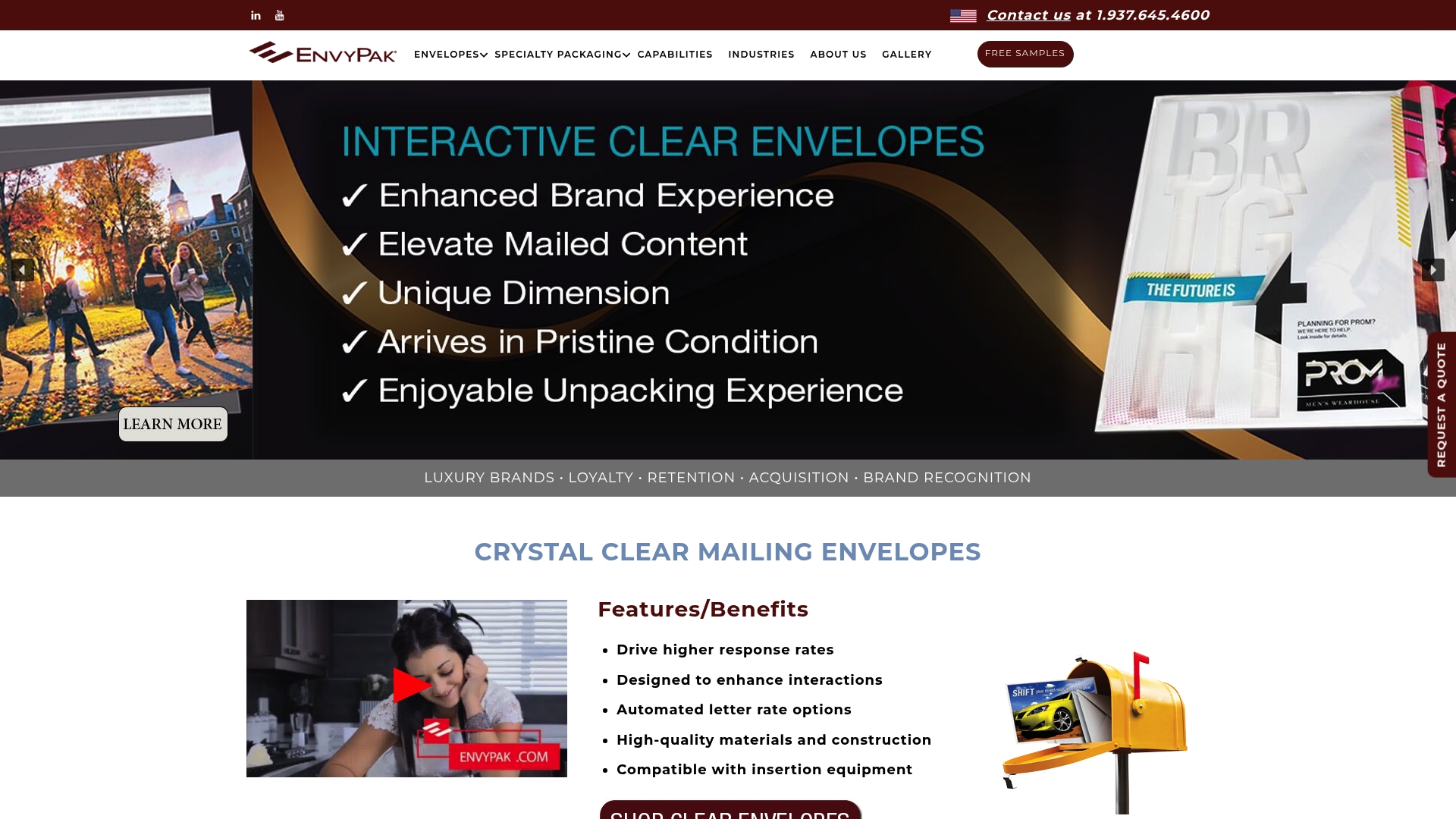
Envypak envelopes are built for automation compatibility, so scaling your campaign volume does not create production bottlenecks. Choosing the right envelope size for your specific offer format is one of the most overlooked decisions in campaign planning, and Envypak’s sizing guide walks you through the options matched to campaign goals. For marketers ready to put the tactics in this article into practice, Envypak’s custom envelopes and mailers are built to support campaigns at every scale, with eco-friendly materials that align with current sustainability standards.
FAQ
What is the average direct mail response rate in 2026?
The average direct mail response rate is 4.4% for house lists and approximately 2.7–2.9% for prospect lists. Both figures are 36 times higher than email response rates.
How much does personalization improve direct mail response?
Adding recipient names to headlines increases response by up to 135%. Advanced variable data personalization with targeted imagery and messaging can improve responses by up to 500%.
Does combining direct mail with digital channels actually work?
Combining direct mail with digital follow-up increases response rates by up to 118%. Digital retargeting alongside mail alone yields 63% higher response rates compared to mail-only campaigns.
How long should I track direct mail responses?
Track responses for at least 17–21 days. Direct mail pieces have an average in-home lifespan of 17 days, and cutting off measurement earlier misses delayed conversions and indirect responses like brand searches.
What is the most important factor in direct mail success?
List quality and targeting accuracy are the most important factors. Execution errors in targeting and timing cause more campaign failures than weak creative or insufficient budget.