

Direct Mail Campaign Timing Strategy That Drives Results

Direct Mail Campaign Timing Strategy That Drives Results
A direct mail campaign timing strategy is the structured plan that determines when each piece of mail reaches a recipient’s hands to maximize engagement and response rates. Get the timing wrong and even the most compelling creative lands in the recycling bin. Get it right and you can see response rates climb 20 to 40% above single-touch benchmarks. The core tools for executing this well include USPS delivery standards, Intelligent Mail Barcode tracking, and multi-touch mailing sequences. This guide breaks down every phase of the process so you can plan with precision, not guesswork.
What is the typical timeline for a direct mail campaign?
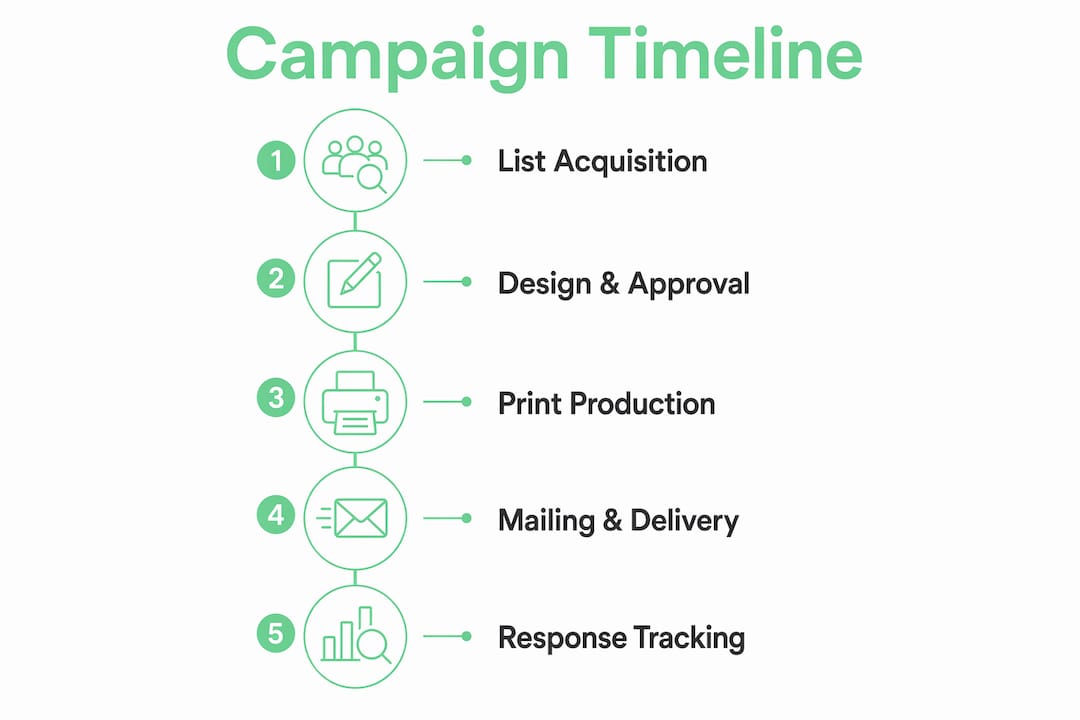
A typical direct mail campaign runs 3 to 6 weeks from kickoff to mailbox delivery, covering list acquisition, design approval, printing, data processing, and USPS transit. That window is not a suggestion. It reflects real production constraints that compress or expand based on your decisions at each phase. Understanding each phase in sequence is the only way to build a schedule that holds.
Here is how the phases break down in practice:
| Phase | Typical Timeline | Rush Timeline |
|---|---|---|
| List acquisition and data processing | 3 to 7 days | 1 to 2 days (clean list required) |
| Design and creative approval | 5 to 10 days | 1 to 2 days (print-ready files required) |
| Printing and finishing | 5 to 10 days | 2 to 5 days (digital print only) |
| USPS induction and transit | 7 to 14 days (Marketing Mail) | 1 to 3 days (First-Class Mail) |
| Total | 3 to 6 weeks | 7 to 10 days |
Print production timelines vary significantly with quantity and print method. Digital printing handles small volumes quickly, while offset printing for large batches adds several days of lead time. Delays in artwork approval are the single most common cause of missed in-home dates, so locking creative before production begins is non-negotiable.
Rush timelines are achievable but require two things upfront: print-ready artwork and a clean, deduplicated mailing list. Without both, a 7-day turnaround becomes 14 days before you realize it.
Pro Tip: Build your campaign calendar backward from the target in-home date. Assign hard deadlines to each phase and add a 3-day buffer between design approval and print submission to absorb last-minute revisions.
How to plan multi-touch mailing schedules for maximum response
Prospects typically need 7 to 13 exposures to a brand before they act. A single mailer rarely moves the needle on its own. The industry standard for direct mail is a three-drop sequence timed at weeks 1, 4, and 7, which gives recipients enough space to process each message without losing momentum between touches.

The logic behind this spacing is deliberate. Week 1 introduces the offer. Week 4 reinforces it with a variation or stronger call to action. Week 7 creates urgency or provides a final reminder. Follow-up mailings consistently generate higher response rates than the initial touch point, which means the second and third drops often carry more conversion weight than the first.
Here are the scheduling best practices that separate disciplined campaigns from ad hoc ones:
- Set drop dates before production begins. Locking dates first forces every upstream decision, from list selection to print specs, to align with delivery windows rather than production convenience.
- Stagger drops by segment. If you are mailing to multiple audience segments, offset their drop dates by 3 to 5 days to manage response volume and follow-up capacity.
- Align creative variations across drops. Each piece should reference the previous one subtly, building a narrative rather than repeating the same message verbatim.
- Track response windows per drop. Most responses arrive within 2 to 3 weeks of delivery, so measure each drop independently before attributing results to the sequence as a whole.
- Schedule drops in your CRM or mailing platform in advance. Scheduling mail online in advance through tools like Click2Mail or integrated CRM triggers prevents the most common failure mode: batch mailing that fires at the wrong time because no one set a hard send date.
Pro Tip: Test a small pilot group at 10 to 20% of your total volume and wait 2 to 4 weeks for results before rolling out the full sequence. This one step can save you from scaling a timing or creative mistake across your entire list.
What mail classes affect timing precision and how to build buffers
USPS offers two primary mail classes for marketing campaigns, and the choice between them shapes every timing decision you make. USPS First-Class Mail delivers in 1 to 5 business days and is the right choice when timing precision is critical, such as event invitations or time-sensitive offers. USPS Marketing Mail delivers in 7 to 14 days and costs significantly less per piece, making it the default for high-volume campaigns where exact delivery dates are less critical.
The catch with Marketing Mail is that USPS does not guarantee exact delivery dates. Seasonal volume spikes around the holidays, election cycles, and major weather events can push delivery windows well beyond the standard range. Planning your campaign around the optimistic end of the delivery window is a reliable way to miss your promotional period entirely.
| Mail class | Delivery window | Cost per piece | Best use case |
|---|---|---|---|
| USPS First-Class Mail | 1 to 5 business days | Higher | Time-sensitive offers, event invitations |
| USPS Marketing Mail | 7 to 14 days | Lower | High-volume campaigns, awareness sequences |
| USPS Priority Mail | 1 to 3 business days | Highest | Premium packages, high-value prospects |
USPS service standards and seasonal variation require campaign timing to be built on conservative transit assumptions, not optimistic ones. The practical rule is to build a 3 to 6 week buffer from your target in-home date back to your production kickoff. That buffer absorbs artwork revisions, print delays, and postal variability without blowing your campaign window.
Pro Tip: Use USPS’s Business Customer Gateway to access service standard maps by origin and destination ZIP code. This gives you a data-backed delivery estimate rather than a generic range, which is especially useful for regional campaigns.
How to synchronize direct mail timing with multichannel campaigns
Direct mail does not operate in isolation. Coordinating mail delivery with email and retargeting campaigns in the same week reinforces messaging across channels and measurably improves conversion. The goal is for the physical piece to arrive when the prospect is already primed by digital touchpoints, not after the digital campaign has gone cold.
Poor synchronization is more common than most marketers admit. A mailer that arrives two weeks after a digital campaign has ended does not benefit from the brand recognition built online. It arrives as a standalone piece competing for attention without any supporting context. That scenario is not a timing edge case. It is what happens when mail schedules and digital calendars are managed by separate teams without a shared timeline.
Here are the coordination practices that prevent desynchronization:
- Map all channel touchpoints on a single calendar. Email sends, paid retargeting windows, and mail in-home dates should live in one document, not separate platform dashboards.
- Time email sends to follow mail delivery by 2 to 3 days. The physical piece creates the first impression. The email reinforces it while the mailer is still on the recipient’s desk.
- Align retargeting ad windows with your mail delivery window. If your Marketing Mail delivers between days 7 and 14 after induction, your retargeting campaign should be active across that entire window.
- Build a shared cutoff date for creative changes. Any change to messaging after this date must be reflected across all channels simultaneously or held for the next drop.
You can explore the direct mail vs. email timing debate in more depth, but the short answer is that neither channel outperforms the other in isolation. Synchronized timing is what creates the lift.
How to monitor and troubleshoot direct mail timing effectiveness
Measurement is where most direct mail timing strategies fall apart. Marketers pull response data at the two-week mark, see modest numbers, and conclude the campaign underperformed. The reality is that B2B campaigns often have longer response tails requiring 4 to 6 weeks of tracking before you have a complete picture. Cutting measurement short is the equivalent of reading the first half of a test and calling it done.
Intelligent Mail Barcode tracking, available through USPS, gives you scan data at each processing facility so you can confirm when pieces entered the mailstream and estimate delivery windows by geography. This is not optional for high-stakes campaigns. It is the only way to know whether a poor response rate reflects a timing problem or a creative problem.
Common timing errors and how to address them:
- Missed mail date. Production ran long and the piece dropped after the promotional window closed. Fix: add hard deadlines with escalation triggers at each production phase.
- Late mail delivery. USPS transit exceeded the standard window during a high-volume period. Fix: switch to First-Class Mail for time-sensitive drops and build seasonal buffers into your annual calendar.
- Insufficient follow-up spacing. Drops were scheduled too close together, creating fatigue rather than reinforcement. Fix: maintain a minimum of three weeks between drops in a sequence.
- Premature response cutoff. Campaign was declared a failure before the full response window closed. Fix: track direct mail ROI over a minimum of four weeks per drop before drawing conclusions.
- Misaligned multichannel timing. Digital campaigns ran on a separate schedule from mail drops. Fix: assign one person or team to own the unified campaign calendar.
Key takeaways
A direct mail campaign timing strategy succeeds when you plan backward from in-home dates, build conservative USPS transit buffers, and synchronize every channel on a single shared calendar.
| Point | Details |
|---|---|
| Plan backward from in-home dates | Work from your target delivery date back through print, data, and design to set realistic kickoff dates. |
| Use conservative transit buffers | USPS Marketing Mail delivers in 7 to 14 days; build 3 to 6 week buffers to absorb seasonal delays. |
| Run multi-touch sequences | Three-drop sequences at weeks 1, 4, and 7 increase response rates by 20 to 40% over single mailings. |
| Synchronize with digital channels | Time email and retargeting to overlap with your mail delivery window, not precede or follow it by weeks. |
| Measure over full response windows | Track each drop for at least 4 weeks before evaluating performance, especially for B2B campaigns. |
Why most direct mail timing failures are calendar failures
I have reviewed dozens of direct mail post-mortems over the years, and the pattern is almost always the same. The creative was solid. The list was clean. The offer was competitive. But the mail arrived three days after the event it was promoting, or the follow-up drop landed during a holiday week when no one was at their desk. The timing failed because no one owned the calendar end to end.
The most underrated practice in direct mail is planning backward. Most teams plan forward: they finish creative, hand it to print, and hope the mail arrives in time. The teams that consistently outperform plan from the in-home date backward, assigning hard deadlines to every upstream phase before a single design file is opened.
Triggered direct mail is where this discipline matters most. When mail fires based on CRM events like a cart abandonment or a lapsed subscription, the file cutoff timing and automation logic have to be airtight. A batch that fires 48 hours late because of a data processing delay is not a minor inconvenience. It is a conversion window that closed without you.
The campaigns I have seen perform best treat timing as a constraint to design around, not a variable to manage after the fact. Build the calendar first. Then build the campaign.
— James
How Envypak helps you execute on timing without delays
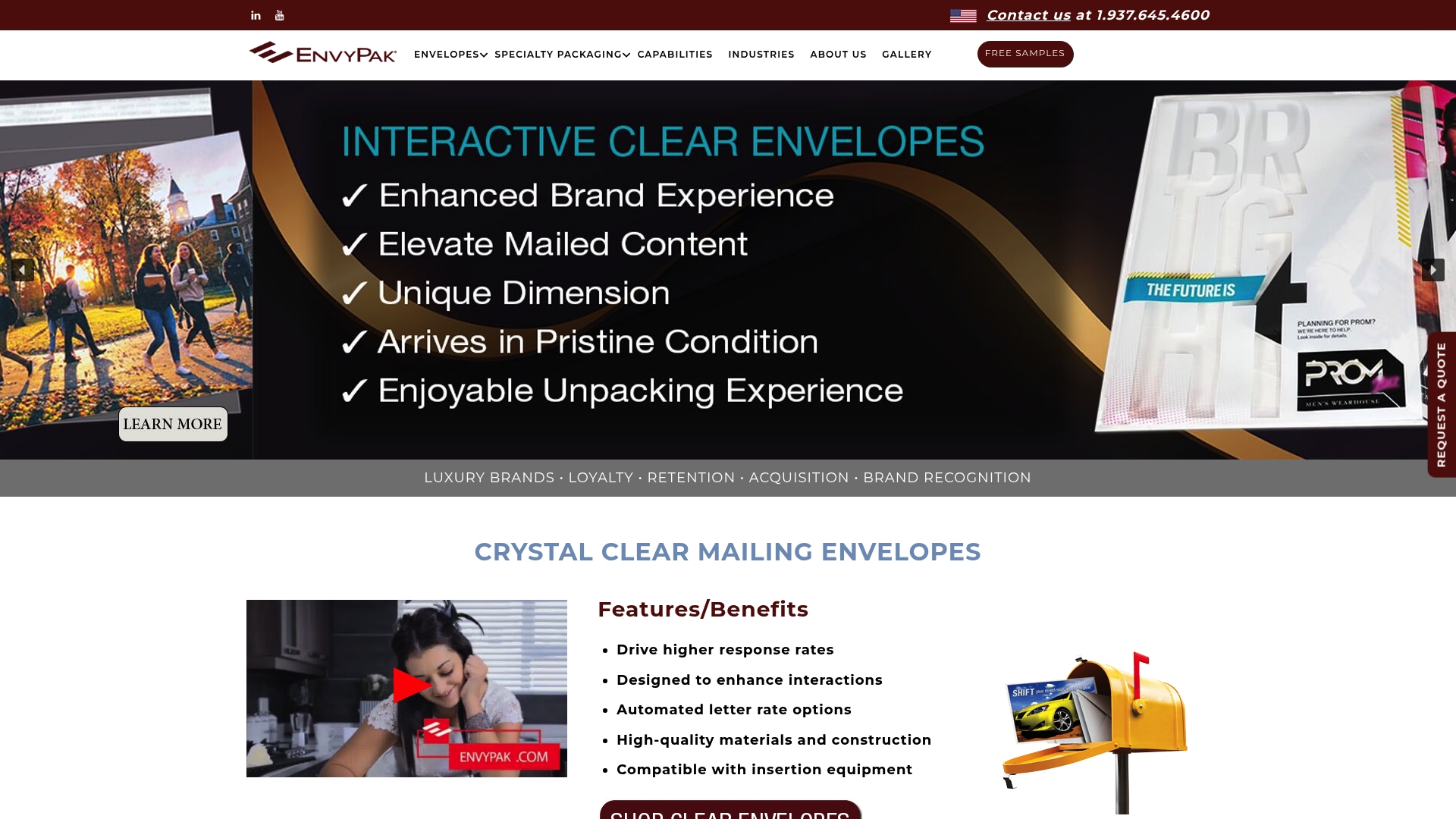
One of the most preventable sources of campaign delay is the approval and production phase, specifically when envelope or mailer specs require back-and-forth with vendors. Envypak’s crystal clear mailing envelopes are automation-compatible and built to move through production and postal induction without the friction that slows standard mailers. Because the design impact is built into the envelope itself, your creative team spends less time compensating for a plain white exterior and more time on the offer inside. Envypak also offers custom envelopes and mailers tailored to specific campaign formats, so your production timeline stays predictable from drop to drop.
FAQ
What is a direct mail campaign timing strategy?
A direct mail campaign timing strategy is a structured plan that coordinates production, USPS transit, and in-home delivery dates to maximize recipient engagement and response rates. It includes multi-touch sequencing, mail class selection, and multichannel synchronization.
How far in advance should you plan a direct mail campaign?
Plan at least 3 to 6 weeks before your target in-home date to accommodate list processing, design approval, printing, and USPS transit. Rush timelines of 7 to 10 days are possible only with print-ready files and a clean mailing list.
What are the best days for direct mail to arrive?
Tuesday through Thursday are generally the strongest in-home days for direct mail response, as Monday mail competes with a full inbox and Friday mail gets set aside over the weekend. Use USPS service standard maps to target specific delivery days by ZIP code.
How many times should you mail the same prospect?
Three-drop sequences at weeks 1, 4, and 7 are the industry standard, reflecting the reality that prospects need 7 to 13 exposures before acting. Follow-up mailings consistently outperform the initial touch point in response rate.
How do you measure direct mail timing effectiveness?
Track responses for a minimum of 2 to 4 weeks per drop, using Intelligent Mail Barcode data to confirm delivery windows. B2B campaigns may require 4 to 6 weeks of measurement before results are statistically meaningful.