

Examples of High-Converting Mailers That Drive Real ROI

High-converting mailers are direct mail pieces that generate above-average response and conversion rates through targeted messaging, compelling offers, and integrated digital elements like QR codes. The best examples of high-converting mailers do not rely on creative alone. They combine precise list targeting, personalization, and measurable follow-up to turn physical mail into a revenue engine. Direct mail response rates range from 5 to 9% for house lists and 2 to 5% for prospect lists, making list quality the single biggest lever you control. Real 2026 campaigns from Canadian Red Cross, Pets & Friends, and Valpak prove that the right format, offer, and timing can produce ROI that digital channels rarely match.
1. What formats and creative styles define high-converting mailers
The format of a mailer determines how much creative real estate you have and how the recipient interacts with your message. Postcards, self-mailers, brochures, and catalogs each serve a different conversion goal, and choosing the wrong one for your objective is one of the most common and costly mistakes in direct mail.

Postcards work best for single, urgent offers because the message is visible the moment the piece is handled. Standard 4×6 postcards suit local service businesses, while oversized 6×9 or 6×11 formats command more attention in a crowded mailbox. Self-mailers fold flat and eliminate the envelope entirely, reducing production cost while still allowing multi-panel storytelling. Catalogs remain the format of choice for retail and e-commerce brands with broad product lines, since creative direct mail ideas that showcase multiple products in a single piece drive higher average order values.
Creative style elements that consistently lift conversion include:
- Bold announcements with a deadline (“Offer expires March 31”) that create urgency without feeling manipulative
- Product hero visuals that show the product in use rather than isolated on a white background
- Before and after layouts for service businesses like pest control, landscaping, or home renovation
- Coupon champions — a single dominant offer printed large enough to be seen at arm’s length
- Local authority messaging that references the recipient’s neighborhood or city to increase relevance
QR codes and personalized URLs (PURLs) belong on every mailer you send in 2026. They connect the physical piece to a digital destination, create a trackable response path, and give recipients a frictionless next step.
Pro Tip: Place your QR code on the front of the mailer, not the back. Eye-tracking studies show recipients scan the front first and often never flip the piece over.
2. Real-world campaigns with outstanding conversion and ROI
The most instructive examples come from campaigns with published, audited numbers. The five cases below represent different industries, budgets, and objectives, yet they share the same structural logic: a targeted list, a specific offer, and a measurable response mechanism.
| Campaign | Key Tactic | Result |
|---|---|---|
| Canadian Red Cross Tiffany Circle | Personalized impact reports + matching gift vouchers | 830% ROI, $2M+ raised |
| Pets & Friends programmatic mail | Behavioral triggers + incentive codes | 40% conversion uplift (5.8% to 8.1%) |
| Valpak pest control franchise | Demographic targeting + call/QR tracking | 323% ROAS, $309 CPA |
| Scribendi Digital Marketing B2B | Mail + QR landing page + 3-email follow-up | 1,200% traffic increase, 11 qualified leads in 5 weeks |
| Qualinet disaster services | Branded notepads + precise postal targeting | $1M revenue in one week |
The Canadian Red Cross campaign is the clearest proof that personalization at scale works in direct mail. Each recipient received an impact report showing exactly what their previous donation had accomplished, paired with a matching gift voucher that made the next donation feel both urgent and consequential. Storytelling combined with a direct next step drove the organization’s highest fundraising ROI on record.
Pets & Friends used programmatic direct mail triggered by website behavior. When a customer browsed but did not purchase, a physical mailer with a targeted incentive code arrived within days. The control group converted at 5.8%. The mail group converted at 8.1%. That 40% lift came entirely from timing and relevance, not from a bigger budget.
“Timing and relevance — mail when the context aligns with immediate customer needs to vastly increase conversion probability.” Qualinet’s disaster-response campaign proved this principle at its most extreme. Branded notepads mailed to precisely targeted postal routes generated $1M in revenue in a single week because the piece arrived when homeowners were actively searching for emergency restoration services.
Valpak’s pest control franchise case demonstrates the power of infrastructure. Mailing 19.62 million households sounds expensive, but demographic targeting and call tracking reduced cost per acquisition to $309 while delivering 323% ROAS. The data infrastructure, not the creative, made that efficiency possible.
3. How tracking and integration impact mailer success
Response rate and conversion rate are not the same metric, and confusing them leads to bad decisions. Response rate measures any contact initiated by the recipient. Conversion rate measures completed desired actions like a purchase, a signed contract, or a qualified appointment. A campaign with a 3% response rate but a 60% close rate outperforms one with a 9% response rate and a 10% close rate. Define your conversion stage before you mail a single piece.
Practical tracking mechanisms that connect physical mail to measurable outcomes include:
- Unique QR codes per list segment or geographic territory to isolate which audience responded
- Call tracking numbers that route to your main line while logging call volume by campaign
- Personalized URLs (PURLs) that pre-populate the recipient’s name on the landing page and track individual visits
- Reply envelopes or BRCs (business reply cards) for audiences less likely to engage digitally
- UTM parameters on all QR destination URLs so Google Analytics attributes traffic correctly
Integrated campaigns that pair physical mail with email follow-up and dedicated landing pages consistently outperform mail-only tactics. Scribendi Digital Marketing’s B2B campaign used a single direct mail piece to drive recipients to a QR-code landing page, then followed up with three targeted emails over two weeks. The result was 11 qualified leads and a 1,200% increase in website traffic in under five weeks. The mail piece opened the door. The email sequence closed it.
Call tracking and QR codes tied to demographic targeting also allow you to compute cost per lead by territory and adjust mail frequency accordingly. Valpak used this approach to identify which zip codes produced the lowest CPA and shifted budget toward those areas in subsequent drops.
Pro Tip: Build your landing page before you finalize the mailer design. The page and the mailer should share the same headline, offer, and visual language so the recipient experiences a single continuous message, not a jarring transition.
4. How to choose the best mailer type for your goals
Matching the mailer format to the campaign objective is the decision that separates high-performing mail campaigns from wasted spend. The table below maps common marketing goals to the formats and tactics most likely to produce results.
| Goal | Best mailer type | Key success factor |
|---|---|---|
| Brand awareness | Oversized postcard or catalog | Bold visual identity, consistent mailing schedule |
| Lead generation | Self-mailer with QR code or PURL | Strong offer, dedicated landing page, email follow-up |
| Sales conversion | Coupon postcard or promotional envelope | Clear deadline, single dominant offer, easy redemption |
| Customer loyalty | Personalized letter or impact report | Recipient-specific data, emotional narrative, reply device |
| B2B prospecting | Dimensional mailer or branded item | Relevance to recipient’s role, follow-up call sequence |
Audience characteristics matter as much as campaign goals. Warm house lists, meaning people who have already purchased or donated, respond to personalization and loyalty rewards. Cold prospect lists respond to offers with low commitment thresholds, such as a free estimate, a sample, or a limited-time discount. Sending a high-personalization piece to a cold list wastes production budget. Sending a generic coupon to your best customers signals that you do not know them.
Budget and scale shape the decision as well. Nonprofits with established donor files, like Canadian Red Cross, can justify the cost of personalized impact reports because the lifetime value of a retained donor is high. A local service franchise like a pest control operator benefits more from direct mail acquisition at volume with demographic targeting than from expensive one-to-one personalization.
Retail and e-commerce brands with seasonal peaks should consider catalogs or multi-panel self-mailers that showcase product ranges. B2B marketers targeting a narrow list of decision-makers get better results from dimensional pieces or branded items, as Qualinet demonstrated, because the physical object stays on a desk rather than landing in a recycling bin. The power of direct mail lies in its physical permanence. A well-designed piece sits in a home or office for days, creating repeated impressions that no digital ad can replicate.
Key takeaways
The most effective direct mail campaigns combine precise list targeting, a single compelling offer, and integrated digital tracking to convert physical touchpoints into measurable revenue.
| Point | Details |
|---|---|
| Format matches objective | Choose postcards for urgent offers, catalogs for product ranges, and dimensional pieces for B2B prospecting. |
| Personalization drives ROI | Canadian Red Cross achieved 830% ROI by pairing individual impact reports with matching gift vouchers. |
| Track conversion, not just response | Define the desired action before mailing and build QR codes, PURLs, or call tracking into every piece. |
| Integration multiplies results | Scribendi’s mail-plus-email campaign generated 11 qualified leads and 1,200% traffic growth in five weeks. |
| Timing is a conversion lever | Qualinet’s precisely timed disaster-response mailer generated $1M in revenue in one week. |
Why list quality beats creative every time
I have reviewed hundreds of direct mail campaigns over 15 years, and the pattern is consistent: marketers obsess over design and ignore their list. A beautiful mailer sent to the wrong audience is a guaranteed loss. A plain postcard sent to a precisely targeted, behaviorally segmented list will outperform it every time.
The Pets & Friends case makes this point better than any theory. The creative was not exceptional. The offer was a standard incentive code. What made the campaign work was the trigger: a physical mailer sent to someone who had already shown purchase intent by browsing the website. The list was not a demographic segment. It was a behavioral signal. That specificity is what produced the 40% conversion lift.
I also think marketers underestimate the role of the envelope or outer packaging in conversion. Recipients make a keep-or-recycle decision in under three seconds. If the outer piece does not communicate relevance immediately, the interior creative never gets seen. Clear envelopes that reveal the offer inside, oversized formats that stand out in a stack, and personalized outer copy that references the recipient by name all increase the probability that the piece gets opened. That is the first conversion, and it happens before anyone reads a word of your copy.
The campaigns I find most instructive are the ones that treat direct mail as the first touchpoint in a sequence, not the only touchpoint. Scribendi’s approach of mail plus three emails is the model I recommend to every client running a B2B campaign. The mail piece earns attention. The email sequence earns the meeting.
— blake
How Envypak helps your mailers get opened and acted on
Every strategy in this article depends on one thing happening first: the recipient opens the piece. Envypak’s crystal clear mailers solve the outer-packaging problem by making the offer visible before the envelope is even opened. When recipients can see a coupon, a product image, or a personalized message through the envelope, open rates increase and the piece earns its place in the decision-making moment.
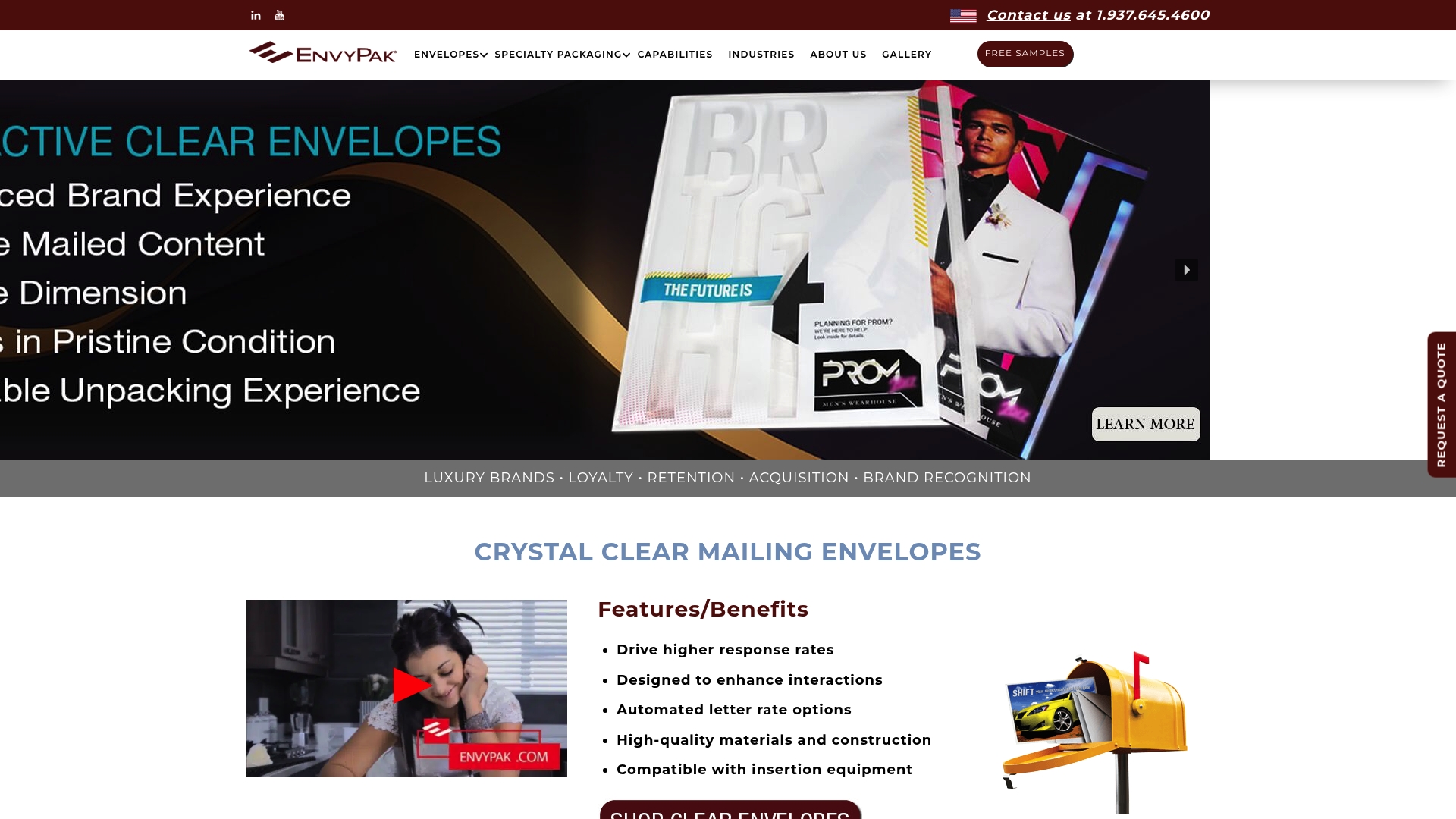
Envypak also offers custom envelope solutions designed for branded direct mail campaigns, with options that accommodate QR code placement, insertion equipment compatibility, and high-volume production runs. Whether you are running a nonprofit fundraising appeal, a retail promotion, or a B2B prospecting sequence, Envypak’s product line gives your mailer the physical presence it needs to compete. Explore the direct mail result stories on the Envypak site to see how brands across industries have used premium packaging to lift response rates.
FAQ
What is a good conversion rate for direct mail?
Direct mail response rates benchmark at 5 to 9% for house lists and 2 to 5% for prospect lists, but conversion rate depends on how you define the desired action. A campaign with a lower response rate and a high close rate can outperform one with a high response rate and weak follow-through.
What makes a mailer high-converting?
High-converting mailers combine precise list targeting, a single compelling offer, a clear call to action, and at least one trackable response mechanism like a QR code or unique phone number. Integration with email follow-up consistently multiplies results beyond what mail alone achieves.
How do QR codes improve direct mail results?
QR codes create a direct, trackable path from a physical mailer to a digital destination, allowing marketers to measure response by list segment, territory, or creative version. Valpak’s pest control campaign used QR and call tracking to compute a $309 cost per acquisition across 19.62 million mailed households.
Which industries see the highest ROI from direct mail?
Nonprofits, retail, home services, and B2B professional services consistently produce strong direct mail ROI when campaigns are properly targeted. Canadian Red Cross achieved 830% ROI through personalized fundraising appeals, while Qualinet generated $1M in one week by timing disaster-service mailers to match immediate homeowner needs.
How important is the envelope in direct mail conversion?
The envelope or outer packaging determines whether the interior creative gets seen at all. Recipients decide within seconds whether to open or discard a piece, making the outer design a conversion factor in its own right. Clear envelopes that reveal the offer inside increase open rates by removing the uncertainty of what is inside.