

Integrating Direct Mail with Digital Campaigns in 2026

Integrating direct mail with digital campaigns is defined as the coordinated use of physical mail and online channels, including email, paid ads, and SMS, to create multiple reinforcing touchpoints that lift response rates beyond what either channel achieves alone. This approach, also called omnichannel direct marketing, delivers results that digital-only programs cannot match. Combining direct mail with email follow-up increases response rates by 27%, climbing to 63% when digital retargeting is added. That gap is the business case for cross-channel advertising. Campaigns using three or more channels earn 250% higher engagement rates than single-channel efforts. The strategies below show you exactly how to build that system.
How to integrate direct mail with digital campaigns: prerequisites first
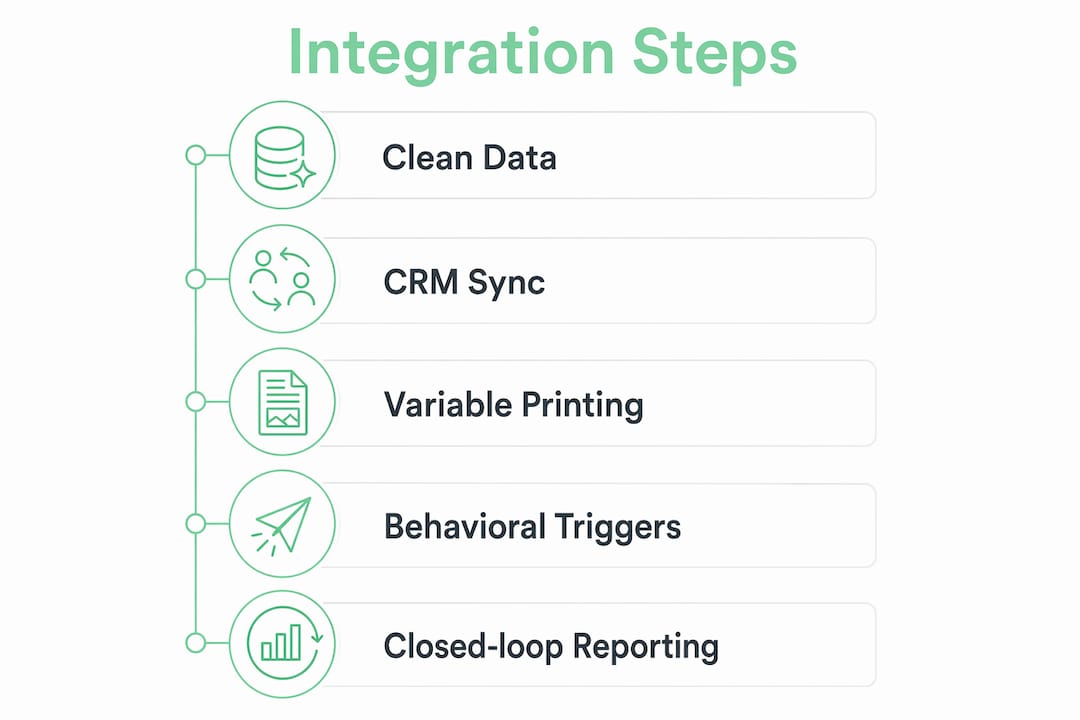
Successful integration starts with clean data. Sending personalized mail to outdated addresses wastes budget and breaks the customer experience before it begins. Data validation via NCOA and CASS is the standard method for verifying address accuracy, and skipping it creates technical debt that compounds across every campaign you run.
Synchronize your CRM and mailing lists
Your CRM is the engine of cross-channel advertising. It must reflect current customer status, purchase history, and digital behavior before any mail piece ships. When CRM data and mailing lists fall out of sync, you send a reactivation offer to an active buyer or a loyalty reward to a churned customer. Both errors damage trust and inflate cost per acquisition.
Use Variable Data Printing for personalization at scale
Variable Data Printing (VDP) enables 1-to-1 personalization by dynamically swapping images, offers, and layouts based on CRM data. A single print run can produce thousands of unique mailers, each tailored to the recipient’s segment, purchase behavior, or geographic location. VDP is the physical equivalent of dynamic email content, and it performs at a similar level when the underlying data is accurate.
Key tools for integration readiness
| Tool category | Primary role | Integration function |
|---|---|---|
| NCOA/CASS validation | Address accuracy | Prevents wasted mail and mismatched records |
| CRM platform | Customer data hub | Triggers mail based on behavior and status |
| Marketing automation | Workflow orchestration | Sends mail automatically after digital events |
| VDP print platform | Personalized production | Adjusts mail content per recipient in real time |
| UTM/PURL tracking | Attribution | Links physical mail response to digital analytics |
Pro Tip: Run your mailing list through NCOA validation at least 90 days before a major campaign launch. Address data degrades faster than most marketing teams expect.
What are the best methods for combining direct mail and email?
Timing is the most underestimated variable in digital campaign integration. Mail does not arrive the moment it ships. You must plan around in-home delivery windows, not drop dates, to align your digital follow-ups correctly. A follow-up email that lands three days before the physical piece arrives destroys the sequencing logic of your campaign.

Trigger mail from digital behavior
The most effective direct mail marketing strategy in 2026 is behavioral triggering. High-performance campaigns send mail within 24–48 hours of detecting a specific online behavior, such as a prospect spending more than three minutes on a product page. Marketing automation triggered by cart abandonment can boost conversion by 40%. That number reflects a simple truth: a physical piece arriving after a digital signal is far more relevant than a cold mailer.
Build the campaign orchestration flow
A repeatable integration process follows this sequence:
- Identify the trigger event. Define the digital behavior that qualifies a prospect for mail, such as cart abandonment, a product page visit exceeding three minutes, or a form submission without conversion.
- Validate the address. Pull the prospect’s mailing address from your CRM and run it through CASS verification before the print job begins.
- Personalize with VDP. Use CRM data to configure the mail piece: name, offer, product image, and call to action.
- Set the delivery window. Confirm the expected in-home date and schedule digital follow-ups to land within 48 hours after that date.
- Attach a PURL or QR code. Personalized URLs increase response rates by up to 45% compared to static landing pages. QR codes serve the same function for mobile-first audiences.
- Launch retargeting ads. Activate paid social or display retargeting to the same audience segment during the mail’s in-home window.
- Send the follow-up email. Time it to arrive 48–72 hours after the expected in-home date, referencing the physical piece by name or offer.
Pro Tip: Tag every QR code and PURL with UTM parameters. Without them, your analytics platform will classify direct mail-driven traffic as organic or direct, making attribution impossible.
Consistent design across channels matters, but identical messaging does not. Adapt your message to the medium while keeping the call to action consistent. A postcard headline should be shorter and more visual than an email subject line, even when both promote the same offer. The physical piece earns attention through format. The digital follow-up earns conversion through timing and convenience.
How do you measure integrated campaign performance?
Attribution is the hardest problem in cross-channel advertising. Direct mail-driven traffic frequently appears as direct or organic in web analytics, inflating those channels and hiding mail’s true contribution. The fix is systematic tracking from the start.
Set up closed-loop reporting
Closed-loop reporting connects physical mail response data to your digital analytics stack. Assign unique phone numbers to each mail version using call tracking platforms. Attach UTM-tagged PURLs and QR codes to every piece. Then pull both data streams into a single dashboard, whether that is Google Analytics 4, a CRM reporting module, or a dedicated direct mail metrics tool.
Run incremental lift analysis
Incremental lift analysis compares response rates between a mailed group and a statistically matched control group that received no mail. This isolates mail’s actual contribution from baseline behavior. Without a control group, you cannot separate the effect of your mail from the effect of your email, your ads, or seasonal demand. Lift analysis is the standard method for proving mail’s ROI to stakeholders who default to digital-only thinking.
| Metric | Measurement method | What it tells you |
|---|---|---|
| Response rate | Unique PURL visits, call tracking | How many recipients acted on the mail piece |
| Conversion rate | CRM pipeline data | How many responders completed a purchase or goal |
| Incremental lift | Mailed vs. control group comparison | Mail’s isolated contribution to conversions |
| Cost per acquisition | Total mail spend divided by conversions | Whether the channel is profitable at current volume |
| Digital halo effect | Organic/direct traffic spike in delivery window | Indirect brand lift from physical mail exposure |
Pro Tip: Track the “digital halo effect” by monitoring organic and direct traffic spikes during your mail’s in-home window. A measurable lift in those channels during that period is strong evidence of mail’s influence, even without a direct click.
What are the common challenges in integrating direct mail with digital?
Siloed channel teams are the single biggest barrier to effective integration. When your email team, paid media team, and direct mail vendor operate independently, unified customer journey mapping becomes impossible. Each team optimizes for its own metrics, and the customer receives a fragmented experience that undermines every channel’s performance.
The most common operational pitfalls include:
- Delivery timing gaps. Teams schedule digital follow-ups based on mail drop dates, not in-home delivery windows. A two-day gap between expected and actual delivery breaks the sequencing.
- Identical messaging across channels. Copying email copy directly onto a postcard ignores how each medium is consumed. Message adaptation per medium is required for both channels to perform.
- Dirty data. Unvalidated addresses produce returned mail, mismatched customer records, and broken PURL tracking. The cost is not just postage. It is attribution accuracy across your entire campaign.
- No shared data stream. True integration requires unified data streams that trigger real-time actions across channels. Matching logos and color palettes is not integration.
“Siloed channel management limits effectiveness. True integration passes the ‘Handshake Test’ by sharing data and unifying customer journeys across every touchpoint, physical and digital alike.”
Pro Tip: Assign one person or team to own the integration workflow end to end. When accountability is split between channel teams, timing errors and data gaps multiply. A single integration owner catches problems before they reach the customer.
For a structured approach to building these workflows, an omnichannel marketing guide that maps customer journeys across physical and digital touchpoints is a practical starting point.
Key Takeaways
Integrating direct mail with digital campaigns requires clean data, behavioral triggers, and closed-loop attribution to outperform either channel alone.
| Point | Details |
|---|---|
| Data hygiene is non-negotiable | Validate addresses with NCOA and CASS before every campaign to prevent wasted spend. |
| Behavioral triggers drive results | Send mail within 24–48 hours of a qualifying digital action for maximum relevance and conversion lift. |
| PURLs and QR codes close the loop | Personalized URLs increase response rates by up to 45% and make attribution trackable. |
| Message adaptation beats repetition | Adapt copy to each channel’s format while keeping the call to action consistent across mail and digital. |
| Incremental lift proves ROI | Compare mailed and control groups to isolate mail’s true contribution from baseline digital performance. |
What I’ve learned after years of watching integrated campaigns succeed and fail
The marketers who get the best results from cross-channel advertising are not the ones with the biggest budgets. They are the ones who treat direct mail as a trigger-based asset, not a scheduled broadcast. The behavioral trigger model changes everything. When a physical piece arrives because a prospect showed genuine interest online, the relevance is immediate and the response rate reflects it.
The harder lesson is about data discipline. Most teams underestimate how quickly address data degrades and how badly dirty data corrupts attribution. I have seen campaigns where 15% of the mailing list was invalid, and the team spent weeks trying to explain why their digital traffic numbers looked wrong. The problem was upstream, in the data, not in the creative or the timing.
Digital fatigue is real, and physical mail fills the gap that overloaded inboxes create. But the envelope or mailer itself is part of the message. A piece that looks premium signals that the brand behind it is worth attention before the recipient reads a single word. That is why the physical format deserves as much creative thought as the email subject line.
The operational discipline required to run these campaigns at scale is significant. Automation handles the trigger logic, but someone still has to own the workflow, audit the data, and verify that the in-home delivery window aligns with the digital calendar. The teams that build that discipline early scale their programs without proportional increases in complexity.
— James
How Envypak supports your integrated direct mail campaigns
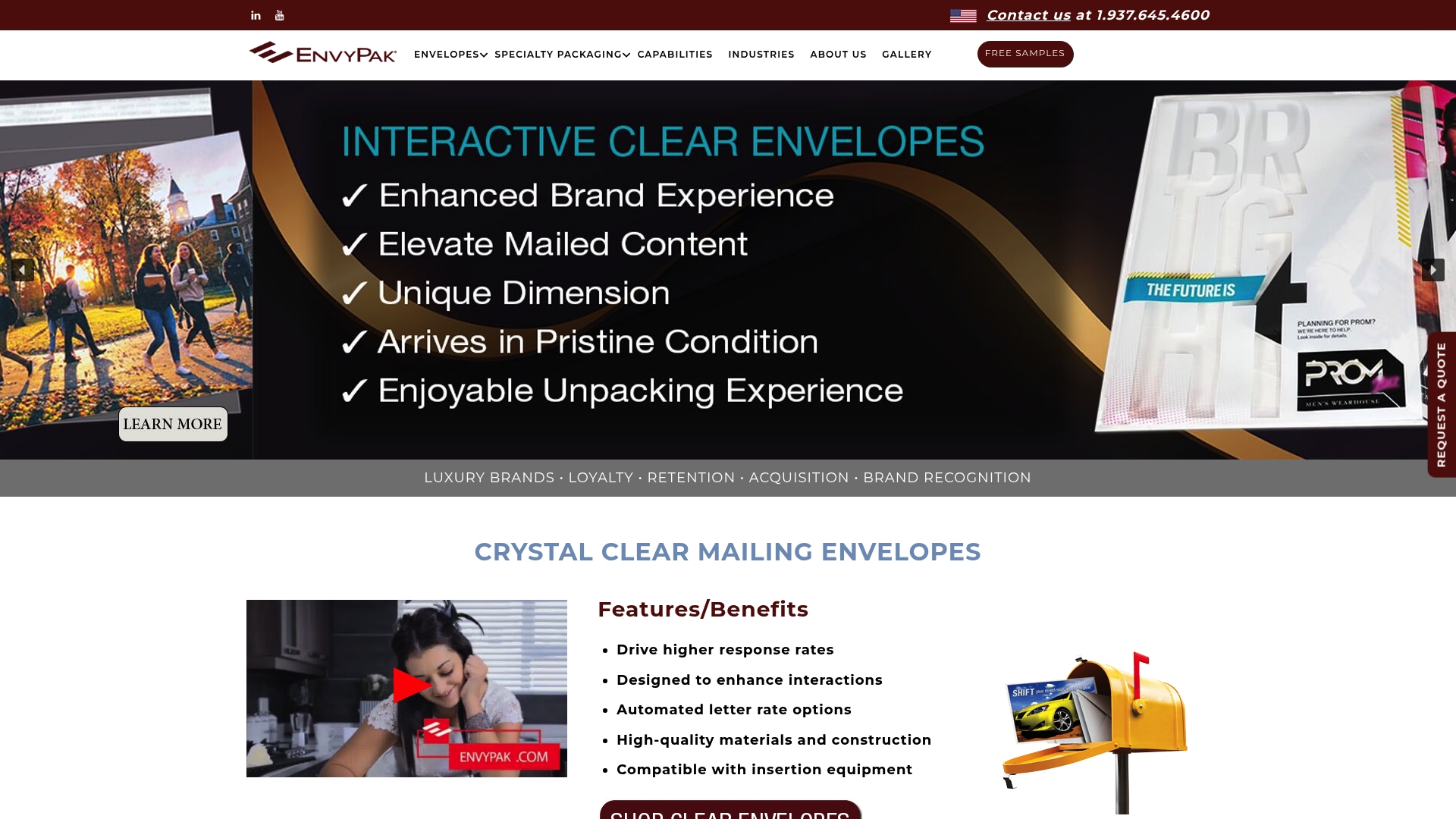
Envypak’s crystal clear mailing envelopes are built for campaigns where first impressions determine whether a piece gets opened or discarded. The envelope’s transparency puts your design, offer, or product image in front of the recipient before they even reach for it. That visibility translates directly into higher open rates, which is the first conversion in any direct mail sequence.
Envypak’s envelopes are automation-compatible, meaning they move through high-volume fulfillment systems without manual handling. For marketers running trigger-based programs at scale, that compatibility removes a major operational bottleneck. Explore Envypak’s clear envelopes for direct mail or browse custom envelope options designed for marketing performance. You can also review real campaign results from brands that have used Envypak to lift response rates in integrated programs.
FAQ
What is integrating direct mail with digital campaigns?
Integrating direct mail with digital campaigns is the coordinated use of physical mail and online channels, such as email, paid ads, and SMS, to create multiple touchpoints that reinforce each other. The goal is to increase response rates and conversions beyond what any single channel achieves alone.
How much do integrated campaigns improve response rates?
Combining direct mail with an email follow-up increases response rates by 27%, rising to 63% when digital retargeting is also included. Integrated direct mail also achieves response rates of 4%–9% compared to under 1% for cold email alone.
What is a PURL and why does it matter for direct mail?
A PURL, or personalized URL, is a unique web address printed on a mail piece that takes each recipient to a landing page customized for them. PURLs increase response rates by up to 45% compared to static pages and make it possible to track exactly which mail recipients converted online.
How do you time digital follow-ups after sending direct mail?
Schedule digital follow-ups to land 48–72 hours after the expected in-home delivery date, not the mail drop date. Delivery timing must account for in-home windows to keep your email and retargeting ads aligned with when the physical piece actually reaches the recipient.
What is the biggest mistake in cross-channel direct mail programs?
The most common mistake is treating direct mail as an isolated event rather than a trigger-based channel. Siloed teams, unvalidated address data, and identical messaging across physical and digital channels all reduce performance. A marketing automation checklist helps teams build the workflow discipline needed to avoid these errors at scale.