

What Is a Marketing Mailer? A 2026 Guide for Marketers

A marketing mailer is a physical advertising piece sent directly to targeted recipients through postal mail to promote products, services, or offers. The industry term for this channel is direct mail, and a marketing mailer is the physical piece at the center of every direct mail campaign. Understanding what a marketing mailer is, how it fits within USPS Marketing Mail regulations, and how to design one that actually gets opened separates profitable campaigns from expensive postage bills. This guide covers definitions, formats, cost structures, response benchmarks, and the best practices that drive real results.
What is a marketing mailer and how does it fit direct mail strategy?
A marketing mailer is any physical promotional piece, such as a postcard, letter, catalog, or brochure, mailed to a defined list of recipients with a specific call to action. It is the tangible output of a direct mail campaign, which itself is one tactic within the broader category of direct marketing.

Direct marketing covers all one-to-one promotional communication, including email, telemarketing, and SMS. Direct mail is the postal subset of that category. A marketing mailer is the physical piece that travels through the postal system. Confusing these three terms impairs campaign strategy, production timelines, and budget planning.
Most marketing mailers in the United States travel under the USPS Marketing Mail class, formerly called Standard Mail. This class exists specifically for bulk promotional pieces and offers significant postage discounts compared to First-Class Mail. The trade-off is delivery speed: Marketing Mail typically arrives in 3–10 business days rather than 1–3.
Physical mail’s durability gives it a measurable advantage over digital advertising. A postcard sits on a kitchen counter for roughly 17 days on average. A promotional email disappears from an inbox in seconds. That physical presence is the core strategic argument for adding direct mail to any multichannel program.
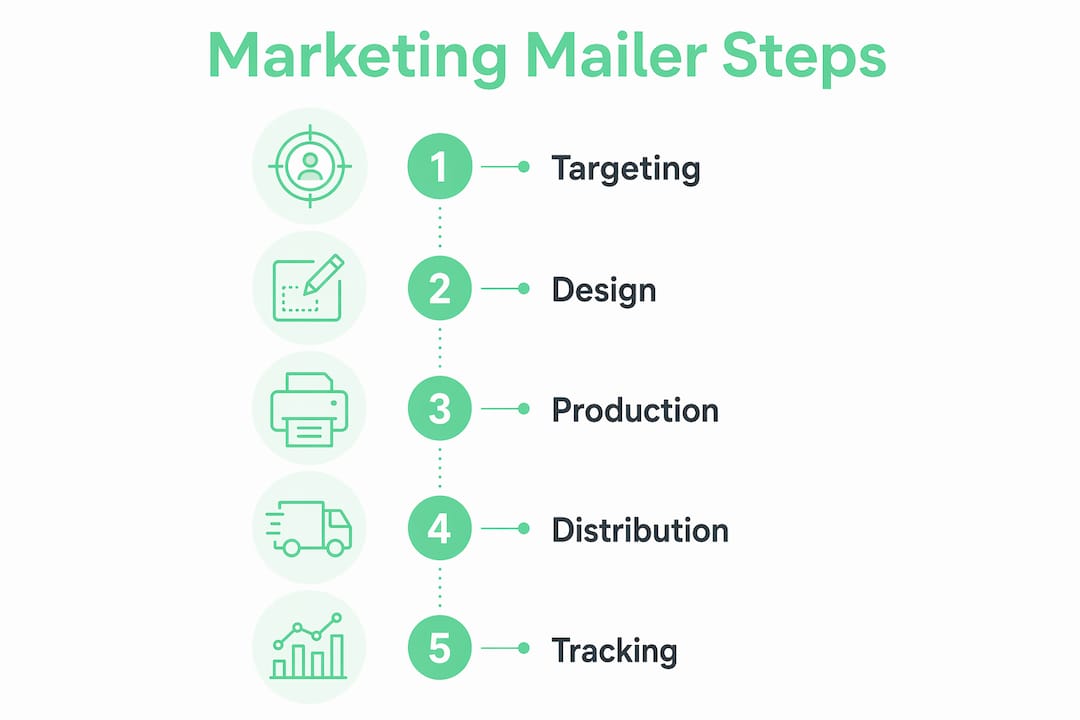
Data-driven targeting is what separates a profitable mailer from wasted postage. Sending to a well-segmented list based on demographics, purchase history, or geographic data produces far better results than broadcasting to a generic audience. Knowing how to identify your target audience before you print a single piece is the single most important step in the planning process.
What types of marketing mailers are most effective?
The format of a marketing mailer directly affects both cost and response rate. Each format serves a different campaign goal, and choosing the wrong one wastes budget before a single piece is mailed.
The most common formats are:
- Postcards: Low production cost, no envelope required, immediate visual impact. Best for short offers, event announcements, and local promotions.
- Letter mailers: A letter inside an envelope creates a personal feel. Strong for financial services, insurance, and high-value offers where trust matters.
- Self-mailers: Folded pieces that mail without an envelope. Cost-effective for brochures and multi-panel content.
- Catalogs: High production cost but strong for retail brands with large product lines. Catalogs drive repeat purchases from existing customers.
- Dimensional mailers: Three-dimensional packages, boxes, or tubes. The highest cost per piece, but open rates increase significantly because recipients cannot ignore a box in their mailbox.
The envelope choice matters more than most marketers realize. A standard white envelope blends into a stack of bills. A clear envelope lets the recipient see the offer before they even open it, which removes the friction of the first decision: whether to open at all. Envypak’s crystal clear mailing envelopes are built specifically for this purpose, combining visual impact with automation compatibility for USPS processing.
Variable data printing (VDP) adds another layer of effectiveness. VDP allows each piece to carry personalized text, images, or offers based on recipient data. A mailer that addresses someone by name and references their last purchase performs measurably better than a generic piece. The technology is widely available through most commercial print vendors.
Pro Tip: Test two envelope types on a split list before committing to a full print run. The difference in open rates between a standard envelope and a clear or dimensional option often justifies the higher per-piece cost.
What are the USPS Marketing Mail requirements and costs in 2026?
USPS Marketing Mail has specific rules that every marketer must understand before planning a campaign. Missing one requirement can delay a mailing by days or disqualify it from bulk rates entirely.
The key requirements are:
- Minimum volume: Each mailing must include at least 200 pieces or 50 pounds of mail. Campaigns below this threshold must use First-Class Mail at higher per-piece rates.
- Permit requirement: Mailers must hold a valid USPS mailing permit. The application requires PS Form 3615 and a physical address. This process is not instant. Budget at least two weeks for permit approval when planning a first campaign.
- Presorting: Mail must be presorted by ZIP code or carrier route to qualify for automation discounts. Most commercial mail houses handle this step automatically.
- Indicia: Each piece must display a printed postal indicia or permit imprint rather than a stamp.
The cost structure in 2026 rewards volume and preparation. Rates start at $0.227 per piece for heavily presorted commercial letters. That figure drops further with carrier-route sorting and automation-compatible formats. For a 10,000-piece campaign, the difference between a well-presorted mailing and a poorly prepared one can reach hundreds of dollars.
| Preparation level | Approximate rate per piece | Delivery window |
|---|---|---|
| Basic Marketing Mail | Higher than presorted | 3–10 business days |
| Presorted commercial | From $0.227 | 3–10 business days |
| Carrier-route sorted | Below $0.227 | 3–10 business days |
| First-Class Mail | Significantly higher | 1–3 business days |
One critical rule catches new mailers off guard. USPS Marketing Mail does not include forwarding or return service by default. If a piece is undeliverable, USPS discards it. To get address corrections or returns, mailers must add paid ancillary endorsements such as “Address Service Requested” or “Return Service Requested.” Without these, bad addresses simply burn budget.
Pro Tip: Add “Address Service Requested” to your indicia area on every mailing. The small per-piece fee for address correction notices pays for itself by keeping your list clean for future campaigns.
How effective are marketing mailers at driving response?
Marketing mailers produce measurable response rates that most digital channels cannot match at the individual recipient level. The data is clear and consistent across industry benchmarks.
Targeted house lists average a 9% response rate, meaning roughly 1 in 11 recipients takes the desired action. Broader cold-list campaigns average between 2.7% and 4.4%. Compare that to average email click-through rates, which typically fall below 3% even for well-managed lists. Direct mail’s physical presence drives a level of attention that digital simply does not replicate at scale.
Precise audience targeting and combining physical mail with digital tools distinguish successful marketing mailers from campaigns that only generate postage costs. The channel works. The list and the offer determine whether it works for you.
House lists outperform cold lists because the recipients already know the brand. A customer who bought from you six months ago is far more likely to respond than a rented name from a third-party list. This is why list management is not a back-office task. It is a core campaign strategy decision.
Integrating direct mail with digital touchpoints through PURLs (personalized URLs) and QR codes closes the attribution gap that historically made direct mail harder to measure. A recipient scans a QR code on a postcard, lands on a tracked landing page, and the conversion is recorded. This makes direct mail a data-driven, measurable channel rather than a broadcast medium. For a deeper look at how physical and digital channels compare, the analysis of direct mail vs. email marketing shows where each channel performs best.
What best practices maximize marketing mailer results?
Execution quality determines whether a well-targeted campaign converts or falls flat. The following practices separate high-performing mailers from average ones.
- Process your list through CASS and NCOA. CASS certification and NCOA processing validate addresses and update records for recipients who have moved. Skipping this step means a measurable percentage of your budget mails to addresses that no longer exist.
- Lead with the offer on the outer envelope or postcard face. Recipients decide in under three seconds whether a piece is worth opening. The offer must be visible immediately.
- Use QR codes and PURLs for every campaign. Tracking response at the individual level gives you data to improve the next campaign. Without tracking, you are flying blind.
- Match the format to the offer value. A $10 coupon does not need a dimensional mailer. A $5,000 B2B software offer might justify a box with a handwritten note inside.
- Choose envelopes that work for your audience. Creative direct mail designs that use clear or custom envelopes consistently outperform standard white envelopes in open rate tests.
Combining direct mail with broader SMB marketing strategies amplifies results. A prospect who sees a social media ad and then receives a physical mailer within the same week is far more likely to convert than one who only encounters a single touchpoint.
Pro Tip: Run a 30-day suppression window after each mailing. Recipients who responded should be moved to a separate nurture track. Mailing the same offer to recent converters wastes budget and annoys customers.
Key Takeaways
A marketing mailer succeeds when precise audience targeting, compliant postal preparation, and a format matched to the offer value work together as a single system.
| Point | Details |
|---|---|
| Definition is specific | A marketing mailer is a physical promotional piece sent under USPS Marketing Mail rules, not a generic term for any mailed item. |
| Volume and permits matter | Campaigns need at least 200 pieces and a valid USPS permit; missing either disqualifies bulk rates. |
| Response rates are real | House lists average 9% response; cold lists average 2.7%–4.4%, both outperforming most digital click benchmarks. |
| Format drives open rates | Clear envelopes and dimensional mailers increase opens; the format choice is a strategic decision, not a production detail. |
| Data hygiene protects budget | CASS and NCOA processing prevent wasted postage on bad addresses and keep lists accurate for future campaigns. |
Why I think most marketers underestimate the postal side of direct mail
Most marketing teams treat the postal requirements of a direct mail campaign as a logistics detail to hand off to a vendor. That is a mistake I have seen cost campaigns weeks of delay and thousands of dollars in avoidable errors.
The permit application alone trips up first-time mailers. PS Form 3615 requires a physical address and takes time to process. If you plan a campaign launch for a specific date and start the permit process a week before, you will miss the window. The postal side of this channel demands the same planning rigor as the creative side.
The other thing I have watched marketers consistently undervalue is the envelope. Teams spend weeks on copy and design, then ship everything in a standard white envelope because it is cheaper. The envelope is the first impression. A clear envelope from Envypak shows the recipient the offer before they even touch the piece. That single change can lift open rates enough to change the economics of an entire campaign.
The channel itself is not complicated. Physical mail reaches people where digital cannot. The direct mail engagement tactics that work in 2026 are built on the same fundamentals that have always worked: the right offer, to the right person, in a format they cannot ignore. The marketers who treat postal compliance and physical design as strategic inputs, not afterthoughts, are the ones who see the 9% response rates instead of the 2.7%.
— James
How Envypak helps your marketing mailers stand out
The physical envelope is the first thing a recipient sees, and it determines whether your campaign gets opened or discarded.
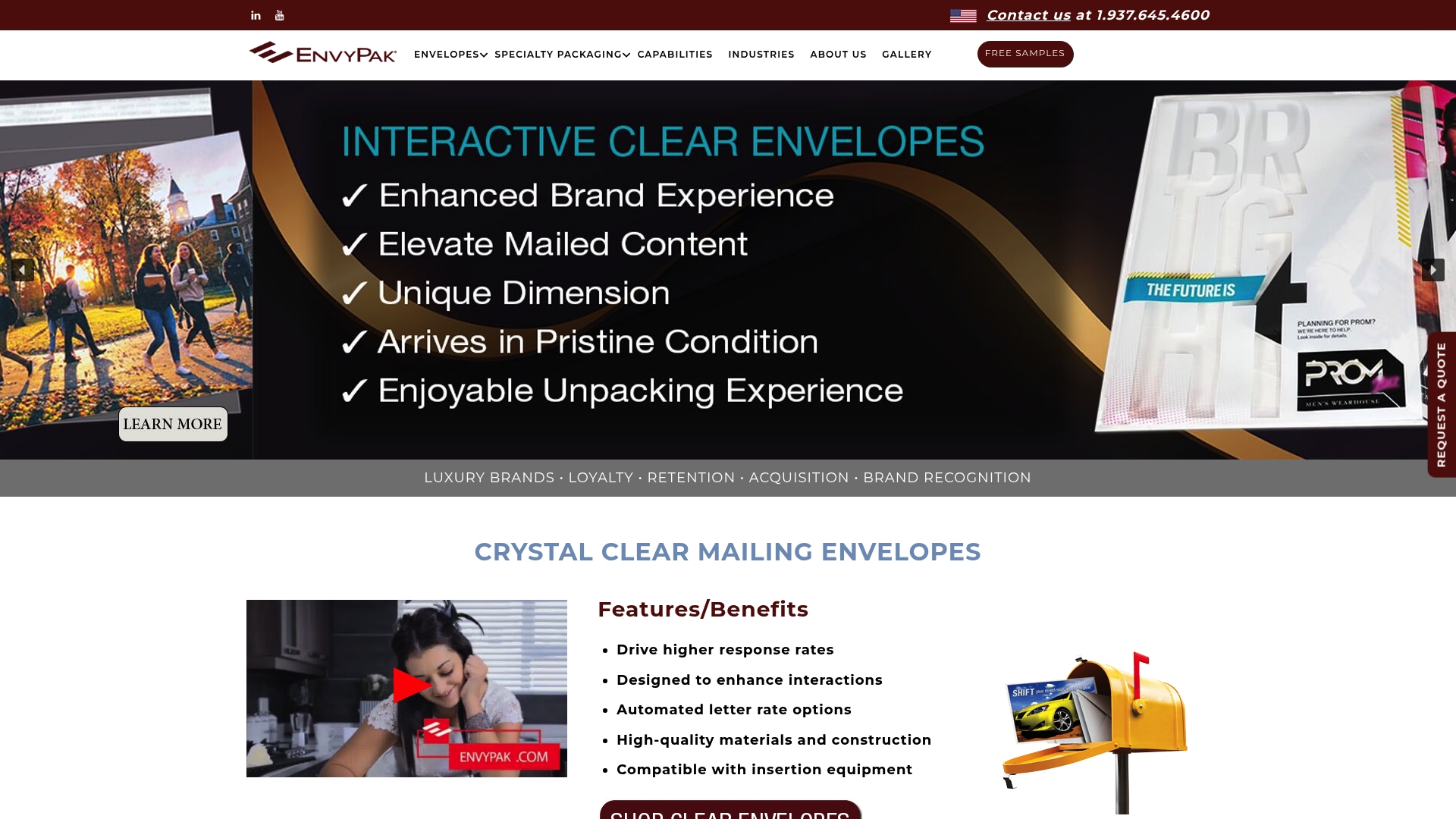
Envypak’s crystal clear mailing envelopes are built for direct mail campaigns that need to get noticed. The clear material puts your offer in front of recipients before they open anything, removing the biggest barrier to engagement. Every envelope is automation-compatible, which means it processes through USPS equipment without issues and qualifies for presort discounts. Envypak also offers custom envelopes and mailers designed to match your brand and meet USPS specifications precisely. If you want to see what a well-executed direct mail piece looks like in practice, the direct mail result stories on the Envypak site show real campaign outcomes.
FAQ
What is a marketing mailer, exactly?
A marketing mailer is a physical promotional piece, such as a postcard, letter, or brochure, sent through the postal system to a targeted list of recipients. In the United States, most marketing mailers travel under the USPS Marketing Mail class, which offers bulk postage discounts.
What is the minimum quantity for USPS Marketing Mail?
USPS Marketing Mail requires a minimum of 200 pieces or 50 pounds per mailing. Campaigns below this threshold must use First-Class Mail at higher per-piece rates.
What response rates should I expect from a direct mail campaign?
House lists average around 9% response, while cold or rented lists average between 2.7% and 4.4%. Response rates vary based on offer quality, list accuracy, and format.
Do marketing mailers get forwarded if the address is wrong?
No. USPS Marketing Mail does not include forwarding or return service by default. Undeliverable pieces are discarded unless the mailer adds a paid ancillary endorsement such as “Address Service Requested.”
How do clear envelopes improve marketing mailer performance?
Clear envelopes let recipients see the offer inside before opening the piece, which removes the first decision barrier and increases open rates. Envypak’s clear envelopes are also automation-compatible, qualifying campaigns for USPS presort discounts.