

Mailer Envelopes for Ecommerce: A Practical Guide
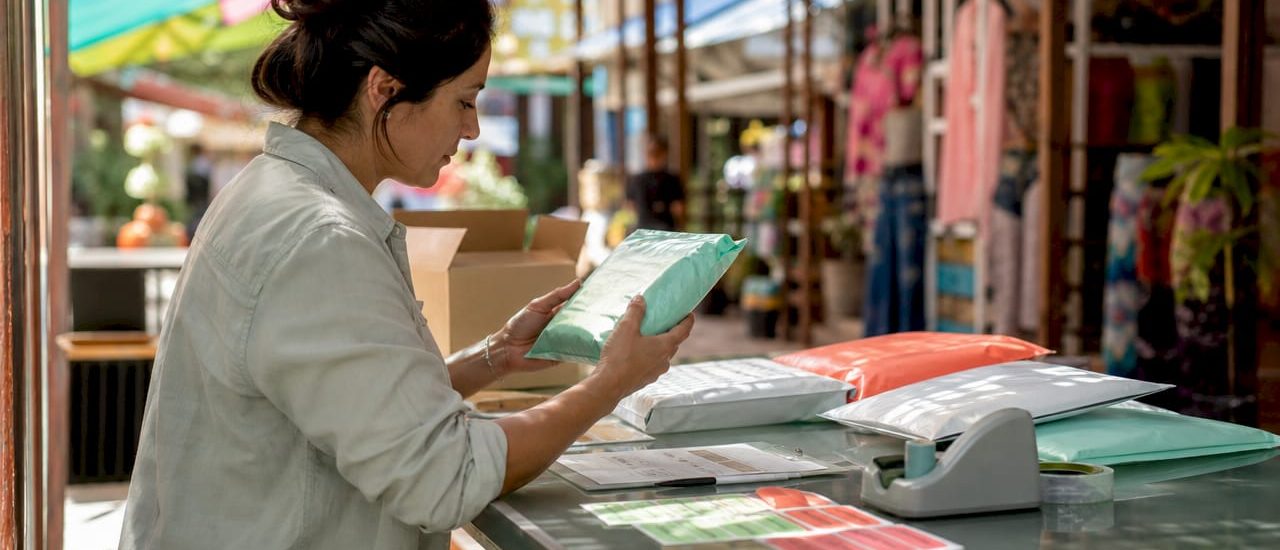
A mailer envelope is a lightweight, flexible shipping envelope designed for ecommerce businesses to send non-fragile products cost-effectively and securely. The industry standard term is “poly mailer” when made from polyethylene film, though the broader category includes paper mailers, bubble mailers, and compostable options. Understanding what a mailer envelope is for ecommerce means knowing how each type affects your shipping costs, carrier classification, and customer experience. USPS classifies poly mailers as envelopes when they are flat, flexible, and meet specific thickness criteria, which directly unlocks lower postage rates. Choosing the right mailer type is one of the fastest ways to cut fulfillment costs without sacrificing product protection.
What are the main types of mailer envelopes for ecommerce?
The three core types are standard poly mailers, bubble mailers, and eco-friendly mailers. Each serves a different product category and budget level.
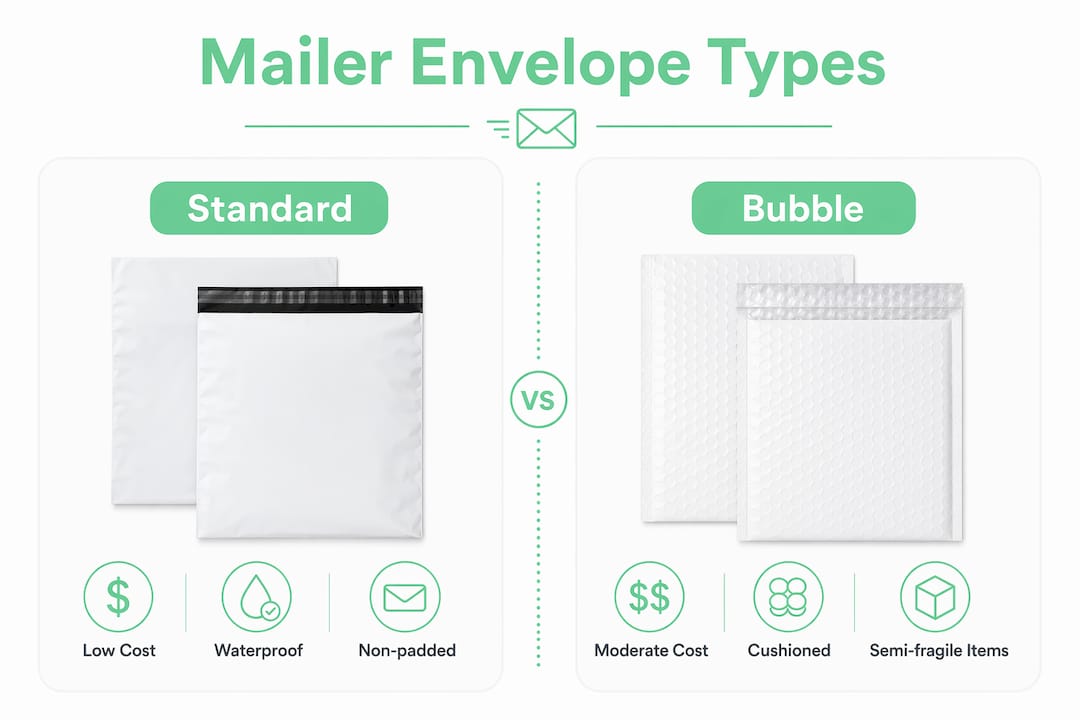
Standard poly mailers are made from polyethylene film. They are waterproof, tear-resistant, and self-seal with an adhesive strip, which removes the need for tape and speeds up packing. Apparel, textiles, and accessories are the classic use case. Standard poly mailers cost between $0.05 and $0.15 per unit in quantities of 1,000 to 5,000. That low unit cost makes them the default choice for high-volume ecommerce operations.
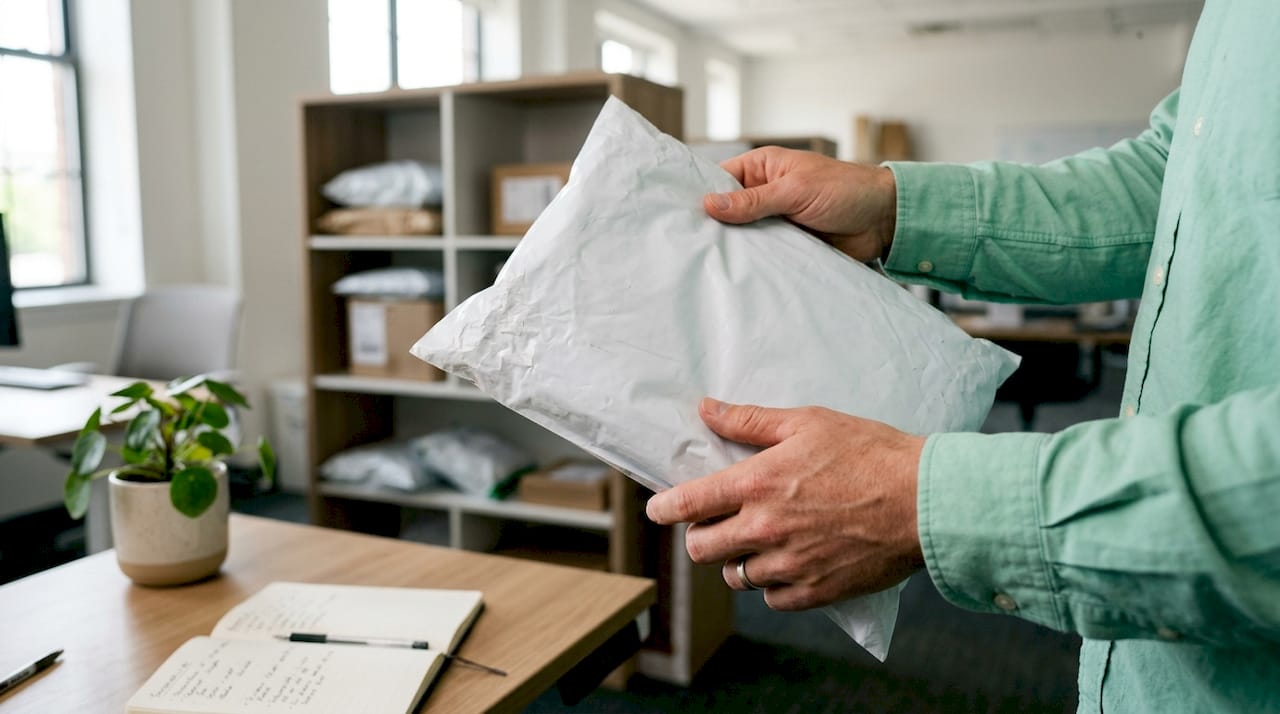
Bubble mailers add a layer of bubble wrap lining inside a poly or paper outer shell. They protect semi-fragile items like electronics accessories, cosmetics, and small collectibles. Bubble mailers cost 30–50% more than standard poly mailers. That premium is worth paying only when the product actually needs cushioning. Using bubble mailers for soft goods like t-shirts wastes money with no protective benefit.
Eco-friendly mailers use recycled polyethylene or certified compostable materials. Recycled options add 5–10% to material cost, while compostable mailers add 15–30%. That cost increase is real, but sustainable packaging choices strengthen brand reputation with environmentally conscious customers. For businesses building a sustainability story, the premium pays off in customer loyalty.
| Type | Relative cost | Protection level | Best use case |
|---|---|---|---|
| Standard poly mailer | Low ($0.05–$0.15/unit) | Basic | Apparel, textiles, soft goods |
| Bubble mailer | Medium (30–50% more) | Cushioned | Electronics accessories, cosmetics |
| Eco-friendly mailer | Low to medium (+5–30%) | Basic to cushioned | Sustainability-focused brands |
Pro Tip: Reserve bubble mailers for items that genuinely need cushioning. Defaulting to bubble mailers for all shipments adds unnecessary cost. Audit your product catalog and assign mailer types by fragility, not habit.
How do carriers classify mailer envelopes for shipping rates?
Carrier classification determines whether your shipment pays envelope rates or parcel rates. The difference can be significant per package.
USPS focuses on flatness and flexibility rather than strict thickness. Poly mailers qualify for First Class Package Service when they weigh under 15.999 ounces. Staying under that threshold is the single most important factor for maintaining envelope-level postage. UPS applies a different standard: UPS limits envelopes to under 2 inches thick. FedEx uses similar dimensional constraints for its envelope classification.
Misclassifying a package costs money in two ways. First, you pay parcel rates instead of envelope rates at the point of shipping. Second, carriers can reclassify shipments in transit and bill the difference back to your account. Neither outcome is recoverable after the package leaves your facility.
Here is how to stay compliant:
- Weigh every product before assigning a mailer size. Include the mailer weight in your total.
- Measure the packed thickness of your mailer before sealing. Overstuffed mailers fail the flatness test.
- Check USPS, UPS, and FedEx envelope criteria annually. Carrier rules update, and rate tables change.
- Build a simple spreadsheet that maps product SKUs to approved mailer types and weight ranges.
- Train your fulfillment team to flag any package that feels rigid or bulky before it ships.
Pro Tip: Weigh your most popular SKUs packed inside their assigned mailers and record the results. If any combination lands above 15 ounces, switch to a smaller mailer or lighter product insert before the order volume scales.
What are the key benefits of mailer envelopes for ecommerce businesses?
The strongest argument for mailer envelopes is cost reduction at scale. Switching from corrugated boxes to poly mailers reduces dimensional weight charges and shrinks your storage footprint. Dimensional weight pricing penalizes bulky packaging even when the actual product is light. A poly mailer conforms to the product, so the billed weight stays close to the actual weight.
Storage efficiency is the second major advantage. Mailer envelopes store flat, and a single pallet holds thousands of units. Corrugated boxes require far more floor space for the same unit count. For space-limited fulfillment operations, that difference directly affects overhead costs.
Branding is a third lever. Custom printed mailers put your logo, colors, and messaging on the outside of every shipment. The package becomes a brand touchpoint before the customer even opens it. Custom printing adds 10–20% to mailer cost, but the impression value across thousands of shipments is difficult to replicate through other channels.
The top five benefits of mailer envelopes for ecommerce:
- Lower shipping costs through reduced dimensional weight and envelope-rate postage
- Faster packing with self-seal adhesive strips that eliminate tape
- Compact storage that frees warehouse space for inventory
- Brand visibility through custom printing on every outbound package
- Sustainability options with recycled or compostable materials that align with customer values
One honest limitation: poly mailers are the standard for everyday, cost-efficient fulfillment of non-fragile items, but they do not deliver a premium unboxing experience. If your brand depends on the ritual of opening a box, a corrugated solution serves that goal better. Mailer envelopes excel at function and cost efficiency. They are not the right tool for luxury positioning.
How to choose and use mailer envelopes effectively
Selecting the right mailer starts with your product dimensions and weight. The mailer should fit the product snugly without forcing it in or leaving excessive empty space. Overstuffed mailers fail carrier thickness tests. Undersized mailers stress the seams and increase damage claims.
Matching size to product
Measure your product at its widest and thickest points. Add at least 1 inch to each dimension for comfortable insertion. For choosing the right envelope size, account for any folding, tissue paper, or inserts you include with the shipment. A mailer that fits perfectly empty may fail the flatness test once packed.
Using custom printing to reinforce your brand
Custom printed mailers do more than look good. They signal professionalism at the doorstep, before the customer reads a single word inside. Envypak’s custom flexible packaging options let ecommerce businesses print full-color designs directly on the mailer surface. That visibility at delivery is a marketing impression you have already paid for through shipping costs.
Incorporating eco-friendly options
Recycled and compostable mailers now meet the same performance standards as standard poly mailers for most non-fragile applications. The cost premium is real but modest for recycled options. Communicating your packaging choice to customers through a printed message on the mailer itself turns a cost line into a brand statement.
Managing inventory efficiently
Flat storage is a genuine operational advantage. Stack mailers by size in labeled bins or on shelving. Assign each product SKU a designated mailer size and record it in your inventory system. That one step eliminates the time wasted searching for the right size during peak fulfillment periods.
Key Takeaways
Mailer envelopes are the most cost-efficient ecommerce packaging solution for non-fragile products, combining low unit cost, carrier-rate advantages, and flat storage into a single format.
| Point | Details |
|---|---|
| Mailer envelope definition | A lightweight, flexible envelope for shipping non-fragile ecommerce products at low cost. |
| Carrier classification matters | Staying under 15.999 ounces with USPS unlocks First Class envelope rates and avoids surcharges. |
| Match type to product | Use standard poly for soft goods, bubble mailers for semi-fragile items, and eco-friendly options for sustainability goals. |
| Custom printing adds value | Branded mailers turn every shipment into a marketing touchpoint at no extra delivery cost. |
| Flat storage saves space | A pallet of mailers holds thousands of units, freeing warehouse capacity compared to corrugated boxes. |
The packaging decision most ecommerce businesses get wrong
I have watched ecommerce businesses default to corrugated boxes for nearly every shipment because boxes feel “safer.” The logic is understandable. Boxes are rigid, familiar, and easy to justify when a customer files a damage claim. But that default costs real money across thousands of orders.
The smarter move is to audit your product catalog by fragility and weight before assigning any packaging. Most apparel, accessories, and paper goods ship perfectly well in a standard poly mailer. Bubble mailers cover the semi-fragile middle ground. Corrugated boxes belong to a narrow category of genuinely fragile or heavy items.
The sustainability angle is also more practical than most businesses realize. Recycled mailers add a small cost premium, but they generate a visible brand signal. Printing “This mailer is made from recycled materials” on the outside costs almost nothing extra and resonates with a growing share of online shoppers.
My honest advice for small to medium ecommerce businesses: start with a three-tier system. Assign standard poly mailers to your soft goods, bubble mailers to your semi-fragile SKUs, and corrugated boxes only where genuinely necessary. Then track your average shipping cost per order for 90 days. The reduction will make the case for you better than any analysis.
— James
Envypak’s mailer envelopes for ecommerce shipping and direct mail
Envypak offers a range of mailer envelopes built for ecommerce businesses that need both functional shipping performance and brand presence. Their direct mail envelopes combine visual impact with practical features like automation compatibility and eco-friendly materials.
For businesses shipping products and running direct mail campaigns simultaneously, Envypak’s clear poly mailers deliver a format that stands out at the doorstep. Crystal-clear construction puts your product or printed insert on display before the envelope is even opened. That visibility drives engagement in a way that opaque mailers cannot match. Envypak’s packaging is reusable, recyclable, and designed to meet carrier classification standards, so your shipping rates stay predictable.
FAQ
What is a mailer envelope used for in ecommerce?
A mailer envelope is used to ship non-fragile products like apparel, accessories, and documents at lower cost than corrugated boxes. It qualifies for envelope-rate postage with major carriers when it meets flatness and weight criteria.
What size mailer envelope do I need?
Choose a mailer that fits your product with at least 1 inch of clearance on each side. For detailed sizing guidance, the right envelope size depends on your product dimensions, any inserts, and the carrier’s thickness limits.
Are poly mailers considered envelopes by USPS?
Yes. USPS classifies poly mailers as envelopes when they are flat, flexible, and weigh under 15.999 ounces, qualifying them for First Class Package Service rates.
What is the difference between a poly mailer and a bubble mailer?
A poly mailer is a plain polyethylene envelope with no padding, suited for soft goods. A bubble mailer adds an interior bubble wrap lining for semi-fragile items and costs 30–50% more per unit.
Can I use custom printed mailers for branding?
Yes. Custom printing on mailer envelopes adds 10–20% to unit cost and turns every shipment into a branded touchpoint. Envypak’s custom envelopes support full-color printing for ecommerce and direct mail applications.